Strategic management, from thinking to the monthly review
Strategic management is the ongoing work of deciding where a company will compete and how it will win, turning those choices into plans, budgets and KPIs at every level, and reviewing results often enough to adjust. It joins strategic thinking, strategic planning and execution into one cycle.
- 01What strategic management is
- 02The three levels of strategy: corporate, business and functional
- 03Strategic thinking: asking the right questions first
- 04Strategic planning: four steps from question to plan
- 05From plan to results: execution and review
- Strategic management is a cycle of thinking, planning, execution and review, not just writing a plan
- Strategy has three levels, corporate, business and functional, and they must cascade
- A plan moves when it has owners, a few KPIs and a review on the same day every month
What strategic management is
The strategic plan is one of four parts of a cycle. Strategies succeed or fail in execution and review.
Tap a stage to see what happens
Read more
Strategic management is often confused with writing a strategic plan, but the plan is only one step in a cycle of four. Strategic thinking frames the questions that matter: where growth will come from, which customers to serve, what to stop doing. Strategic planning turns the answers into choices with owners, budgets and targets. Execution carries those choices into the daily work of each department. Review closes the loop: results are compared with the plan every month, and the plan is adjusted when the market moves. Most companies are reasonably good at the first two parts, because they happen in workshops and produce documents. The last two are where strategies succeed or fail, because they happen in ordinary weeks. What separates a company that manages its strategy from one that only writes it is the fourth part: a fixed rhythm that puts the strategy back on the leadership agenda every month.
The three levels of strategy: corporate, business and functional
Each level answers a different question, and the three must cascade from top to bottom.
Tap a level to see the details
Goals cascade from top to bottom. In a single-business company, the corporate and business levels usually share one plan.
Which businesses should the company be in, where should it grow and invest, and what should it sell or close?
- Who decides
- The board and top management
- Horizon
- 3–5 year direction
A food company moves into health foods and reduces low-margin contract manufacturing
How does this business win in its market: which customers, what value, and does it compete on cost, difference or a niche?
- Who decides
- The head of each business
- Horizon
- 1–3 year plan
The health-food unit targets health-conscious city buyers with premium products in modern trade and online
How will sales, marketing, operations, people, finance and technology each deliver the business strategy?
- Who decides
- Department heads
- Horizon
- Annual plan, reviewed monthly
Marketing launches new products, operations adapts the production line, HR recruits a product development team
Read more
Strategy is decided at three levels, and each answers a different question. Corporate strategy asks which businesses the company should be in: where to grow, where to invest, what to sell or close, and how the parts add up to more than their sum. Business strategy asks how one business wins in its market: which customers it targets, what it offers that they value, and whether it competes on cost, on difference, or by focusing on a niche. Functional, or operational, strategy asks how each function (sales, marketing, operations, people, finance and technology) delivers the business strategy through its own plans, budgets and KPIs. The levels must cascade: functional goals come from the business strategy, which comes from the corporate one. In a company with a single business, corporate and business strategy often merge into one plan, but the corporate questions return the moment the owners look for a new S-curve.
Strategic thinking: asking the right questions first
Before planning, check whether your leadership team can answer these four questions.
Tap each card your team can already answer
0 of 4 answered
Read more
Strategic thinking is the habit of looking at the business from the outside and from the future before deciding what to do next. In practice it rests on a few disciplines. Start from customers and the market rather than from what the company is already good at: what will buyers need in three years, and who else is moving toward them? Make choices explicit, including what the company will not do, because a strategy that says yes to everything is a budget, not a strategy. Think in consequences: a price cut today shapes competitor behavior, margins and the brand next year. And treat the big assumptions as hypotheses to test with data rather than as facts. Strategic thinking is not reserved for the CEO. Managers who think this way escalate fewer problems, because they can see how their own decisions connect to the company's direction.
Strategic planning: four steps from question to plan
From a clear question to a plan with owners, KPIs, budgets and a review calendar.
Agree with leadership what must be decided, by when, and on what criteria
Output A decision question and criteria the leadership team agrees on
Market, customers, competitors and internal numbers, only as far as the question needs
Output Facts that answer the question, not a thick report
Workshops where the leadership team debates the trade-offs openly
Output A choice the leadership team made and owns
Initiatives with owners, KPIs, budgets and a review calendar
Output A plan ready to run, with review dates already booked
The direction is revisited every year; the one-year plan is reviewed every month and refreshed every year.
Read more
Strategic planning is the structured process that turns strategic thinking into a plan the organization can carry out. A workable process has four steps. First, frame the decision: agree with leadership what must be decided, by when, and on what criteria. Second, gather and analyze only the data that answers that question: market, customers, competitors and internal numbers. Third, compare the options and choose, in workshops where the leadership team debates the trade-offs openly, so the result is owned rather than imposed. Fourth, translate the choice into initiatives with owners, KPIs, budgets and a review calendar. A common horizon is a three-to-five-year direction with a one-year plan that is reviewed monthly and refreshed every year. The most frequent failure is skipping the first step: a plan that answers no clear question produces a long document and very few decisions.
From plan to results: execution and review
Three mechanics that carry a strategy through the year instead of leaving it in a file.
Switch views, or tap one card at a time
Read more
A strategic plan creates value only when it changes what people do on Monday morning. That is why strategic management ends with execution and review rather than with an approved document. Three mechanics carry a strategy through the year. Each initiative has one owner and two or three KPIs, cascaded from the business and functional strategy, so every department can see its part. A monthly business review on a fixed date builds its agenda from what is off track, so leadership time goes where the plan is slipping. And the plan is allowed to change: when a key assumption proves wrong, the review is where the strategy is adjusted, deliberately and on the record, instead of being dropped quietly. The strategy execution guide covers this rhythm in detail, including how to cascade KPIs without drowning departments in numbers.
Insights on this topic
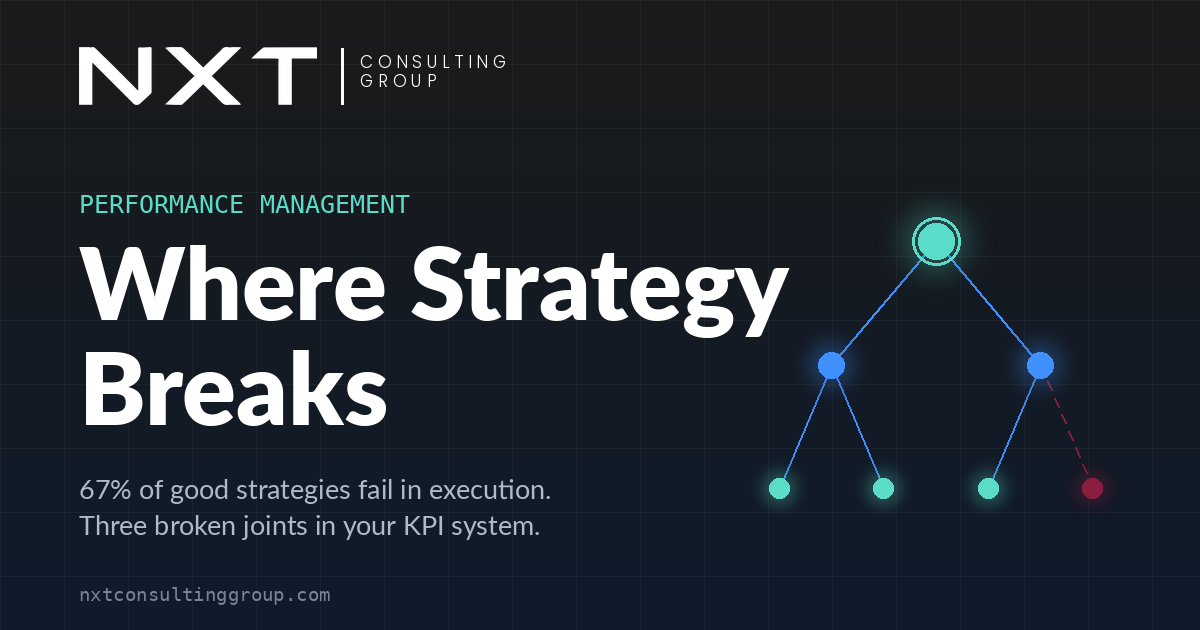
KPIs Everywhere, Strategy Going Nowhere: 3 Places Performance Measurement Systems Usually Break
Read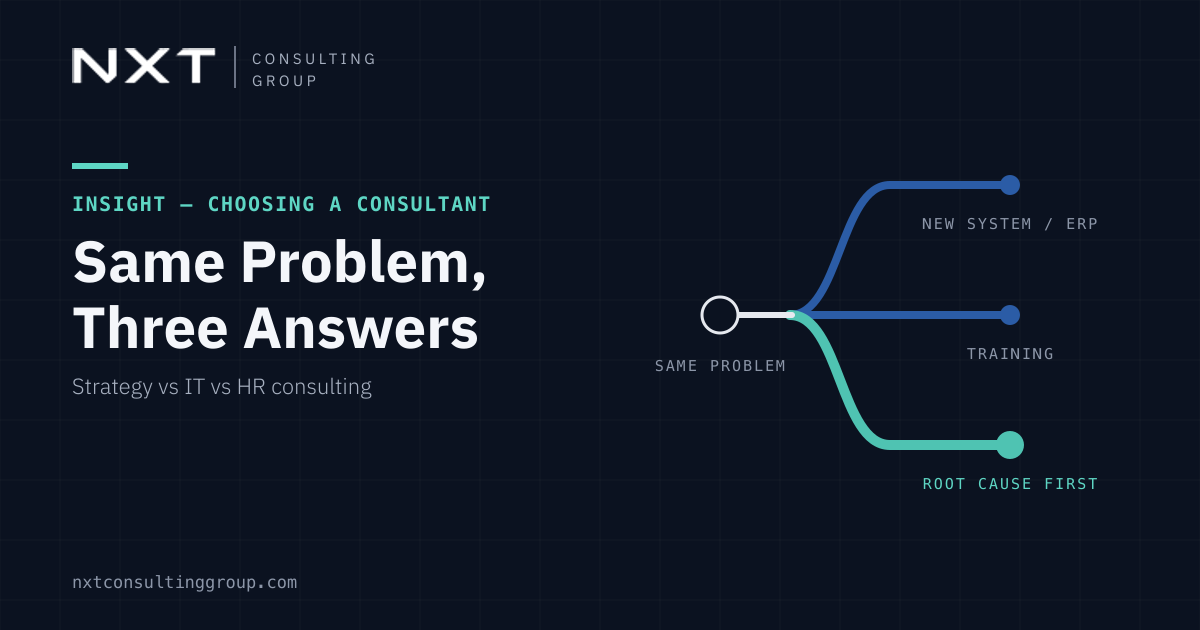
Which Type of Consultant Should You Hire? 9 Types of Consulting Compared, and Strategy vs IT vs HR Consulting
Read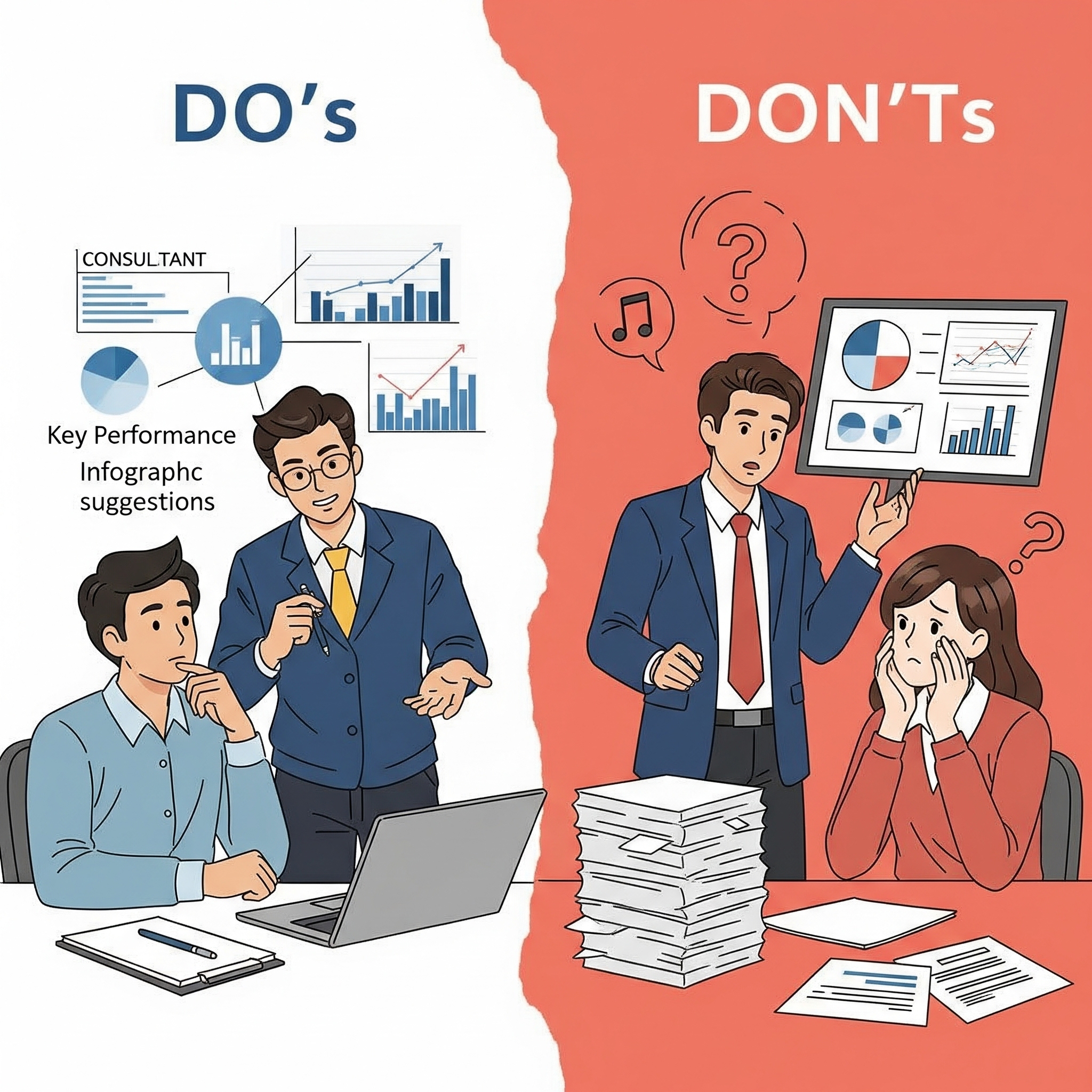
Hiring a Business Consultant: Key Reasons, Types of Consultants, and How to Choose One That Is Worth It
ReadOur people in this area
 Piyamin TrithipcharoenchaiManaging Partner & Co-founderCo-founder of NXT, working across strategy, research and organization developmentView profile
 Garuna YooyartwongPrincipalStrategy, new-venture building and operations excellenceView profile
 Kit KittirattanaPrincipalOperations, supply chain and process improvement, from consulting to running businessesView profile
Book a 30-minute call
Tell us your organization's problem. We'll help you see where to start. No obligation.
Contact usStrategic planning consulting for government agenciesBusiness consulting for companies and family businesses