Hiring a Business Consultant: Key Reasons, Types of Consultants, and How to Choose One That Is Worth It
Short answer: Organizations hire consultants mainly for specialized expertise, to save time through proven best practices, for an objective outside perspective, to handle politically sensitive decisions neutrally, and to transfer knowledge to internal teams. Common types are strategy, organizational development, marketing, and digital/IT consultants, plus financial, HR, and operations specialists. When choosing, check relevant experience and references, agree scope, KPIs, timeline, and fees in writing, verify reputation and ethics, avoid consultants who build dependency, and weigh price against quality rather than picking the cheapest bid.
Today, many organizations choose to hire a professional consultant to help solve problems and develop their business, whether in strategy, organizational development, marketing, or digital. Having outside experts look at the big picture and suggest new approaches can greatly increase the chances of success.
This article explains why organizations hire consultants, the types of business consultants, and what to check before choosing one, so that the work fits the problem and is worth the fee.
Why organizations should hire a consultant
Hiring a consultant can create value for an organization in several ways. These are the main reasons many organizations use consultants:
1. Specialized expertise
Consultants bring specialized knowledge and skills from outside the organization, filling expertise gaps the internal team may not have. Consultants usually have deep understanding of their field and can analyze problems, find solutions, and help implement them effectively. The organization therefore gets advice from people with direct experience in the matter at hand.
2. Saving time and improving efficiency
Experienced consultants who have worked on many projects know shortcuts and best practices. This helps organizations launch new projects or solve problems faster than by trial and error on their own, leading to faster and clearer business results.
3. Fresh perspectives and creativity
Solving problems purely in-house can hit a dead end or fall back on familiar habits with nothing new. Hiring a consultant gives you an outsider's perspective that is neutral and free of internal vested interests. Consultants can push teams to think outside the box, propose new ways to solve problems, and broaden thinking beyond what the organization is used to.
4. Objectivity and handling sensitive issues
When there are internal politics or conflicts, it can be hard to have insiders solve the problem. An outside consultant can act as a neutral third party, supporting difficult decisions or unpopular changes so they go more smoothly. Senior executives often cite the views of well-known consultants to add credibility to their decisions, or ask consultants to gather input and build consensus among stakeholders.
This role reduces internal friction and keeps projects moving.
5. Knowledge transfer and team development
An important by-product of hiring consultants is the new knowledge they pass on to internal teams, whether intentionally or not, because knowledge, skills, and insight are a consulting team's core tools. If the organization is open to learning and absorbing this knowledge, it benefits over the long term, even after the consulting project has ended.
For example, a marketing team that works with outside consultants often learns new marketing techniques or tools it can keep applying on its own, so the organization does not have to rely on consultants forever.
Common types of business consultants
There are consultants in many fields that organizations can hire for advice. Choose the type that matches your organization's needs:
Strategy consultant
Experts who help define the vision, long-term business strategy, and growth path. Strategy consultants analyze market trends, competitors, and expansion opportunities, and give data-backed strategic advice to improve the organization's performance and competitive advantage. Many large companies therefore use strategy consultants to plan organizational transformations and major projects.
Organizational development consultant
Consultants who focus on improving organizational structure, developing people and culture, and making internal processes more efficient. They often help with change management, leadership development, team restructuring, or building a strong organizational culture. The goal is to help the organization adapt well in a fast-changing business environment and strengthen its competitiveness from the inside out.
Marketing consultant
Experts who help plan and execute marketing strategy to increase sales and growth. Marketing consultants analyze target segments and plan branding, communication, and marketing campaigns suited to the client's business, and recommend modern marketing tools such as digital marketing and data-driven marketing. Using a marketing consultant gives the organization fresh outside perspectives, both creative ideas and marketing insight.
Demand for marketing consulting is high today. According to Mordor Intelligence, the global marketing consulting market is worth about USD 35.1 billion in 2025 and is expected to grow to about USD 44.16 billion by 2030 (average growth of about 4.7% a year), which shows that businesses see the value of investing in this kind of consultant.
Digital and technology consultant (digital transformation / IT)
Experts who help organizations adopt technology and digital systems to improve business processes and create new innovation. Digital consultants help plan digital strategy, recommend adopting new technologies (such as cloud, AI, and big data), and manage large IT projects. The goal is to increase efficiency, reduce costs, and improve the customer experience in the digital era.
It is no surprise, then, that many companies are turning to digital consultants to accelerate their digital transition and maintain their competitive edge.
Note: Beyond the types above, there are other specialist consultants organizations may hire as needed, such as financial advisory for financial and investment planning, HR consultants for developing people-management systems and compensation structures, and operations consultants for improving the efficiency of production processes and the supply chain. Which type to use depends on each organization's specific problem and goals.
What to consider when choosing a consultant
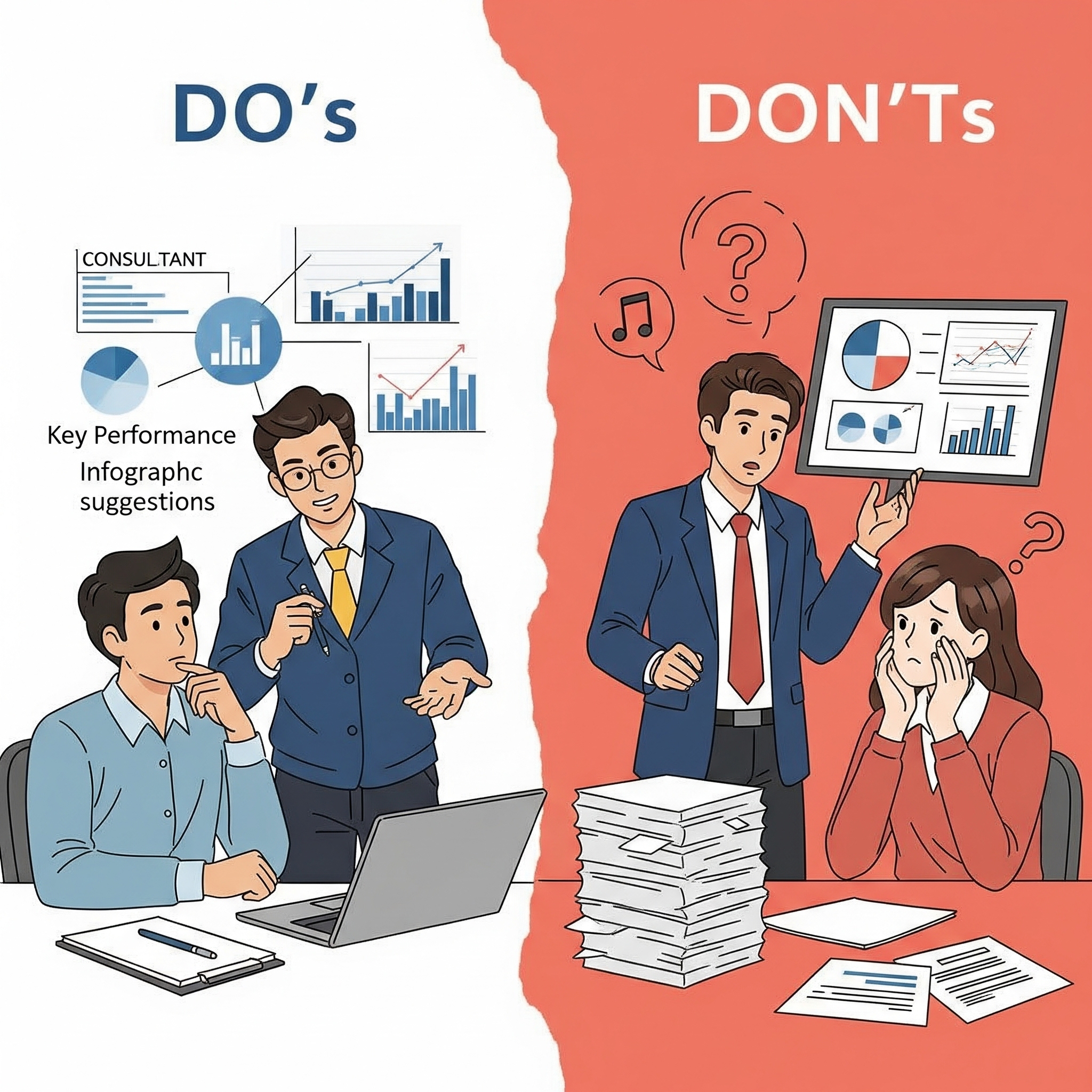
Although hiring a consultant can be very beneficial, choosing the right one is critical to the project's success. Before deciding, organizations should consider the following factors and cautions:
Experience and expertise that match your needs
Choose a consultant with experience in your industry or line of business and a proven track record. Ask for case studies or references from the consultant's past clients so you can assess their capability and past results with confidence.
Clear communication and shared understanding
Before signing a contract, agree clearly with the consultant on the scope of work, target outcomes, key performance indicators (KPIs), project timeline, and fees. Put everything in writing to prevent misunderstandings later. A good consultant asks detailed questions to understand the client's needs and reports progress regularly.
Credibility and professional ethics
Check the reputation of the consultant or consulting firm, whether through online reviews, word of mouth, or the experience of people you know. Choose a consultant who is credible, trustworthy, and ethical in their work (for example, keeping the client's business information confidential). This factor has a major effect on a long-term working relationship.
Avoid lock-in or over-reliance on the consultant
Be wary of consultants who try to make your company depend on them indefinitely, for example by offering only short contracts that must be renewed frequently, or by using their own proprietary tools or software that force the client to keep paying for services. If you see these signs, proceed with caution. The purpose of hiring a consultant is to solve problems and strengthen the organization, not to create unnecessary long-term obligations. A good consultant should be flexible and offer the working options that are most beneficial to your organization.
Compare cost against quality
Consulting fees are one factor to consider, but you should not decide on the lowest price alone. A bid that looks unrealistically cheap may signal a lack of experience or an under-qualified team, which can delay the work or fail to deliver the intended results. In the end, the organization may spend more fixing a failed project. Consider price and quality of work together, and ask bidders for a comprehensive, transparent cost breakdown so you understand what you will get before you hire.
Final thoughts
In short, hiring a consultant can be a smart investment in taking your business to the next level, provided the organization chooses the right consultant and manages the relationship well. A good consultant strengthens the internal team, builds data-backed solutions, and helps the organization reach its goals faster. At the same time, the organization should be open to new ideas and learn from the consultant so it can get the most out of the engagement.
When the project ends, the consultant leaves, but the knowledge and practices that remain help the organization keep growing sustainably. With careful consideration, hiring the right consultant is well worth the strategic results and long-term success the organization gains.
NXT Consulting Group is a strategy consulting firm that works closely with each client's team, as one team. It provides corporate strategic planning, research and evaluation, and process design and improvement for both government agencies and the private sector.
Translated from the Thai original by NXT Consulting Group.
Share this article