KPIs Everywhere, Strategy Going Nowhere: 3 Places Performance Measurement Systems Usually Break
Short answer: KPI cascading means translating company-level metrics down to departments, teams and individuals so everyone works in the same direction. In practice it often fails because each layer waits for the one above, so goals reach frontline teams about six weeks into the cycle, and because it assumes useful information only flows from the top down. The fix is to align rather than cascade: executives announce strategic context, every team sets its own goals at the same time, measures outcomes rather than activities, and reviews progress weekly against quarterly goals.
Every organization we work with has KPIs. Nobody says their company has no metrics. Most actually have too many: thirty per department, five per person, and an Excel file no one has opened since February. Yet by year-end, the strategy is still exactly where it started.
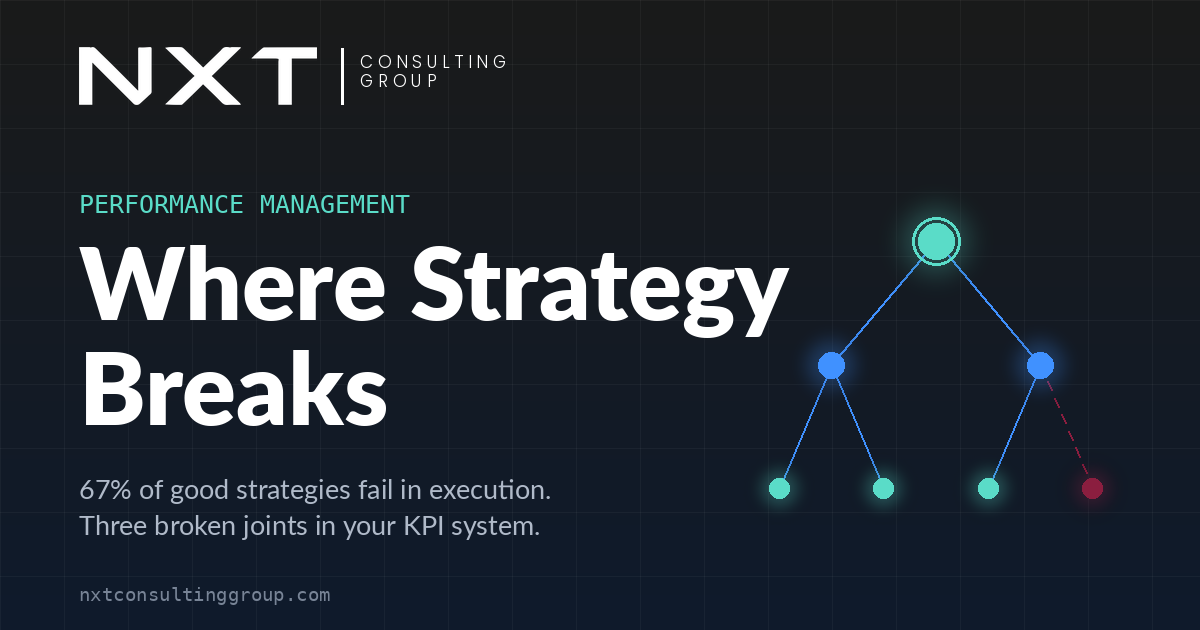
Global figures confirm this is no coincidence. Bridges Business Consultancy found that 67% of well-formulated strategies fail because of execution, not because the strategy itself was wrong. Executives themselves estimate that organizations lose nearly 40% of their strategy's value to weak execution. Gartner, meanwhile, found that organizations that execute better are up to 3 times more likely to grow faster than average and 2 times more likely to be more profitable than average.
So the gap between strategy and results does not sit in the planning room. It sits in the measurement system whose job is to turn strategy into daily work. From our work with Thai organizations, performance management systems tend to break in three places: they measure activities instead of outcomes, they cascade goals down like a waterfall until it is too late, and they review only once a year, when nothing can be fixed in time. This article walks through each one and how to fix it.
Why most KPIs measure activities instead of outcomes
Open your organization's KPI file and read it line by line. If you find items like "run 4 manager training sessions," "launch a new app," or "produce 10 pieces of content a month," those are not performance metrics. They are to-do lists with numbers in front of them.
The difference matters more than it seems. Activities are what you put effort into, and you can complete every one of them without the business improving at all. Run all four training sessions without anyone changing their behavior and you still score full marks. Outcomes are real, measurable value, such as raising the Manager Effectiveness score from 7.5 to 8.5, which forces whoever designs the training to care whether it actually works.
The clearest example is in marketing. Setting a goal to write 10 articles and setting a goal to generate 500 qualified leads from organic search use similar resources. But the first pushes the team to chase volume until quality drops, while the second forces the team to care about content quality, distribution channels and SEO all at once.
A test you can apply immediately: check whether the metric has a number that moves from one point to another. If it doesn't say where you move from and where you move to, it is not yet a performance metric. The result of measuring activities is that everyone scores well in a year when the company doesn't grow, and that is why many executives have stopped trusting the numbers in their own systems.
What is the difference between KPIs and OKRs?
KPIs measure the health of the business in routine operations that the organization wants to keep stable and predictable. OKRs are a goal-setting framework for measuring the change the organization intends to drive. The two are not substitutes; they are used together, each for a different job.
Many Thai organizations layer OKRs on top of their existing KPIs and end up with both but getting value from neither, because they assume one can replace the other. In reality, they do different jobs.
KPIs measure business health: the routine numbers you want to stay steady and predictable, such as the defect rate on a production line, payroll accuracy, or system uptime. OKRs measure business change: goals for the things you deliberately intend to move away from where they are today, such as entering a new market or restructuring costs.
An organization needs both. KPIs keep the lights on; OKRs build the new house. Problems start the moment you use OKRs to measure things that should stay stable, or use KPIs to measure projects that require change, because the system begins sending the wrong signals across the whole organization. The job, then, is not to choose a tool. It is to separate clearly which metrics are about holding a level and which are about moving the needle, and to manage them on different rhythms.
What is KPI cascading, and why does the waterfall approach usually fail?
KPI cascading is the process of translating metrics from the company level down to departments, teams and individuals so that everyone works in the same direction. The problem is the waterfall method, where each layer waits for the layer above to finish, so goals reach the front line so late that half the quarter has already passed.
The standard advice you hear everywhere is to cascade KPIs down the hierarchy: the CEO sets goals first, then the senior executives, then the managers, and finally the employees. It sounds orderly, but in practice it creates a state of waiting across the entire organization.
Department managers can't set their goals until the directors are done. The directors can't set theirs until the CEO signs off. If the top layer is two weeks late, the whole organization stalls in sequence. By the time goals reach the people actually doing the work, half the quarter is gone. Organizations that use this approach typically lose around six weeks per cycle waiting for approval to start work.
The second problem is bigger than speed. Waterfall cascading assumes that valuable information flows only from the top down, which is simply not true. Salespeople know before anyone else what terms a competitor has just offered. Frontline teams know which machine is about to have problems. If you force everyone to translate goals solely from the perspective of the layer above, you get a strategy that looks good on paper but is detached from reality on the ground.
The fix is to shift from cascading to aligning. The difference lies in sequence and timing:
- —Executives announce context instead of announcing everyone's goals, for example by defining three core strategic themes for the year and communicating them clearly.
- —Each team immediately answers the same question: how will our team help these themes succeed? They then set their own goals based on that answer.
- —All teams set goals at the same time, without waiting for the layer above to finish, and then reconcile them in the first review cycle.
Data from TraineryHCM and PerformSpark (2026) indicates that organizations switching to this approach cut goal-setting time from about six weeks to roughly five days. This matters because LSA Global research found that strategic clarity explains up to 31% of the performance gap between high- and low-performing organizations. Employees don't need to recite the whole strategy, but they do need to be able to say which big priority the work in front of them connects to.
If your organization still sets goals by queuing them down the hierarchy, the real problem is not that employees lack commitment. It is that the system gives them only half a quarter to actually execute.
How often should KPIs and OKRs be reviewed?
The practice that works is to set goals quarterly but review progress weekly. Setting and reviewing goals once a year is the main reason goals drift away from real work without anyone noticing until it is too late to fix.
The most common pattern: goals are set in January, the file is closed, urgent work takes over from February through November, and when the file is reopened in December, it turns out most of the year went to work that didn't move a single metric. This happens in almost every organization that reviews goals once a year.
The market is clearly moving away from this model. Some notable figures:
- —The share of companies still using annual performance reviews fell from 82% in 2016 to 54%, according to PerformYard data (2026).
- —As many as 95% of managers are dissatisfied with their organization's performance review system, and about 42% of HR teams admit that their current performance management process doesn't really work.
- —About 69% of high-performing organizations use continuous performance management instead of waiting for the annual cycle.
The fix is not to add more review rounds, which only adds paperwork. What you need is to separate the rhythm of goal-setting from the rhythm of review: set goals quarterly, but review progress weekly in the team meetings or 1-on-1s you already hold, using a single question: what did you do this week that actually moved a metric?
If the answer is "nothing," one of two things is happening: people are working on the wrong things, or the goal is no longer relevant to reality. Either way, you would rather find out within seven days than ninety. Weekly reviews don't add work; they move the point where problems are discovered from the end of the year to the beginning, which is the only time they can still be fixed.
Audit your measurement system with five questions
Before deciding to rebuild the whole system, use these questions to check what you already have:
- —Open the KPI file of any one department and count what percentage is written as outcomes with a starting and target number, rather than as lists of activities.
- —If you walked up to frontline employees and asked which company goal their work connects to, how many could answer within ten seconds?
- —This year, how many weeks did it take for goals to reach team level, counting from the day executives signed off on the strategy?
- —How many metrics has no one looked at again since the day they were set?
- —When was the last time the organization dropped or changed a goal mid-year because circumstances changed? If it has never happened, the system is not connected to reality.
One more caution that is often overlooked: don't tie OKRs directly to bonuses. The moment you do, people start setting goals they can easily hit, to play it safe, which completely defeats the purpose of setting stretch goals. Use a holistic assessment to decide compensation instead.
Conclusion
Most Thai organizations are not short of metrics. What they lack is a system that makes those metrics change how people behave on a Tuesday morning. If the goals you set don't change what the team does this week, they are just documents sent to HR for filing.
Fixing the system doesn't start with buying new software. It starts with answering three questions: are we measuring outcomes or activities, how quickly do goals reach the front line, and do we review often enough to correct course in time?
At NXT, we design performance management systems, KPI and OKR architecture, and cascading models that connect company-level strategy to team and individual levels, guided by the principle of reducing complex problems to evidence, reasoning and options.
If you are planning to overhaul your KPI system or introduce OKRs in the next fiscal year:
Sources
- —Bridges Business Consultancy: statistic that 67% of strategies fail in execution
- —Gartner: the relationship between execution quality and growth and profit
- —LSA Global: research on strategic clarity and the 31% performance gap between organizations
- —TraineryHCM and PerformSpark: "The OKR Failure Rate: Why 60% of Implementations Fail (and the Cascading Myth)," 2026
- —PerformYard and SelectSoftwareReviews: performance management statistics, 2026
Frequently asked questions
- What is the difference between KPIs and OKRs?
- KPIs measure the health of the business in routine operations that should stay stable, such as defect rates or system uptime. OKRs measure the change you intend to create, such as entering a new market. Organizations should use both together rather than choosing one or the other.
- How many OKRs should one person have?
- Good practice is no more than three Objectives, each with no more than three Key Results. Beyond that, people lose focus, because when everything is equally important, nothing is important.
- Should OKRs be tied to bonuses?
- Not directly, because people will set goals they can easily hit to play it safe, which defeats the purpose of setting stretch goals. Use a holistic assessment to decide compensation instead.
- Why does KPI cascading fail?
- The main cause is making each layer wait for the layer above to finish setting goals, which wastes about six weeks per cycle, and assuming information flows only from the top down. The fix is for executives to announce the context and for all teams to set their goals at the same time.
- How can you tell whether a KPI actually works?
- Check whether the metric specifies a starting number and a target number. If it doesn't say where you move from and where you move to, it is still just a to-do item, not a performance metric.
Translated from the Thai original by NXT Consulting Group.
Share this article