Employee Not Performing? Find the Broken Half Before You Judge the Person
Short answer: Before you decide an underperforming employee can’t do the job, score two things from 1 to 3. Expectation (E): do their role, the results that count and their way of working match your version? Resources (R): are money, people, tools, time, information, skill and knowledge enough? Find their square in the NXT Employee Performance Matrix, fix the lower score first (when the scores are equal, start with the brief) and judge attitude only once they reach E3 R3.
Read the full guide: scoring, the nine types, the 1-on-1 agenda and sources
Most managers have had this day. You hand over a piece of work, it comes back wrong, you explain again and it is still not what you meant. Before long the conclusion forms: they are not good enough, or they are not trying. Sometimes that is true. Often, though, the problem sits around the person rather than in them: they picture the job differently from you, or they were never given enough to do it.
This article uses the NXT Employee Performance Matrix, a nine-square grid that scores each person on two things, Expectation and Resources, and tells you which of nine situations they are in and what to fix first. It works in a one-on-one (1-on-1) with one person and in a quarterly performance review of a whole team. The interactive version at the top of this page lets you score someone on your team; this is the full text to read and cite.
Why employees don’t meet expectations: look around the person first
When work falls short, the first explanations are usually about the person: they lack skill, they don’t care, they have an attitude problem. Each one points at the person, and none tells the manager what to do differently tomorrow, so the same people problem keeps coming back.
In Human Competence (1978), Thomas Gilbert set out six things people need to perform, known as his Behavior Engineering Model. The organization provides three: information (knowing what is expected), resources (tools, time, money) and incentives. The person brings three: knowledge, capacity and motives. Gilbert argued that it is more cost-effective to work through them in that order, starting with information and leaving motives for last. The WORC lab at Boise State University, which summarizes his model, notes (citing Chyung, 2005) that he saw deficiencies in management as the ultimate cause of poor performance.
Gallup’s research points the same way. Its 12-question engagement survey (Q12) opens with these two items: “I know what is expected of me at work” and “I have the materials and equipment I need to do my work right.” Gallup calls clear expectations the most basic and fundamental employee need, yet globally only about half of employees strongly agree that they know what is expected of them, and only one in three that they have the materials and equipment they need (Gallup, Q12).
If only about half of employees worldwide strongly agree that they know what is expected of them, check the two things a manager can fix before deciding that someone is not capable. The NXT Employee Performance Matrix reduces Gilbert’s six factors to two axes, Expectation and Resources. Incentives such as pay and bonuses stay outside it, and capacity and motives are looked at only once both axes are in place. The one exception is the Drifter: after several full briefs, that square says to rethink whether the person and the job fit.
What is the NXT Employee Performance Matrix?
The NXT Employee Performance Matrix is a 3x3 grid developed by NXT Consulting Group to diagnose why an employee is, or is not, delivering and what the manager should fix first. It is used in 1-on-1s and quarterly performance reviews. The rows are Expectation (E), scored 1 to 3 from misaligned through partly aligned to aligned. The columns are Resources (R), scored 1 to 3 from short through stretched to sufficient. Each square has a name, the sentence a manager tends to hear, what you see in the work and what to do.
- 1 Score Expectation (E) Ask them to describe their role, the results that count and how work gets done. Compare with your version. Score 3 if it matches, 2 if partly, 1 if not.
- 2 Score Resources (R) Check what the organization gives (money, people, tools, time, information) and what they bring (skill, knowledge). Score 3 if enough, 2 if stretched, 1 if short.
- 3 Find the square, do the fix E3 R1 means Expectation 3, Resources 1. Follow the DO line in that square. Fix the lower score first. Judge attitude only after they reach E3 R3.
Read it row by row. The bottom row is people whose picture of the job differs from yours: the more resources they get, the more wrong work they can do, so the fix for the whole row starts with a new brief. The middle row knows what the job is but not what matters most, so the fix is to name the priority, and for the Firefighter, whose lower score is Resources, to drop the rest so the load fits. The top row already shares your picture of the job, so only resources are left. The darker the square, the closer it is to E3 R3, where work runs without rescue.
How is the NXT Employee Performance Matrix different from the 9-box grid and the skill/will matrix?
The 9-box grid is a widely used talent management tool that places employees on two axes, performance and potential, to inform leadership development and succession planning decisions (Ratanjee and Gandhi, Gallup, 2024). The NXT Employee Performance Matrix scores Expectation and Resources instead, to find out why work isn’t landing and what the manager should fix first, so the two can be used together.
The skill/will matrix rates a person on skill and will (motivation) and picks one of four coaching styles: direct, guide, excite or delegate (Mind Tools, after Max Landsberg’s The Tao of Coaching, 2003). The NXT Employee Performance Matrix counts skill and knowledge as two of its seven resources, beside the five the organization provides, and looks at motivation and attitude only once someone reaches E3 R3.
How to use the matrix in three steps
Step 1: score Expectation (E)
Ask the person to describe, in their own words, their role, the results that count and how the work should be done. Listen to the end without correcting, then compare with your version. Score 3 if it matches, 2 if it partly matches and 1 if it does not. Let them speak first: if you go first, people tend to nod along and you never hear the job as they see it. Gallup advises managers to develop expectations together with employees and to be clear enough that nobody has to guess (Rigoni and Nelson, 2016).
Step 2: score Resources (R)
Go through seven resources. The organization provides five: money, people, tools, time and information. The person brings two: skill and knowledge. Score 3 if they can deliver in normal working hours, 2 if they deliver only with overtime, borrowed help or cut corners, and 1 if they cannot deliver even with full effort. Gallup stresses that materials and equipment are not just a checklist of tools: they include intangible resources such as information and empowerment, and the most effective managers ask rather than assume what their team needs (Gallup, Q12).
Step 3: find the square and fix the lower score first
Put the two scores together to find the square: E3 R1 means Expectation 3, Resources 1, the Striver. Then follow the DO line in that square. The key rule is to fix the lower score first. When the scores are equal, NXT starts with the brief, following Gilbert’s order of information first, because resources added for someone who misunderstands the job turn into more wrong work. And judge attitude only after they reach E3 R3.
| Score | Expectation (E) | Resources (R) |
|---|---|---|
| 3 | Role, results that count and way of working all match your version | Delivers in normal working hours |
| 2 | Some of it matches: the role, but not the results that count, or too many equal priorities | Delivers, but only with overtime, borrowed help or cut corners |
| 1 | Their version of the job is not yours | Cannot deliver, even with full effort |
The score describes the situation now, not the person. The same employee can be E3 on one job and E1 on a new one they were handed last week, so score each main responsibility separately and score again whenever the work changes.
The nine types of employee and how to manage each
The NXT Employee Performance Matrix sorts employees into nine types by their Expectation and Resources scores. The bottom row holds the people whose picture of the job differs from the manager’s: the Drifter, the Improviser and the Wanderer. The middle row, partly aligned, holds the Firefighter, Core and the Rough Diamond. The top row, aligned, holds the Striver, the Grinder and the Performer. People move between squares as fixes land; a square is for choosing the fix, not for grading the person.
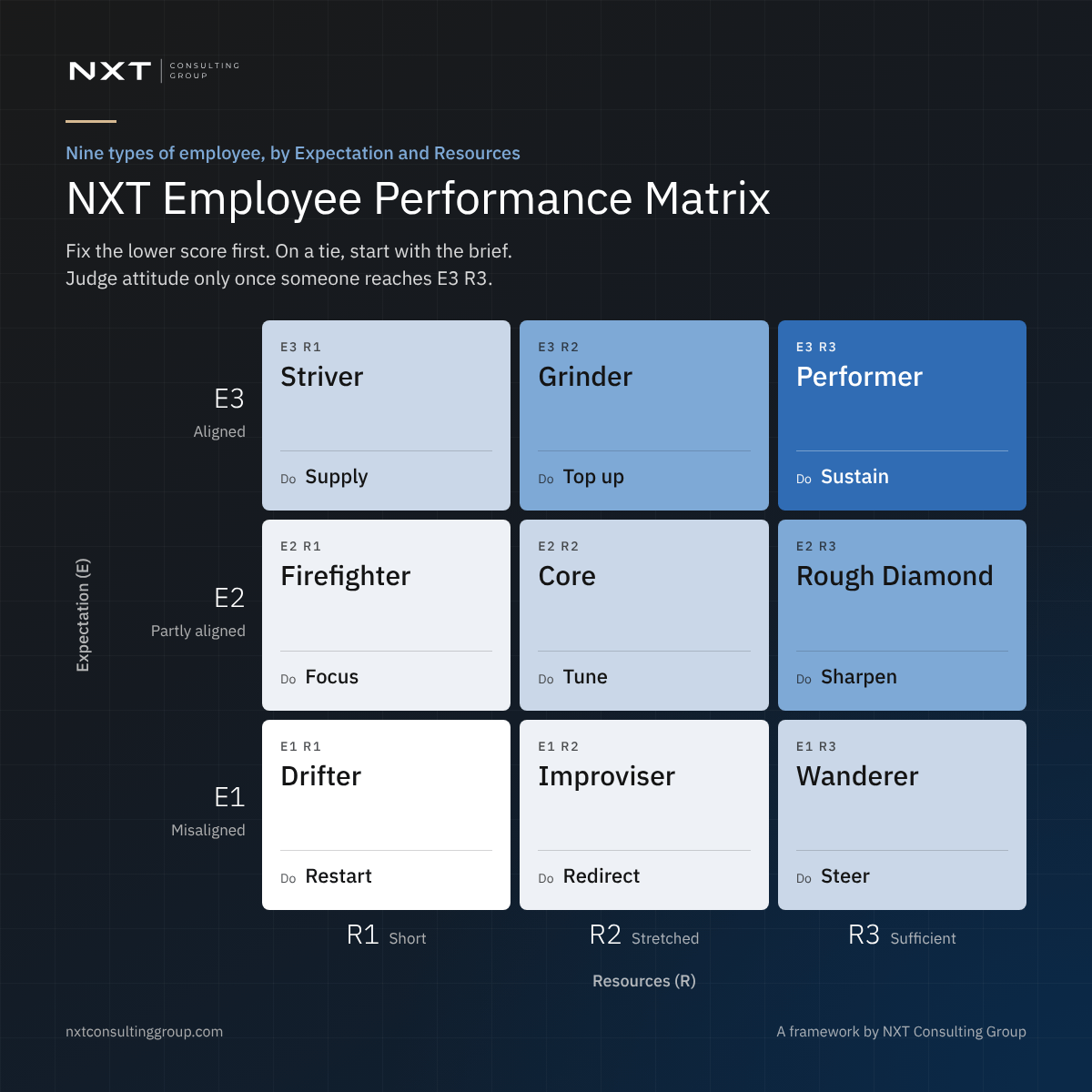
Here are all nine squares, from the bottom row up. Each has the sentence a manager tends to hear, what you see in the work, the usual cause, what to do this week and a question to open the 1-on-1.
Drifter (E1 R1): the employee who doesn’t know what to do
“What should I be working on?” They wait to be told every time and stop when the assigned task is done. Managers often read this as a lack of initiative, but the matrix says they are missing both the picture of the job and the means to do it. It is common in new hires, people moved from another team and roles that were never written down.
- This week: re-brief the job from zero, write down the results expected in the first month and book a short weekly check-in. If they stay in this square after several full briefs, rethink whether the person and the job fit.
- Opening question for the 1-on-1: “How would you describe your job in three sentences?”
Improviser (E1 R2): work that misses the brief
“I figured you’d want this.” They move fast and make good use of what they have, but deliver things nobody asked for. Managers who see this often say the employee “doesn’t get it.” The cause is usually a brief that named the task but not the result, so they filled the gap with a guess.
- This week: re-brief before adding any resources. Show one example of work that is right and ask them to say back what they understood.
- Opening question for the 1-on-1: “On your last piece of work, what did you think I wanted?”
Wanderer (E1 R3): hard work on the wrong job
“But I thought that was my job.” They are well equipped and work hard, on work that is not the role’s. It tends to happen when a role changes and nobody says so, or when the written job description differs from the work that is actually measured. Gallup notes that in many cases employees are held accountable for work that doesn’t match their job description, which can confuse and frustrate them (Gallup, Q12).
- This week: rewrite their role, results and way of working with them, then agree which work stops and who takes it over.
- Opening question for the 1-on-1: “If this role could deliver only one result, what should it be?”
Firefighter (E2 R1): everything is urgent
“Everything is urgent.” Busy all day, taking whatever comes in, finishing little that matters. They know what the job is, but they hold more than their time and help allow, so the urgent crowds out the important. Resources are the lower score, so the first fix cuts the load: agree on the top priorities, drop or postpone the rest, then see whether they still need more people or time.
- This week: agree on no more than three top priorities and drop or postpone the rest. Tell the people who send them work what has been postponed.
- Opening question for the 1-on-1: “If you could only finish three things this week, which three?”
Core (E2 R2): meets targets, rarely beats them
“It’s going fine, I think.” They meet targets without major problems but rarely beat them. Managers tend to leave this square alone because nothing is on fire, yet it is where a small push goes furthest: each axis is only one step short.
- This week: clarify one priority and add one missing resource. Don’t try to fix everything at once.
- Opening question for the 1-on-1: “What one thing, clearer or better supplied, would lift your results most?”
Rough Diamond (E2 R3): strong, but spread too thin
“Which of these matters most?” Skilled and well equipped, with good output spread across too many equal goals, so nothing stands out. This is often the person who keeps receiving more work because they do it well.
- This week: name the one result that matters most this quarter and the work that can shrink.
- Opening question for the 1-on-1: “Of all the goals you hold, which one would hurt most to miss?”
Striver (E3 R1): knows what to do, can’t do it
“I know what to do. I just can’t.” They share your picture of the job and keep asking for budget, people or tools. Some managers hear excuses; the matrix says the gap is in what the organization provides. Gallup finds that, of its 12 elements, having the materials and equipment to do the work well is the strongest indicator of job stress, and that employees get frustrated with managers or organizations that set goals which seem impossible to achieve (Gallup, Q12).
- This week: give the budget, people or tools that are missing. If you can’t, lower the target to fit what there is, and tell them plainly which you chose.
- Opening question for the 1-on-1: “If you could have one more thing tomorrow, what would it be?”
Grinder (E3 R2): delivers on overtime
“I’ll get it done. Somehow.” They know the job and deliver, but only by staying late, borrowing help or working weekends. The numbers look good while the person nears burnout, and the problem rarely shows in the results until the day they fall ill or resign.
- This week: add time or people before they burn out, or move part of the work elsewhere. Don’t let overtime become the standard you praise.
- Opening question for the 1-on-1: “Which part of the work runs into your evenings, and why?”
Performer (E3 R3): hits targets without rescue
“Done. What’s next?” They share your picture of the job, have what they need and hit targets without rescue. The manager’s job is to protect that setup: don’t route other people’s emergencies to them and don’t fix a way of working that works. This is also the right square for a conversation about growth and stretch work.
- This week: ask what makes their work go well and keep it that way. If results still don’t come while they are in this square, it is now about the person.
- Opening question for the 1-on-1: “What makes your work go well, and what should I leave alone?”
How to give instructions to employees and set clear expectations
To give instructions that come back right, cover the six lines of NXT’s brief. The first three set the expectation: the result, the reason and the priority. The last three set the resources: the time, the budget and authority, and the help. Then ask the person to say it back in their own words. Work that comes back wrong often went wrong the moment it was handed over, and leaving a line out tends to land the person in a particular square:
| Line | What to say | If it is missing |
|---|---|---|
| 1 Result | What finished work looks like and how it will be judged | They guess the job: Expectation drops to 1 (bottom row) |
| 2 Reason | Why it matters and who uses it next | They follow instructions but can’t decide anything unplanned: Expectation 2 |
| 3 Priority | Where it ranks against everything else they hold | They can’t tell which goal matters most: Expectation 2 |
| 4 Time | The deadline and the dates you will check progress | It gets done on overtime: Resources 2 |
| 5 Budget and authority | Budget, tools and what they may decide alone | They come back to ask about everything: Resources 1 |
| 6 Help | Who can help and where the information is | Time lost chasing people and data: Resources 2 |
End every brief by asking them to say it back in their own words: what they will deliver, by when and where they will start. If their version differs, the brief is not finished; it does not mean they weren’t listening. It costs a few minutes and saves giving the same instruction twice.
How to delegate work: hand over a result, not a task
To delegate is to hand over a result together with the resources and the authority to deliver it, not to pass on tasks one at a time. You still own the outcome, but you agree in advance what they can decide alone, what needs your sign-off and when you will review. Take the work back at the first problem and they learn to wait, sliding toward the Drifter square.
Work you have to brief every week should be written down as a standard procedure, so the team works systematically without waiting for you. See the business process and SOP guide.
How to train employees effectively
Training works only when the gap is skill or knowledge. When work falls short, the first fix many companies reach for is training, but of the seven resources in the NXT Employee Performance Matrix, those are the only two teaching can change. If time, tools, money, people or information is short, no amount of training helps; if the person doesn’t know what the job is, they need a new brief. When the gap really is skill, NXT suggests teaching in four beats: explain the purpose, show it, let them try with you there, then let them do it alone with a review date.
| What is missing | The fix |
|---|---|
| Skill or knowledge | Teach it |
| Money, people, tools, time or information | Supply it, or lower the target to fit what there is |
| Knowing what the job is | Re-brief, and ask them to say it back |
The four beats in detail:
- Explain the purpose: who uses the work next and what good work looks like.
- Show it: do the real work once, saying where you make decisions and why.
- Let them try with you there: allow small mistakes and talk about them straight away.
- Let them do it alone, with a review date: agree when you will look at the work together instead of checking in every day.
New hires usually start in the bottom row because they don’t yet have a picture of the job, so their first week should be a brief before it is training. Longer-term employee development also needs clear job levels and career paths; see the Organization Development guide.
A 30-minute 1-on-1 meeting agenda
A 1-on-1, or one-on-one, is a regular meeting between a manager and one employee. NXT’s 30-minute agenda has three ten-minute parts: Expectation, then Resources, then finding the square together and agreeing on one fix, with an owner and a date. In a Gallup study of 7,712 U.S. adults, employees whose managers held regular meetings with them were almost three times as likely to be engaged as those whose managers did not (Harter and Adkins, 2015). Yet many 1-on-1s end with a general impression and nothing agreed. The agenda below is NXT’s method for ending each one with a fix.
- Minutes 0 to 10, Expectation: they describe their role, the results that count and how they work, first. Listen to the end, then compare with your version. Where the two differ is the E score.
- Minutes 10 to 20, Resources: go through them one by one: money, people, tools, time, information, skill and knowledge. Ask what is missing, and what only gets done with borrowed help or overtime.
- Minutes 20 to 30, square and fix: find the square together and agree on one fix, with an owner and a date.
Start the next 1-on-1 by checking whether the last fix happened. If you promised a tool and didn’t deliver it, the low Resources score is yours to fix, not theirs. The opening question for each square is in the nine types above, and the interactive version at the top of this page copies an agenda for your employee’s square.
The quarterly performance review: read the whole team
At each quarterly performance review with the NXT Employee Performance Matrix, score Expectation (E) and Resources (R) for everyone on the team, record the square and the agreed fix, and track the changes from quarter to quarter. The record can be simple.
| Employee | Last quarter | This quarter | Agreed fix | Owner and deadline |
|---|---|---|---|---|
| Person 1 | E1 R1 Drifter | E3 R1 Striver | Get the missing tool, or lower the target | Team lead, before the next 1-on-1 |
| Person 2 | E1 R2 Improviser | E3 R2 Grinder | Move the weekly report to an assistant | Team lead, by month end |
| Person 3 | E1 R1 Drifter | E2 R1 Firefighter | Pick three top priorities, postpone the rest | Team lead, this week |
Put the whole team on one grid
Placing everyone on one grid shows problems that reviewing people one at a time misses. NXT reads the grid with a simple threshold: a row or column is “crowded” when it holds at least two people and at least half the team, and reads a crowded row or column as follows.
- Crowded bottom row: the team’s direction is unclear, and the problem is not any one person. Re-brief the team’s goals before fixing anyone individually. Turning company goals into team work is covered in the strategy execution guide.
- Crowded left column: the plan is short of resources. Review the team’s budget, people or targets before concluding that the people can’t deliver.
- Most people at E3 R3: protect what makes the team work, then look at individuals.
- Neither the bottom row nor the left column crowded: fix person by person, square by square.
KPIs say whether results came; the matrix says why
The NXT Employee Performance Matrix does not replace KPIs. Indicators tell you whether results came; the matrix tells you why they did or didn’t, and where to fix. If you don’t yet have KPIs that cascade from company goals to each person, see cascading KPIs and OKRs and the performance management guide.
Use the matrix to choose the fix, not to grade people or set pay. If the scores are tied to money, people will describe the job the way the manager wants to hear it, not the way it is, and the matrix stops working. Pay needs its own structure; see how to set employee salaries in Thailand.
When is it the employee’s attitude?
The NXT Employee Performance Matrix leaves attitude until someone reaches E3 R3: the job is clear and the resources are there. If, at that point, someone still doesn’t do what was agreed, makes no effort, neglects their duties or walks away from the work, it is now about the person. Waiting until this point has one advantage: when you have the conversation, both of you know that an unclear job and missing resources have already been dealt with.
NXT suggests four steps. Only the written warning appears in the law (section 119, below); the other three are NXT’s method.
- A direct conversation with evidence: what was agreed, what actually happened and the dates.
- A performance improvement plan: measurable targets, the support you will give and a review date, recorded each time.
- A written warning: when a lawful and just work rule, regulation or order has been broken.
- A labor lawyer’s advice: before any decision to dismiss.
On the legal side in Thailand, section 119 of the Labour Protection Act B.E. 2541 (1998) lists six cases in which an employer that dismisses an employee does not have to pay severance pay. Two of them matter here. One is breaking a lawful and just work rule, regulation or order after a written warning; no warning is needed in a serious case, and a warning is valid for no more than one year from the offense. The other is being absent from duty for three consecutive working days without good reason, whether or not a holiday falls in between. Falling short of targets is not one of the six. If the employer does not state the cause in the termination letter, or tell the employee at the time of termination, it cannot rely on that cause later. Cases differ a great deal, so check with a labor lawyer first. This paragraph paraphrases the English translation published by the Department of Labour Protection and Welfare (2014), which the department compiled for study and reference. The paraphrase was checked against the Thai text of section 119 in the Royal Gazette. Section 119 was replaced by the Labour Protection Act (No. 2) B.E. 2551 (2008), and none of the later amendments, up to the Labour Protection Act (No. 9) B.E. 2568 (2025), changed it (the Office of the Council of State’s consolidated text through No. 7 and the Royal Gazette texts of No. 8 and No. 9, all in Thai).
A fair process for underperformance, from the evidence-based conversation to the performance improvement plan, is set out in the performance management guide.
When the people problem belongs to the whole organization
If several teams have a crowded bottom row at the same time, or many of your best people are stuck as Grinders, the cause usually lies in the structure: overlapping roles, unclear decision rights or goals that never reach the teams. Fixing it at that level means looking at the organization’s structure, job scopes and performance system together. NXT helps companies design these; see organization design and restructuring consulting.
Where the ideas and figures come from
The NXT Employee Performance Matrix, its square names and the three-step rule are NXT Consulting Group’s framework, not the 9-box grid used to review performance and potential. The scoring guide, the seven resources, the six-line brief and how each line maps to a square, the four teaching beats, the opening questions, the 30-minute agenda, the team reading and its threshold, and the four steps before a dismissal (except the written warning, which follows section 119) are NXT’s method, not research findings. Facts and figures in this article come from the sources below, opened on November 27, 2026. The legal passages paraphrase the English translation of the Act, checked against the Thai text of section 119.
- Gallup: Q12 Employee Engagement Survey, items 1 and 2 (© Gallup, Inc.)
- Rigoni, B. and Nelson, B. (2016). Do Employees Really Know What’s Expected of Them? Gallup Business Journal
- Harter, J. and Adkins, A. (2015). Employees Want a Lot More From Their Managers. Gallup
- Ratanjee, V. and Gandhi, V. (2024). Avoid Getting Boxed in By Conventional Succession Planning Methods. Gallup
- Mind Tools: The Skill/Will Matrix, after Max Landsberg, The Tao of Coaching (2003)
- Workplace-Oriented Research Central Lab, Boise State University: Evidence for Behavior Engineering Model, a summary of Gilbert (1978)
- Labour Protection Act B.E. 2541, English translation published by the Department of Labour Protection and Welfare (2014), copy in the FAOLEX database
- Labour Protection Act (No. 2) B.E. 2551 (2008), section 18, which replaced section 119. Royal Gazette, vol. 125, part 39 (a), February 27, 2008, page 12, in Thai; copy on the Mahidol University website
- Office of the Council of State: Labour Protection Act B.E. 2541 and its amendments, consolidated text through No. 7 (updated April 2019), in Thai; reprinted in a Senate Secretariat briefing paper (2024), pages (206) to (207) and (227)
- Labour Protection Act (No. 8) B.E. 2566 (2023). Royal Gazette, vol. 140, part 20 (a), March 19, 2023, pages 56 to 59, in Thai
- Labour Protection Act (No. 9) B.E. 2568 (2025). Royal Gazette, vol. 142, part 74 (a), November 7, 2025, pages 41 to 44, in Thai
Frequently asked questions
- How should I handle an underperforming employee?
- Before deciding they can’t do the job, score two things from 1 to 3. Expectation: do their role, the results that count and their way of working match your version? Resources: are money, people, tools, time, information, skill and knowledge enough? Find their square in the NXT Employee Performance Matrix and fix the lower score first; if the scores are equal, start with a new brief. Look at attitude only once both scores are 3.
- How can I tell whether an employee lacks ability or just doesn’t know what to do?
- Ask them to describe their job first: the role, the results that count and how it should be done. If their version differs from yours, the problem is expectation, not ability, and the fix is a new brief. If it matches but they still can’t deliver, look at resources, and teach only when the gap is skill or knowledge. In the NXT Employee Performance Matrix, only when they score 3 on both and results still don’t come is it about the person’s capability or attitude; the one exception is a Drifter whom several full briefs leave at E1 R1, where the square itself says to rethink the fit.
- What are the nine types of employee in the NXT Employee Performance Matrix?
- The NXT Employee Performance Matrix has nine types, from two scores, Expectation and Resources. The bottom row, whose picture of the job differs from the manager’s, needs a new brief: the Drifter, the Improviser and the Wanderer. The middle row, partly aligned, needs one clear priority: the Firefighter, Core and the Rough Diamond, and the Firefighter also needs the rest of the load cut. The top row is aligned and down to resources: the Striver, the Grinder and the Performer. Supply what is short, and protect what works. Each type describes the person’s situation now, not their character, so the same person moves squares when the manager fixes the right thing.
- How should I give instructions or delegate work so it comes back right?
- NXT’s brief covers six lines. Three set the expectation: the result you need, why it matters and where it ranks against their other work. Three set the resources: the deadline and check-in dates, the budget and authority to decide, and who can help. Then ask them to say it back in their own words; if their version differs, the brief is not finished. To delegate, hand over the result with the resources and the authority to deliver it, not tasks one at a time, and agree in advance what they can decide alone.
- How do I set clear expectations with an employee?
- Agree on three things with them, the first three lines of NXT’s brief: the result you need and how it will be judged, why it matters and who uses it next, and where it ranks against their other work. Gallup advises managers to develop expectations together with employees and to be clear enough that nobody has to guess (Rigoni and Nelson, 2016). Then ask them to describe the role, the results that count and how the work should be done in their own words; if their version differs from yours, the expectation is not yet set.
- How do I train an employee so it actually works?
- First check that the gap really is skill or knowledge: of the seven resources in the NXT Employee Performance Matrix, those are the only two teaching can fix. If time, tools, money, people or information is short, supply it or lower the target; if they don’t know what the job is, re-brief. When the gap really is skill, NXT suggests teaching in four beats: explain the purpose, show it, let them try with you there, then let them do it alone with a review date.
- What is a 1-on-1, and what should the agenda cover?
- A 1-on-1 is a regular meeting between a manager and one employee about the work, what is in the way and what the manager needs to provide. NXT’s 30-minute agenda has three parts. Minutes 0 to 10: they describe their role, the results that count and how they work, and you compare with your version. Minutes 10 to 20: go through the seven resources and ask what is short or stretched. Minutes 20 to 30: find their square in the NXT Employee Performance Matrix together and agree on one fix, with an owner and a date. Open the next 1-on-1 by checking that fix.
- How do I use the NXT Employee Performance Matrix in a quarterly performance review?
- Each quarter, score everyone’s Expectation and Resources on the NXT Employee Performance Matrix, record the square and the agreed fix, and put the whole team on one grid. In NXT’s reading, a crowded bottom row (at least two people and at least half the team) means the team’s direction is unclear, so re-brief the team first. A crowded left column means the plan is short of resources, so review budget, people or targets. Use it alongside KPIs: KPIs say whether results came, the matrix says why.
- Can I use the NXT Employee Performance Matrix to grade employees or set pay and bonuses?
- It is better not to. The NXT Employee Performance Matrix is for choosing the fix. If the scores are tied to money, people will describe the job the way the manager wants to hear it rather than the way it is, and the matrix stops working. Base pay decisions on KPIs, actual results and the company’s salary structure.
- What should I do when an employee refuses instructions, stops trying or walks off the job?
- First check whether they are at E3 R3 in the NXT Employee Performance Matrix. If not, fix expectation or resources first. If they are, follow NXT’s steps: a direct conversation with evidence, a performance improvement plan with measurable targets and a review date, and a record of every step. Under section 119 of Thailand’s Labour Protection Act, dismissal without severance for breaking a lawful and just work rule, regulation or order requires a written warning first, except in serious cases, and absence from duty for three consecutive working days without good reason is a separate case in the same section. Falling short of targets is not one of the six cases that section lists. Details vary a great deal, so check with a labor lawyer before any decision.
- What is the 9-box grid, and how is it different from the NXT Employee Performance Matrix?
- The 9-box grid is a widely used talent management tool that places each employee in one of nine boxes by performance and potential, to inform leadership development and succession planning decisions (Ratanjee and Gandhi, Gallup, 2024). The NXT Employee Performance Matrix places them on Expectation and Resources to find out why work isn’t landing and what the manager should fix. The 9-box helps decide who gets the next opportunity; the NXT matrix says what the manager should do differently tomorrow. They can be used together.
- What is the skill/will matrix, and how is it different from the NXT Employee Performance Matrix?
- The skill/will matrix rates a person on skill and will (motivation) and picks one of four coaching styles: direct when both are low, guide when will is high but skill is low, excite when skill is high but will is low, and delegate when both are high (Mind Tools, after Max Landsberg’s The Tao of Coaching, 2003). The NXT Employee Performance Matrix counts skill and knowledge as two of seven resources, beside the five the organization provides (money, people, tools, time and information), and looks at motivation and attitude only once someone reaches E3 R3. The manager fixes the brief and the resources first, and only then decides whether it is about the person.
The NXT Employee Performance Matrix, its square names and the three-step rule are NXT Consulting Group’s framework. Sources were opened on November 27, 2026: Gallup (Q12; Rigoni and Nelson, 2016; Harter and Adkins, 2015; Ratanjee and Gandhi, 2024), Mind Tools on the skill/will matrix, the summary of Gilbert (1978) by the WORC lab at Boise State University, the English translation of the Labour Protection Act B.E. 2541 published by the Department of Labour Protection and Welfare (2014), which the legal passages paraphrase, and the Thai text of section 119 in the Royal Gazette (2008), which they were checked against. The Office of the Council of State’s consolidated text through No. 7 and the Royal Gazette texts of Nos. 8 (2023) and 9 (2025) show that no later amendment, up to No. 9, changed section 119. The scoring guide, the seven resources, the six-line brief and how each line maps to a square, the four teaching beats, the opening questions, the 30-minute agenda, the team reading and its threshold, and the four steps before a dismissal (except the written warning, which follows section 119) are NXT’s method, not research findings. The example team and record are hypothetical. This article is general information, not legal advice. Prepared by NXT Consulting Group.
Share this article