How Much Should You Pay an Employee in Thailand? Build a Salary Structure in Five Steps, with 2026 Reference Figures
Short answer: Set pay from the job level: compare the market rate at the median (P50) for the same role, then set a salary range with a minimum, a midpoint and a maximum, never below the minimum wage of THB 337 to 400 a day (about THB 10,110 to 12,000 a month). Reference figures as of November 2026: average private-sector entry-level pay of about THB 20,000 to 38,000, and a 2027 salary increase budget of about 4.6 to 5%. Once social security, bonus and benefits are added, the real cost in this article's example is about 20% above the salary.
Read the full guide: every step, table, calculator and source
The question of how much to pay a new hire is often answered with whatever the candidate asks for, or whatever the last person in the job earned. It is quick, but the problems build up: people in the same role earn different amounts for reasons nobody can explain, new joiners earn more than long-serving staff, and the company cannot forecast its people cost for the year. This article brings together the reference figures that apply in Thailand as of November 2026, five steps to build a salary structure for a private company, and free sources of salary data, so you can set pay in a way you can explain to employees and owners alike. Three calculators let you try your own figures.
Thailand minimum wage, graduate pay and salary increases, 2026 to 2027
| Item | Figure | Source |
|---|---|---|
| Daily minimum wage | THB 337 to 400, in 17 rates by area; THB 400 in Bangkok, Chonburi, Rayong, Chachoengsao, Phuket and Ko Samui | Wage Committee Announcement No. 14, in force from 1 July 2025; still the latest as of 20 November 2026 |
| Minimum wage as a monthly amount | About THB 10,110 to 12,000 | Daily rate x 30 |
| Average wage of private-sector employees, nationwide | THB 14,704 a month (government employees THB 21,378) | National Statistical Office, Labour Force Survey, Q3 2026 |
| Civil service starting salary, bachelor's degree | THB 18,150 | Second-round starting rate, in force from 1 May 2025 |
| Average entry-level pay, private sector (0 to 3 years' experience) | About THB 20,000 to 38,000 | Adecco Thailand Salary Guide 2026, which reports a fall of about 5 to 10% on the previous year outside IT |
| Average salary increase budget, 2027 | About 4.6 to 5% | Aon 4.6% (actual 2026: 4.5%) and Marsh 5% (2026: 4.7%) |
| Employee turnover | 10.4% to 16.4% | Marsh 10.4% (2025) and Aon 16.4% (2026); different samples |
| Employer social security contribution | 5% of wages on a base of THB 1,650 to 17,500, so at most THB 875 a month | New ceiling from 1 January 2026 to 31 December 2028 |
| Employee Welfare Fund | 0.25% of wages each from employer and employee, from 1 January 2027 | For employers without a provident fund that meets the legal conditions |
Sources: Ministry of Labour minimum wage rates, National Statistical Office Labour Force Survey, civil service starting salaries, Adecco Thailand Salary Guide 2026, Aon Salary Increase and Turnover Study, Marsh remuneration survey, the new social security wage ceiling and the postponed start of the Employee Welfare Fund.
These figures are reference points, not the answer. The minimum wage tells you the floor you cannot go below, and the surveys show a market average across many industries and company sizes. The right salary for your role has to be worked out from the work the role is responsible for, following the steps below.
Thailand minimum wage 2026 by province
Choose a province to see the daily and monthly rate, and enter the salary you plan to pay to check it meets the minimum. The full table for every province is below the calculator.
What is the 2026 minimum wage in your province?
Type 2 to 4 hotels and entertainment venues pay THB 400 nationwide
Other areas on the same rate: Chachoengsao, Chon Buri, Phuket, Rayong, Surat Thani (Ko Samui district only)
Source and method
Wage Committee Announcement No. 14, in force from 1 July 2025 and still the latest as of 20 November 2026. For monthly-paid staff, the salary divided by 30 must not be below the area's daily rate. Check the latest rates with the Ministry of Labour before you rely on them.
| THB a day | THB a month (x 30) | Province or district |
|---|---|---|
| 400 | 12,000 | Bangkok, Chon Buri, Rayong, Chachoengsao, Phuket, Surat Thani (Ko Samui district only) |
| 380 | 11,400 | Chiang Mai (Mueang Chiang Mai district only), Songkhla (Hat Yai district only) |
| 372 | 11,160 | Nonthaburi, Pathum Thani, Samut Prakan, Nakhon Pathom, Samut Sakhon |
| 359 | 10,770 | Nakhon Ratchasima |
| 358 | 10,740 | Samut Songkhram |
| 357 | 10,710 | Khon Kaen, Chiang Mai (other districts), Prachin Buri, Phra Nakhon Si Ayutthaya, Saraburi |
| 356 | 10,680 | Lop Buri |
| 355 | 10,650 | Nakhon Nayok, Suphan Buri, Nong Khai |
| 354 | 10,620 | Krabi, Trat |
| 352 | 10,560 | Kanchanaburi, Chanthaburi, Chiang Rai, Tak, Nakhon Phanom, Buri Ram, Prachuap Khiri Khan, Phang Nga, Phitsanulok, Mukdahan, Sakon Nakhon, Songkhla (other districts), Sa Kaeo, Surat Thani (other districts), Ubon Ratchathani |
| 351 | 10,530 | Chumphon, Phetchaburi, Surin |
| 350 | 10,500 | Nakhon Sawan, Yasothon, Lamphun |
| 349 | 10,470 | Kalasin, Nakhon Si Thammarat, Bueng Kan, Phetchabun, Roi Et |
| 348 | 10,440 | Chai Nat, Chaiyaphum, Phatthalung, Sing Buri, Ang Thong |
| 347 | 10,410 | Kamphaeng Phet, Phichit, Maha Sarakham, Mae Hong Son, Ranong, Ratchaburi, Lampang, Loei, Si Sa Ket, Satun, Sukhothai, Nong Bua Lam Phu, Amnat Charoen, Udon Thani, Uttaradit, Uthai Thani |
| 345 | 10,350 | Trang, Nan, Phayao, Phrae |
| 337 | 10,110 | Narathiwat, Pattani, Yala |
Average salary by job category, industry and region in Thailand, 2026
Choose the job category you are hiring for, the region, your industry and where in the market to pay, and get a starting figure for the offer with context from two public sources: JobThai Salary Survey 2026 and the National Statistical Office's Labour Force Survey. The full tables are below the tool.
How much should you pay? Compare with 2026 market data
The midpoint of the advertised range for this category, rounded to THB 500
This industry pays 28% above the national private-sector average in this region. If you compete for people with firms in the same industry, consider a higher position.
These ranges come from general job ads, mostly operational to supervisor level. Manager roles and above usually pay more: see the salary guides under free salary data.
Source and method
Ranges by job category and region come from JobThai's summary of its Salary Survey 2026: base pay in JobThai job ads from January to June 2026, all education levels, excluding commission and benefits. Industry averages come from the National Statistical Office's Labour Force Survey, Q3 2026 (Table 21), averaging every role in the industry. The starting figure is the 25%, 50% or 75% point of the category range, by the position you choose. The tool never multiplies the two sources together, and no public data splits pay by company size, so you choose a market position instead. Use it as a starting point, then compare with job ads for the same role in your area.
National private-sector average: 14,704 THB a month
Salary by job category in job ads, 2026
| Job category | Average salary (THB a month) | Openings |
|---|---|---|
| Sales | 20,295 to 30,898 | 109,018 |
| Production and quality control | 20,121 to 27,914 | 62,652 |
| Technicians | 15,655 to 21,117 | 51,917 |
| Purchasing and administration | 17,841 to 23,649 | 34,137 |
| Engineering | 23,858 to 34,113 | 33,352 |
| Customer service | 17,909 to 23,341 | 28,816 |
| Transport and warehouse | 18,161 to 24,180 | 27,514 |
| Accounting | 21,999 to 30,164 | 27,187 |
| Marketing | 22,736 to 32,290 | 21,122 |
| Food and beverage service | 18,376 to 23,747 | 17,949 |
| Computer and IT | 26,896 to 39,524 | not stated |
Fresh-graduate starting salary by category, 2026
| Job category | Average starting salary (THB a month) |
|---|---|
| Interpreting and translation | 24,524 to 35,378 |
| Medical services | 20,288 to 28,657 |
| Secretary and executive assistant | 20,190 to 27,311 |
| Computer and IT | 19,500 to 28,110 |
| Engineering | 19,424 to 26,818 |
Salary in job ads by region
| Region | Average salary (THB a month) |
|---|---|
| Bangkok and vicinity | 20,938 to 32,426 |
| Central | 16,500 to 27,320 |
| East | 15,867 to 30,237 |
| Northeast | 14,485 to 25,534 |
| North | 14,057 to 25,596 |
| South | 14,179 to 30,200 |
Average private-sector wage by industry and region
| Industry | Nationwide | Bangkok | Central | East | Northeast | North | South |
|---|---|---|---|---|---|---|---|
| Manufacturing | 14,609 | 18,757 | 14,093 | 15,461 | 12,032 | 11,650 | 11,609 |
| Construction | 12,590 | 17,272 | 14,368 | 13,609 | 9,422 | 9,520 | 11,958 |
| Wholesale, retail and vehicle repair | 14,243 | 19,945 | 14,658 | 13,893 | 11,090 | 11,115 | 12,234 |
| Transport and storage | 18,233 | 22,881 | 16,570 | 18,234 | 12,922 | 15,762 | 14,806 |
| Accommodation and food service | 12,407 | 15,675 | 12,317 | 11,948 | 10,236 | 9,837 | 12,190 |
| Information and communication | 30,797 | 35,906 | 28,414 | 14,304 | 15,879 | 17,055 | 23,659 |
| Finance and insurance | 25,536 | 35,004 | 22,328 | 21,254 | 18,210 | 18,187 | 20,080 |
| Real estate | 17,157 | 18,044 | 17,122 | 15,589 | 10,635 | 11,707 | 15,933 |
| Professional, scientific and technical | 26,314 | 30,667 | 26,447 | 26,279 | 18,673 | 14,940 | 20,485 |
| Administrative and support services | 14,783 | 15,791 | 14,906 | 13,323 | 12,203 | 13,551 | 13,984 |
| Education | 19,059 | 26,204 | 19,627 | 22,718 | 16,091 | 13,697 | 15,870 |
| Health and social work | 25,256 | 37,985 | 18,684 | 23,030 | 13,564 | 12,410 | 15,741 |
| Arts, entertainment and recreation | 15,803 | 21,915 | 15,387 | 11,124 | 8,676 | 12,896 | 12,088 |
| Agriculture, forestry and fishing | 8,427 | 10,226 | 8,946 | 10,172 | 7,358 | 6,998 | 8,550 |
| Other services | 10,495 | 16,716 | 11,549 | 10,151 | 7,548 | 10,438 | 10,459 |
| All industries | 14,704 | 20,610 | 14,595 | 14,674 | 10,617 | 11,046 | 12,370 |
The two sources measure different things. JobThai's ranges are the salaries companies advertise when hiring; the National Statistical Office's figures are average wages of employees already in work at every level, including daily workers, so they are usually lower. Use the category range to set the figure, and the industry average to see whether your market pays above or below the overall level. For manager roles and above, compare with the salary guides under free salary data.
Key terms before you build a salary structure
- —Salary structure: the set of salary ranges for every job level in the company, with the rules for hiring, annual increases and promotion.
- —Salary range (salary band): the pay range for one job level, with a minimum, a midpoint and a maximum.
- —Midpoint: the middle of the range, (minimum + maximum) ÷ 2, usually set at the market rate the company chooses to pay.
- —P25, P50, P75: positions in market pay data. P50, the median, means half the market earns less than this figure; P75 means three quarters earn less.
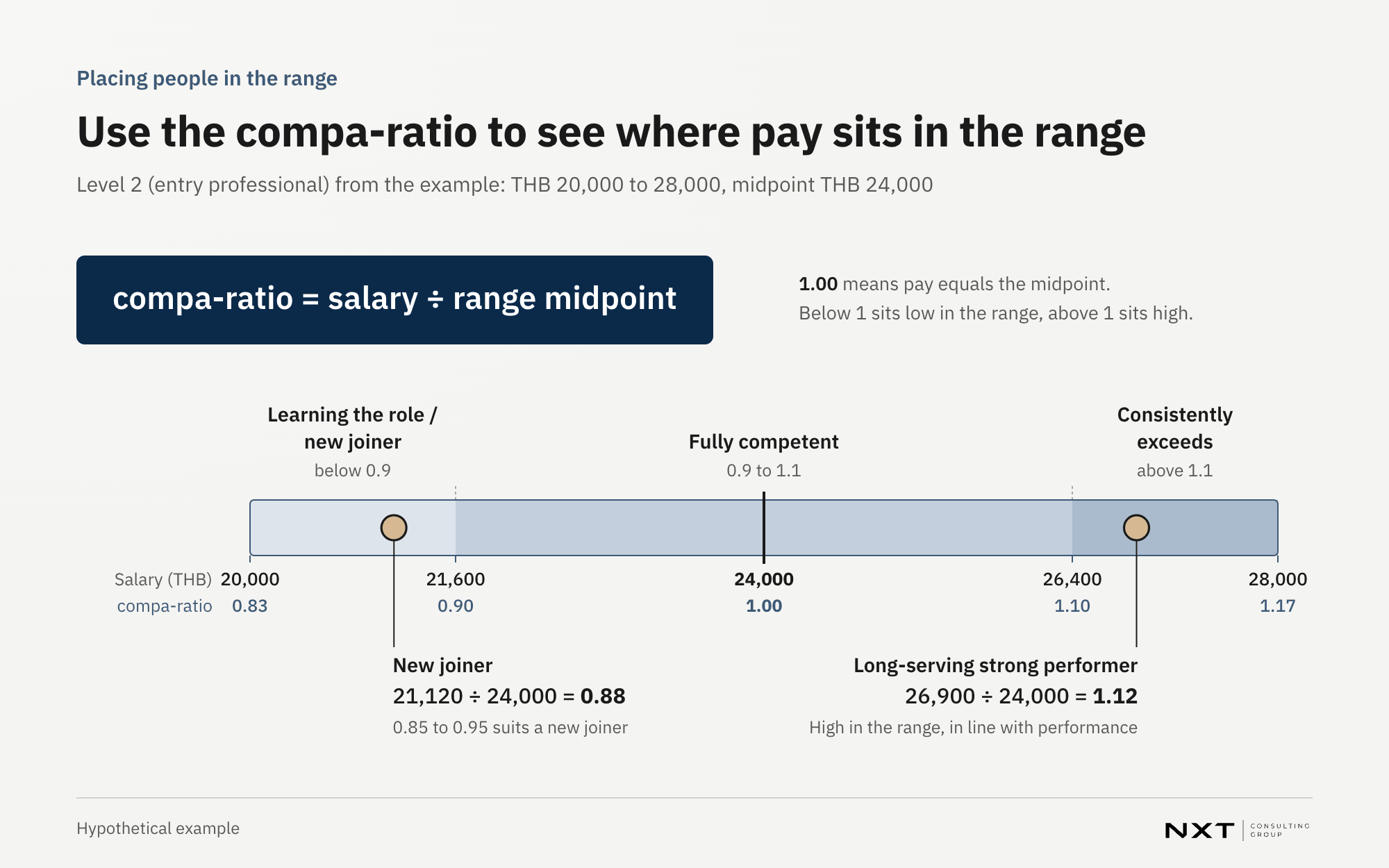
- —Compa-ratio: salary ÷ range midpoint, for example 21,120 ÷ 24,000 = 0.88. Below 1 means paid below the midpoint.
- —Merit increase: the annual pay rise based on performance, separate from the adjustment that comes with a promotion.
How to set salaries in a private company: five steps
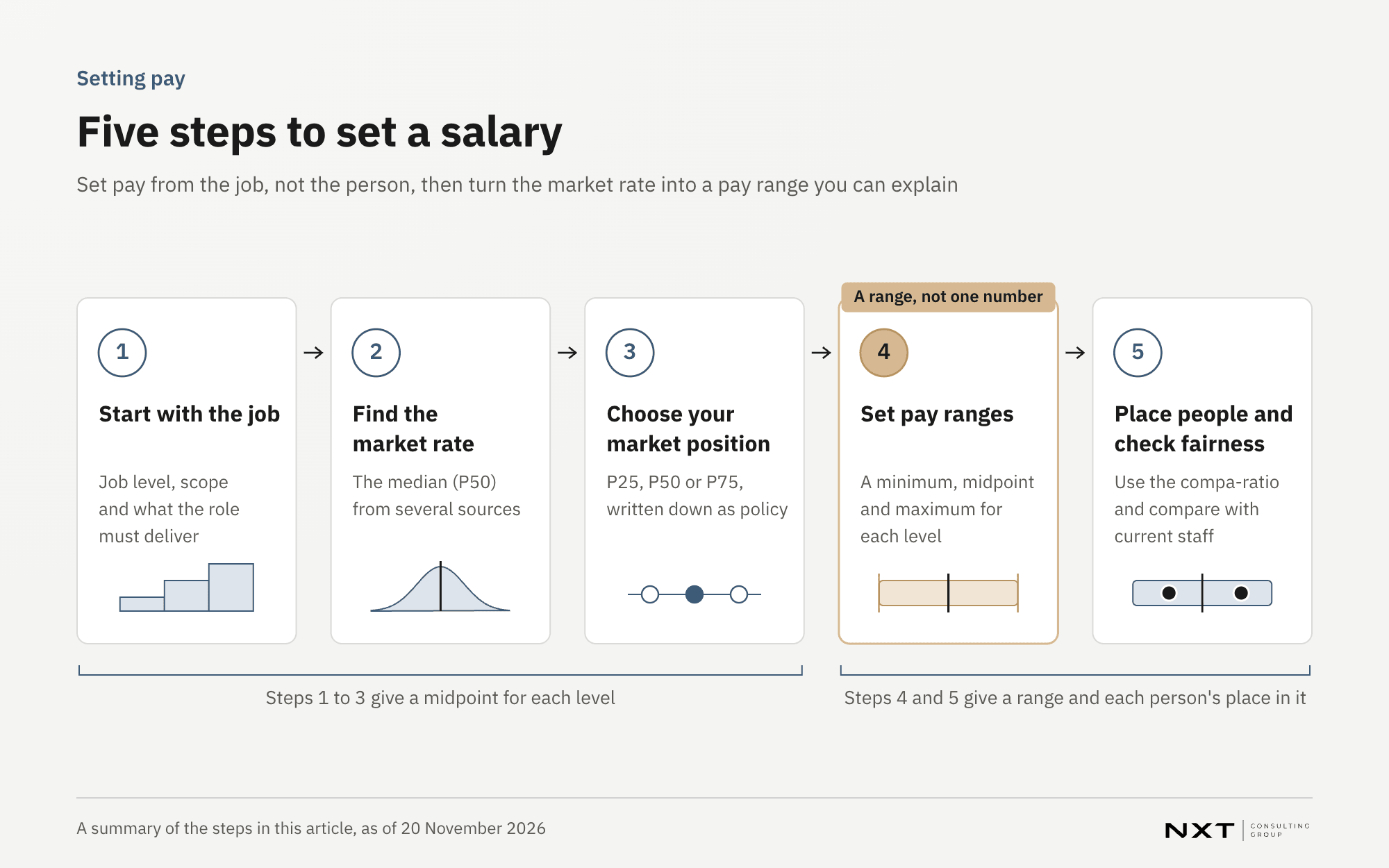
1. Start with the job, not the person
Write down what the role must deliver, what it can decide on its own, how many people it manages, and how much damage a mistake in the role would do. Then place the role in a job level, such as operational, professional, supervisor and manager. Roles at the same level should sit in the same salary range, even when their titles differ.
Companies without clear job levels tend to set pay by title or by whatever each person asks for, so people doing harder work can end up earning less. If the organization structure and job scopes are not yet clear, start there. See our guide to organization development (OD) and guide to setting up business processes.
2. Find the market rate for the same role
The market rate is what other companies pay for work at the same level, in a similar industry and location. The sources come at several levels of detail.
- —Paid compensation surveys, broken down by role, level and industry. They cost money and usually require you to submit your own pay data.
- —Annual salary guides from recruitment firms, which give pay ranges by role. Many can be downloaded free and are useful for checking that your figure is in a reasonable range.
- —Job-board data: surveys built from job ads, and postings that state a salary for the same role in the same area. Collect at least 10 to 15 postings and look at the middle value.
- —Interview data: candidates' current and expected salaries. Recorded over many interviews, they show the market rate for roles that are hard to find data on.
Use the median (P50) rather than the average, because a few very high salaries pull the average up. Market figures by category, industry and region, with a comparison tool, are in the average salary section above, and a list of free sources is at the end of this article.
3. Decide where in the market to pay
This is a policy decision, not a calculation. Most companies choose one of three positions.
- —Below the market (around P25) for roles that are easy to fill, or for companies that compensate in other ways, such as flexible hours, fast learning or room to grow.
- —At the market (P50), the starting point for most roles.
- —Above the market (P75 or higher) for roles that are hard to fill, or roles whose vacancy would hurt the business, such as specialist engineers, data and AI roles or managers who look after key accounts.
You do not need one position for the whole company. Many companies pay at the market for general roles and above it only for the roles at the heart of the business. What matters is to write the policy down and apply it the same way every time.
4. Set a salary range for each level
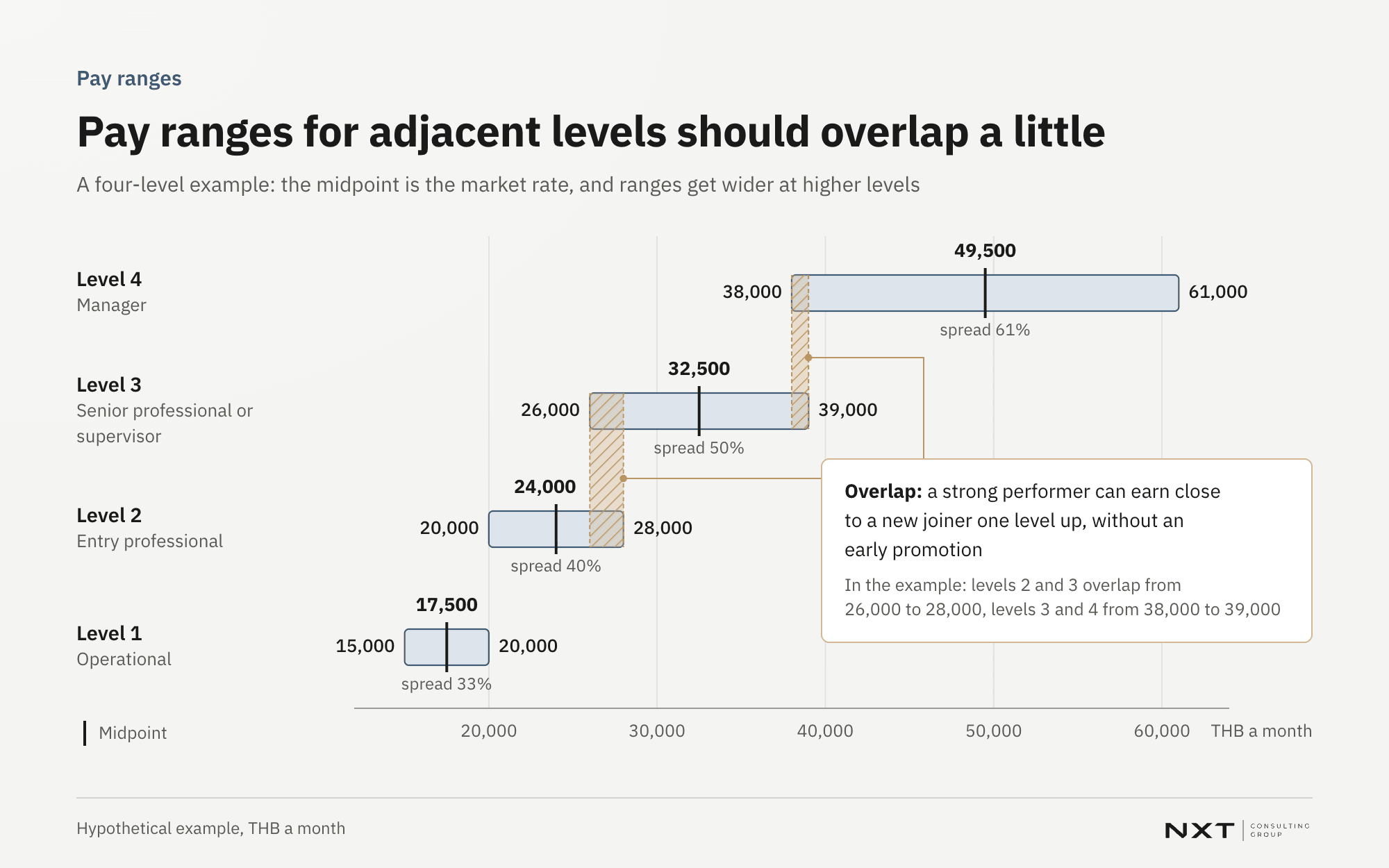
Instead of a single salary per role, set a range with a minimum, a midpoint and a maximum. The midpoint is the market rate at the position you chose in step 3, and the width of the range depends on the level. Common practice is a spread of about 30 to 40% for operational roles, 40 to 60% for professional and supervisor roles, and 50 to 70% for managers and above (measured from minimum to maximum).
| Job level | Minimum | Midpoint | Maximum |
|---|---|---|---|
| 1. Operational | 15,000 | 17,500 | 20,000 |
| 2. Entry professional, e.g. new graduate | 20,000 | 24,000 | 28,000 |
| 3. Senior professional or supervisor | 26,000 | 32,500 | 39,000 |
| 4. Manager | 38,000 | 49,500 | 61,000 |
Ranges for adjacent levels should overlap a little, as levels 2 and 3 do between THB 26,000 and 28,000 in the example, so that a strong performer at the lower level can earn close to a new joiner at the level above without being promoted too early.
5. Place people in the range and check internal fairness
New joiners who are still learning the job should start in the lower to middle part of the range, people who are fully competent should sit around the midpoint, and the top of the range is for those who consistently exceed the standard. A simple check is the compa-ratio = salary ÷ range midpoint. A value of 0.85 to 0.95 suits a new joiner, and around 1.0 means fully competent in the role.
Before making an offer, always compare it with current employees at the same level. If the new joiner would earn more than a current employee who performs well, adjust the current employee at the same time, or record a reason you can explain, because pay rarely stays confidential inside a company for long. In Adecco's survey of more than 1,500 workers in Thailand, 34% named misaligned pay as a reason to leave, second only to limited career advancement (47%).
What does one employee really cost in Thailand?
When you ask how much it costs to hire someone, work out the full-year cost, not just the salary. Employers also pay for the following.
- —Employer social security contributions: 5% of wages on a base of THB 1,650 to 17,500, so at most THB 875 a month in 2026 to 2028. The ceiling rises to THB 20,000 in 2029 to 2031 and to THB 23,000 from 2032.
- —Workmen's Compensation Fund: paid by the employer only, about 0.2 to 1% of wages depending on the risk of the business type.
- —Employee Welfare Fund: from 1 January 2027 the employer pays 0.25% of wages (and the employee another 0.25%) until the end of 2031, rising to 0.5% each from 2032. It applies to employers without a provident fund that meets the legal conditions.
- —Bonus: if you plan to pay one month a year, add one twelfth of the salary to the cost every month.
- —Provident fund, if you have one: the employer contributes at least as much as the employee, between 2 and 15% of wages.
- —Benefits such as group health insurance, which is getting more expensive: Marsh's survey expects medical costs to rise about 10.8% in 2027.
- —Overtime: under the Labour Protection Act, overtime on a working day must be paid at no less than 1.5 times the hourly wage.
- —Severance pay: a liability to set aside, from 30 days' wages for employees with 120 days' service up to 400 days' wages for those with 20 years' service.
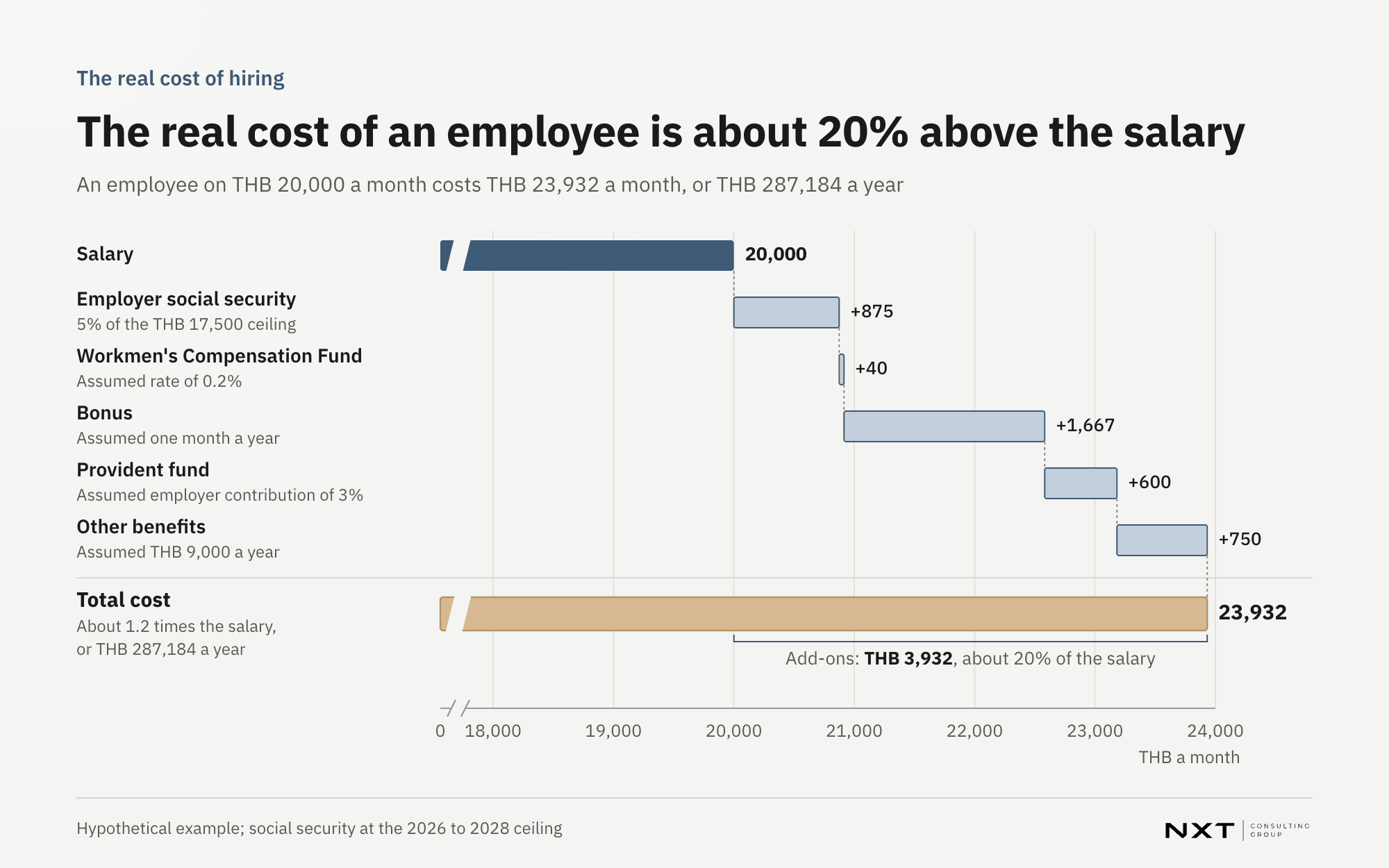
| Item | THB a month | Assumption |
|---|---|---|
| Salary | 20,000 | |
| Employer social security | 875 | 5% of the THB 17,500 ceiling |
| Workmen's Compensation Fund | 40 | Assumed rate of 0.2% |
| Bonus | 1,667 | Assumed one month a year |
| Provident fund | 600 | Assumed employer contribution of 3%, so no Employee Welfare Fund |
| Other benefits, e.g. group health insurance | 750 | Assumed THB 9,000 a year |
| Total cost | 23,932 | About 1.2 times the salary, or THB 287,184 a year |
If the company has no provident fund, remove the THB 600 line and add the Employee Welfare Fund at 0.25% (THB 50) from 2027 instead. This still leaves out costs that never appear on the payroll, such as recruitment, equipment and the first months when a new joiner is not yet fully productive. If the role turns over often, these costs recur every time.
Try it with your own figures. Change the salary, year, bonus, funds and headcount, and see what share of the total each item takes.
What does one employee really cost?
About 1.20 times the salary
THB 287,180 a year per employee
How it's calculated
Employer social security is 5% of the salary on a base of at least THB 1,650 and at most THB 17,500 in the chosen year. The Employee Welfare Fund is 0.25% of the salary, only for companies without a provident fund (from 1 January 2027). The Workmen's Compensation Fund uses the rate you choose. The bonus and benefits are averaged over 12 months. This is an estimate that leaves out overtime, recruitment and severance.
Thailand salary increase 2027: how much to budget
Two surveys published in 2026 give similar figures. Aon expects companies in Thailand to raise salaries by 4.6% on average in 2027, after an actual 4.5% in 2026. Marsh found an average salary increase budget of about 5% for 2027, up from 4.7% in 2026, with energy higher at 5.5% and life insurance at 5.3%. These are budgets for the whole company, not the rise everyone should get.
A way of sharing out the budget that you can explain is a merit grid that looks at two things together: each person's performance, and where their salary sits in the range. Strong performers who are still low in their range should get more than the average, while those near the maximum may get less, or a lump sum instead of a rise in base pay.
| Performance | Low in range (compa-ratio below 0.9) | Around midpoint (0.9 to 1.1) | High in range (above 1.1) |
|---|---|---|---|
| Clearly above target | 8 to 10% | 6 to 8% | 4 to 5% |
| On target | 5 to 6% | 4 to 5% | 2 to 3% |
| Below target | 0 to 2% | 0 to 1% | 0% |
Try it for one employee. Enter the range midpoint, the spread, the current salary and the performance rating. The calculator shows the compa-ratio, where the person sits in the range, the suggested rise from the grid above, and a warning when the new salary would pass the range maximum.
Salary range, compa-ratio and how much to raise pay
How it's calculated
Minimum = 2 x midpoint ÷ (2 + spread) and maximum = minimum x (1 + spread). Compa-ratio = salary ÷ midpoint. The suggested rise comes from the article's example grid, designed for a total budget of about 5%; adjust your own grid until the total matches your actual budget.
The grid only works if performance ratings are credible. If your company cannot yet tell strong performers from the rest, see our guide to performance management for Thai companies and KPI cascading and OKRs.
Common mistakes when setting pay
- —Paying what the candidate asks for: good negotiators earn more than good performers, and the gap lasts for years.
- —Paying new joiners more than current staff without adjusting current staff: strong performers already in the team are often the first to leave once they see the numbers.
- —Forgetting costs beyond the salary: the people budget overruns even when salaries are exactly as planned.
- —Giving everyone the same rise: strong performers conclude that results make no difference to their pay.
- —Using pay to fix problems that are not about pay: the top reason for wanting to leave in Adecco's survey was limited career advancement, so a rise on its own may not keep people for long if they see no career path.
- —Not reviewing the ranges every year: if market pay moves about 5% a year, a range set three years ago will be about 14% below the market.
Free salary data for Thailand
The sources below can be used without buying anything. Some ask you to fill in a form or create an account before downloading, and many are in English. Use several together, because each draws on a different group of companies.
Salary guides from recruitment firms
- —Adecco Thailand Salary Guide 2026: key roles in 12 job categories and 8 industries; download via a form, or search by job title in the E-Salary Guide.
- —ManpowerGroup Thailand Salary Guide 2026 (PDF): minimum-to-maximum ranges across 12 industries, from entry level to executives; direct download. The 2027 edition is on the Salary Guide page.
- —Michael Page Thailand Salary Guide 2026: by industry and seniority; free account required. There is also a salary comparison tool.
- —Robert Walters Salary Survey Thailand 2026: by discipline, with a separate Eastern Seaboard edition; download via a form.
- —PERSOL Thailand Salary Guide: professional and technical roles; download after registering.
Job-board data
- —JobThai Salary Survey 2026: built from job ads in the first half of 2026, across all fields and regions; a Thai summary is free to read.
- —Jobsdb salary explorer: search pay by role and industry.
Salary increase and bonus surveys
- —Marsh: 2026 Thailand Total Remuneration Survey: increase budgets, turnover and benefits from about 1,065 companies in Thailand.
- —Aon: Salary Increase and Turnover Study: actual and projected increases for Thailand and Southeast Asia.
- —Deloitte Thailand Salary Policies Survey 2025: 176 companies, a 4.5% increase in 2025 and bonuses of about two months on average; download via a form.
Government sources
- —Ministry of Labour minimum wage rates: every Wage Committee announcement.
- —National Statistical Office Labour Force Survey: quarterly average wages by industry, region and education.
- —Social Security Office ministerial regulations: the wage base and contribution rates.
- —BOI Cost of Doing Business in Thailand 2026 (PDF): salary ranges by position, overtime and the minimum wage, in English.
When you need a formal salary structure
A company with a handful of employees can set pay person by person. Once several people hold the same role, there are several departments, or people start asking why someone else earns more, it is time to set clear job levels and salary ranges. A salary structure that works rests on a clear organization structure and clear job scopes. NXT helps design the organization structure, roles and job levels that HR or an HR consultant then uses as the basis for setting pay. For how the types of consultant differ, see which type of consultant to hire.
Frequently asked questions
- How much should a new graduate with a bachelor's degree earn in Thailand in 2026?
- It depends on the field and location. A reference candidates often use is the civil service starting salary for a bachelor's degree, THB 18,150. In the private sector, the Adecco Thailand Salary Guide 2026 reports average entry-level pay (0 to 3 years' experience) of about THB 20,000 to 38,000, and notes that some IT roles such as data scientists have much higher ceilings. Check job postings for the same role in your area before you set a figure.
- What does one employee really cost per month in Thailand?
- Always more than the salary. Add the employer's 5% social security contribution (at most THB 875 a month in 2026 to 2028), 0.2 to 1% for the Workmen's Compensation Fund, any planned bonus divided by 12, the provident fund or the Employee Welfare Fund, and other benefits. In this article's example of an employee on THB 20,000, the real cost is about THB 23,900 a month, or about 1.2 times the salary.
- What salary increase should we budget for 2027?
- Surveys published in 2026 put the average 2027 increase budget for companies in Thailand at about 4.6 to 5% (Aon 4.6%, Marsh 5%). Treat this as the total budget, then give different rises according to performance and position in the salary range. Strong performers who are paid below the midpoint should get more than the average.
- What is Thailand's minimum wage in 2026, and what is the monthly minimum?
- As of 20 November 2026 Thailand still uses Wage Committee Announcement No. 14, in force from 1 July 2025: THB 337 to 400 a day depending on the area. Bangkok, Chonburi, Rayong, Chachoengsao, Phuket and Ko Samui are at THB 400, and Nonthaburi, Pathum Thani, Samut Prakan, Nakhon Pathom and Samut Sakhon at THB 372. If you pay monthly, the salary divided by 30 must not be below the area's daily rate, so in Bangkok at least THB 12,000 a month.
- When will the 2027 minimum wage be announced?
- As of 20 November 2026 no new rate has been announced, so employers continue to use Announcement No. 14 and can follow updates on the Ministry of Labour's minimum wage page. When a new rate is announced, check that pay for the lowest levels is still above it and that the Level 1 salary range still sits clear of the minimum wage.
- How much social security does an employer pay in Thailand?
- Employer and employee each pay 5% of wages, calculated on a wage base of THB 1,650 to 17,500 from 1 January 2026. Employees earning THB 17,500 or more therefore contribute THB 875 a month, and those earning less pay on their actual wage, for example THB 750 on a salary of THB 15,000. The ceiling rises to THB 20,000 in 2029 and THB 23,000 in 2032.
- How much is the Employee Welfare Fund contribution, and when does it start?
- Collection starts on 1 January 2027 after a postponement. Employer and employee each pay 0.25% of wages until the end of 2031, rising to 0.5% each from 2032. It applies to employers without a provident fund that meets the legal conditions. Check the details with the Department of Labour Protection and Welfare before you set your budget.
- Should we state a salary range in job postings?
- If you have set salary ranges, stating one screens out candidates whose expectations are far apart early on and saves wasted interviews. State the range you can actually offer a new joiner, not the whole range up to the maximum, so that the upper part stays available for future rises.
- A candidate wants more than a current employee in the same role. What should we do?
- First check whether the request reflects the market rate. If it does, your current employee may already be paid below the market, so plan to adjust them at the same time. If it does not, offer within the range for the level and explain how pay will rise once performance criteria are met. Paying a new joiner more without adjusting current staff often costs you strong performers you already have.
- What should we do when an employee reaches the top of their salary range?
- Once pay reaches the range maximum, give a smaller rise in base pay or none, and reward performance with a lump sum instead. Promote only when the scope of the job really changes, and review the ranges every year against the market. If many strong performers hit the ceiling at once, the ranges are probably below the market or the job levels are too narrow.
- Is it illegal not to give an annual pay rise in Thailand?
- The Labour Protection Act does not require a rise every year, but pay must not fall below the minimum wage, and the company must follow its employment contracts, work rules or any agreement it has announced. Cutting pay changes the terms of employment to the employee's disadvantage, so it needs the employee's consent. If in doubt, consult a labour law specialist.
- How much do accounting, sales and IT jobs pay in Thailand in 2026?
- According to JobThai's summary of its Salary Survey 2026, based on base pay in job ads from January to June 2026, accounting averages THB 21,999 to 30,164 a month, sales THB 20,295 to 30,898 and computer and IT THB 26,896 to 39,524, the highest range among the categories in the survey. The figures cover all education levels; manager roles and above usually pay more.
- How much do wages differ between Bangkok and the provinces?
- National Statistical Office data for Q3 2026 put the average private-sector wage in Bangkok at THB 20,610 a month, against THB 14,674 in the East, THB 11,046 in the North and THB 10,617 in the Northeast. In JobThai job ads, the range for Bangkok and vicinity is THB 20,938 to 32,426, above every other region.
- Do large companies in Thailand pay more than small ones?
- Yes. In the National Statistical Office's 2024 Business Trade and Services Survey, businesses with more than 200 people paid about 1.7 times as much in wages and salaries per employee as businesses with 1 to 5 people, and about 2.1 times as much once bonuses, benefits and social security contributions are included. The survey covers trade and services only, not manufacturing, and counts part-time employees, so use it to decide where in the market range to pay, not as a fixed multiplier.
- We are a small company with no budget for compensation surveys. Where can we find market data?
- Use free sources such as the ManpowerGroup Thailand Salary Guide 2026, which downloads directly, Adecco's E-Salary Guide, the JobThai Salary Survey 2026 summary and average wages from the National Statistical Office. Add at least 10 to 15 job postings that state a salary for the same role and area, and the expected salaries of the candidates you interview. Together these are enough to set a first midpoint for each salary range.
All figures are as of 20 November 2026, from Wage Committee Announcement No. 14, the National Statistical Office's Labour Force Survey for Q3 2026, the social security wage ceiling in force from 1 January 2026, the royal decree that moved the start of Employee Welfare Fund collection to 1 January 2027, civil service starting salaries under the Office of the Civil Service Commission's circular, Marsh's 2026 Thailand Total Remuneration Survey (published 12 November 2026), Aon's study (published 23 September 2026) and the Adecco Thailand Salary Guide 2026 (published 14 January 2026). Each survey uses its own sample and method, so treat them as reference points. The salary ranges, cost example and merit grid are hypothetical examples that illustrate the method. External sources belong to their publishers; NXT is not affiliated with them. This article is general information, not legal advice; check the latest rates with the Ministry of Labour and the Social Security Office before you rely on them. Prepared by NXT Consulting Group in Thai and English.
Share this article