Which Type of Consultant Should You Hire? 9 Types of Consulting Compared, and Strategy vs IT vs HR Consulting
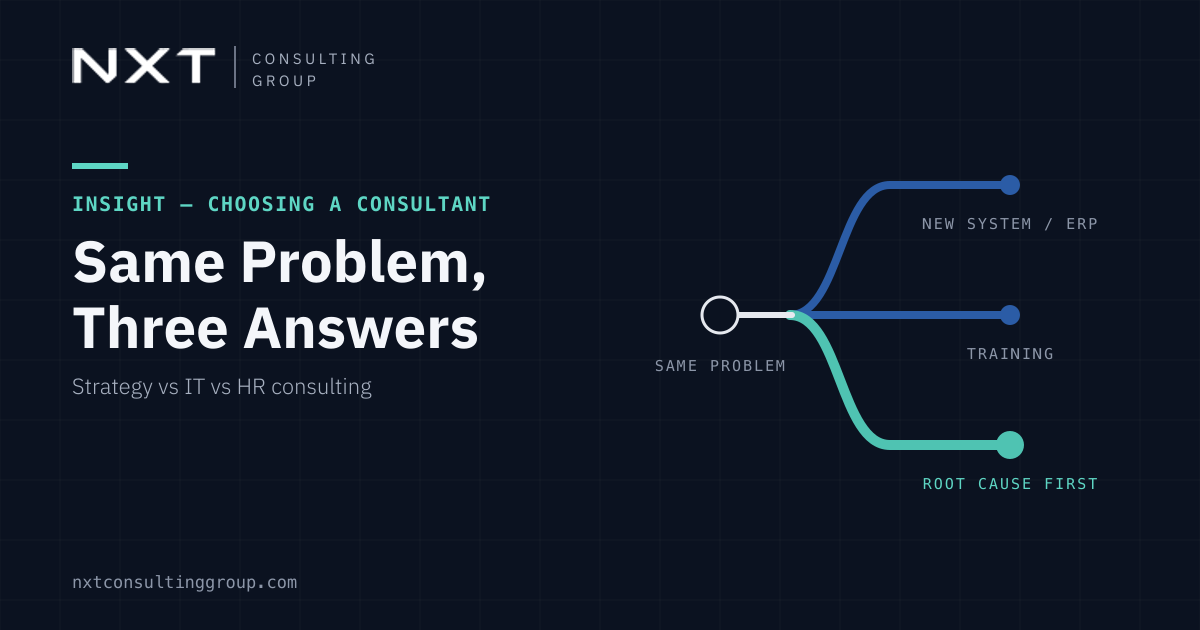
Short answer: Each type of consultant tends to propose solutions that match its own expertise. IT Consulting usually starts from systems and proposes software or ERP; HR and Training Consulting usually starts from people and proposes upskilling and reskilling programs; Strategy Consulting starts by diagnosing the organization as a whole and then chooses the most cost-effective solution, which may be a system, training, process redesign, or buying nothing at all. Beyond these three, there are also operations, finance and deals, marketing and research, risk and compliance, sustainability, and engineering consultants. The rule of thumb: if you have already diagnosed the problem clearly, hiring a specialist directly is better value; if you are not yet sure what the real problem is, or the problem cuts across several functions, start with a strategy consultant.
Executives facing problems like "the team is slow" or "costs are high but work isn't moving" often start by contacting a consulting firm they know. What is rarely said is that the answer you get depends on who you ask. Not because anyone is dishonest, but because each type of consultant is built to deliver something different. This article explains this phenomenon using well-established consulting concepts, compares the three types of consultants executives hesitate over most, and maps all 9 types of consultants so you can choose correctly the first time.
Why the answer depends on who you ask: 3 concepts that explain it
1. The Law of the Instrument
The philosopher Abraham Kaplan named this idea in 1964, and the psychologist Abraham Maslow put it memorably in 1966: if the only tool you have is a hammer, it is tempting to treat everything as if it were a nail. The idea describes the consulting industry precisely: the expertise, teams and products a firm has shape the lens through which it sees a problem. A firm with a systems implementation team sees problems as systems problems first; a firm with training programs sees problems as skills problems first; and strategy consultants have a hammer of their own: they tend to see problems as calling for more analysis or restructuring. All of this is a result of structure, not intent.
2. Buying expertise or buying diagnosis
MIT professor Edgar Schein divided consultant–client relationships into 3 models. In the purchase-of-expertise model, the client diagnoses the problem and buys a solution, which works when the diagnosis is correct. In the doctor–patient model, the consultant diagnoses and prescribes treatment, which is risky if the doctor has only one kind of medicine to offer. And in process consultation, the consultant helps the organization see the problem for itself and own the solution. Hiring IT or HR Consulting directly is usually the first model, which is appropriate once you are confident in your own diagnosis.
3. Brains, Grey Hair and Procedure work
David Maister, an expert on managing professional service firms, classified consulting work by how new the problem is. Brains work is a new, complex problem that requires original thinking. Grey Hair work is a problem others have faced before and that calls for experience. Procedure work is a problem whose solution is already known and that needs efficient execution. Most system implementations and standard training programs are Procedure work, which is excellent value when the problem is clear. But if the problem is not yet clear, what you need first is Brains or Grey Hair work that helps define the problem correctly.
Comparing the 3 types executives hesitate over: Strategy, IT and HR
| IT Consulting | HR / Training Consulting | Strategy Consulting | |
|---|---|---|---|
| Starts from | Systems and technology | People and skills | The organization as a whole and business goals |
| First question asked | Which system needs to change? | What skills is the team missing? | Where is the real problem, and where is fixing it most cost-effective? |
| Problem: the team is slow and underperforming | Deploy new software or implement ERP | Run upskilling and reskilling training | Diagnose the root cause first, then choose the most cost-effective option, which sometimes means buying nothing |
| Relationship model (Schein) | Usually purchase of expertise | Usually purchase of expertise | Doctor–patient or process consultation |
| Type of work (Maister) | Mostly Procedure | Mostly Procedure or Grey Hair | Mostly Brains or Grey Hair |
| Typical deliverables | Systems, licenses and implementation | Training programs, workshops and assessment tools | Decision-ready recommendations, an actionable plan, and implementation support |
| Strengths | Deep capability to implement and maintain systems | Designs people development that targets specific skills | Looks across functions and links problems to business goals |
| Watch out for | A new system does not fix processes or structures that were wrong from the start | Training does not help if people are held back by systems, KPIs or processes | Implementation must follow; if it ends with a report, nothing changes |
| Best when | You know for certain the system must change | You know for certain the problem is skills | You are not sure what the real problem is, or it cuts across several functions |
Example: a slow team, three consultants, three answers
Suppose your operations team regularly delivers late. IT Consulting will see old systems and scattered data, and propose a new system or ERP. HR or Training Consulting will see a team without enough skills, and propose a skills development program. Either answer may be right, but both may be wrong if the real root cause lies elsewhere.
Common causes of low productivity that are not systems or skills
- —Redundant approval steps. Work waits for signatures longer than it takes to do.
- —Unclear accountability. Work falls between departments because nobody owns it.
- —Conflicting KPIs. Each department follows its own KPIs, which pull against each other.
- —Work tied to individuals. There is no SOP, so when a key person is on leave, work stops.
- —Duplicate data entry. The same figures are entered several times in several files.
- —Genuinely insufficient skills. In this case, training is the right answer.
Different causes need different solutions. If you buy an ERP before fixing the approval steps, you get the same slow process, just in a more expensive system. Diagnosis must come before prescription, the same principle as Schein's doctor–patient model.
A map of 9 types of consultants: what question each one answers
The International Labour Organization (ILO) defines management consulting as an independent professional advisory service that helps managers and organizations achieve their goals by solving management problems, discovering new opportunities, enhancing learning and implementing changes. In practice, the consulting market splits into several types according to the questions each is best at answering:
| Type | Main question answered | Typical deliverables | Best when |
|---|---|---|---|
| Strategy and management consulting | Where should we go, and what should we fix first? | Direction, decision-oriented recommendations, roadmaps | The problem is not yet clear, or cuts across several functions |
| Operations consulting | How can work be faster, cheaper and more accurate? | New processes, SOPs and KPIs | You already know the problem lies in processes |
| IT and digital consulting | Which system fits, and how should it be implemented? | Systems, licenses, implementation and integration | You already know you need to change or add a system |
| HR and training consulting | What skills, roles and incentives do people need? | Training programs, appraisal systems and compensation structures | The problem lies in skills, roles or incentives |
| Financial advisory and deals | What is it worth, and how should we buy, sell or raise capital? | Valuation, due diligence and financial models | There is a clear transaction or financial decision |
| Marketing, brand and market research consulting | What do customers think, and how should we communicate? | Research findings, brand strategy and marketing plans | You need clearer customer insight or communication |
| Risk, compliance, tax and legal advisory | Are we compliant, and are risks under control? | Risk assessments, internal control systems and professional opinions | There are laws or standards you must comply with |
| Sustainability and impact consulting (ESG) | What impact do we create, and how should we report it? | Impact measurement, SROI and sustainability reports | You must report or prove social and environmental impact |
| Engineering and technical consulting | Is it technically feasible, and how should it be designed? | Design work and technical feasibility studies | The problem is a specialized technical one |
The firm's business model also shapes its advice
Besides the type of work, the adviser's business model also determines which solutions tend to be proposed.
- —Large global strategy consulting firms focus on top-management problems, with large teams, high standards and correspondingly high fees.
- —Large accounting and advisory firms (such as the Big Four) offer many services under one roof, from accounting, tax and risk to technology. Many countries have independence rules that restrict certain consulting services for clients whose accounts the firm audits.
- —Boutique firms go deep in one area or one industry, with small teams that work closely with the client.
- —System or training vendors that bundle consulting charge low or no consulting fees, but their advice usually leads to their own products, per the Law of the Instrument.
- —Independent consultants are flexible and affordable, but quality depends on a single person.
Examples of firms in each group in Thailand, with their strengths, budgets and the problems they suit, are in our comparison of business consulting firms in Thailand.
What a good consultant should deliver
Arthur Turner wrote in the Harvard Business Review in 1982 that consulting has 8 hierarchical purposes: providing information, solving the problem as defined by the client, making a diagnosis that may lead to redefining the problem, making recommendations based on the diagnosis, assisting with implementation, building consensus and commitment, facilitating client learning, and permanently improving organizational effectiveness. The step most often skipped is step 3, diagnosis. Consultants with ready-made solutions tend to start at solving the problem as defined by the client, or skip straight to implementation, which works only when the problem has already been defined correctly.
When to hire which type of consultant
Hire IT Consulting directly when
- —You already know you need to change or add a system, and you know what the system must do
- —Your work processes are already clear and you just need tools to support them
- —You need someone to implement, integrate and maintain systems over the long term
Hire HR or Training Consulting directly when
- —You already know the problem is people's skills, not systems or structure
- —You need training programs, competency assessments or leadership development programs
- —Your organizational structure and roles are already clear
Start with Strategy Consulting when
- —You are not sure what the real problem is and can only see the symptoms
- —The problem cuts across several functions and cannot be solved by one department alone
- —You are about to make a major investment and want to be sure it goes to the right place
- —You need help prioritizing what to fix first and how much spending is worthwhile
5 questions to check whether a consultant's advice is impartial
Whatever type of consultant you are talking to, the answers to these questions tell you whether they are solving your problem or selling what they already have.
- —Do they ask about your business goals before proposing a solution? Consultants who propose a solution in the very first meeting have usually not yet diagnosed the problem.
- —Do they offer more than one option? With the pros, cons and costs of each.
- —If the best option is not what they sell, do they say so? Ask them directly in which cases they would not recommend their own services.
- —Is the proposal tied to their own licenses or training programs? If it is, get a second opinion before deciding.
- —How do they measure success? By business results, or just by finishing the installation and completing the training?
Where NXT fits in this picture
NXT Consulting Group is a management consulting firm specializing in strategy and evaluation that follows through to implementation, covering corporate strategy, operations, market research, data analytics, AI adoption planning, organizational restructuring and KPIs, and SROI impact measurement. Every engagement starts with diagnosis before proposing a solution. For work outside our expertise, such as ERP implementation, auditing or legal opinions, we tell you plainly and help write the brief for specialists, so you can hire with a clear brief and compare proposals. We work closely with your team, as one team, from day one to delivery.
References
- —Kaplan, A. (1964). The Conduct of Inquiry: Methodology for Behavioral Science. Chandler.
- —Kubr, M. (Ed.). (2002). Management Consulting: A Guide to the Profession (4th ed.). International Labour Office.
- —Maister, D. H. (1993). Managing the Professional Service Firm. Free Press.
- —Maslow, A. H. (1966). The Psychology of Science: A Reconnaissance. Harper & Row.
- —Schein, E. H. (1999). Process Consultation Revisited: Building the Helping Relationship. Addison-Wesley.
- —Turner, A. N. (1982). Consulting Is More Than Giving Advice. Harvard Business Review, 60(5), 120–129.
Frequently asked questions
- How many types of consultants are there?
- Grouped by the questions they are best at answering, there are about 9 types: strategy and management, operations and process, technology and digital, HR and people development, finance and deals, marketing and market research, risk and compliance, sustainability and impact, and specialized engineering. Many firms offer several types at once.
- How is a strategy consulting firm different from IT Consulting?
- IT Consulting starts from systems and technology and usually proposes software, ERP and implementation, which is Procedure work that is good value when the problem is clear. A strategy consulting firm starts by diagnosing the organization as a whole and its business goals, then chooses the most cost-effective solution, which may or may not be a new system.
- If the problem is low productivity, which type of consultant should I hire?
- If you do not yet know the root cause, start with a strategy consultant, because low productivity can have many causes, such as redundant approval steps, unclear accountability, conflicting KPIs, work tied to individuals, or insufficient skills, and each cause needs a different solution. If you already know the root cause is systems or skills, hiring IT or HR directly is better value.
- How are the Big Four different from strategy consulting firms?
- The Big Four offer many services under one roof, from auditing, tax and risk to technology and strategy, which suits you when you need breadth. Strategy consulting firms focus on diagnosis and top-management decisions. Many countries have independence rules that restrict certain consulting services for clients whose accounts the firm audits.
- After hiring a strategy consultant, do I still need to hire IT or HR consultants?
- You may, if the most cost-effective solution is a new system or training. The advantage is that you hire with a clear brief, know what you need, and can compare proposals, which reduces the risk of investing in the wrong place.
- Are strategy consultants more expensive than other types of consultants?
- Fees depend on the scope of work, but the cost that is usually larger is investing in the wrong direction, such as a system nobody uses or a training program that does not change performance. For focused problems, NXT offers a fixed-price Advisory Sprint lasting 4 to 8 weeks.
- How can I tell whether a consultant's advice is impartial?
- Check whether they ask about your business goals before proposing a solution, whether they offer more than one option, whether they tell you if the best option is not what they sell, whether the proposal is tied to their own licenses or training programs, and whether they measure success by business results.
This article summarizes the typical scope of work of each type of consultant. Individual firms may work more broadly or narrowly than this, and many do excellent work in their own field. The concepts cited are paraphrased from the works in the reference list, not direct translations. NXT Consulting Group is a management consulting firm specializing in strategy and evaluation and prepared this article, which is translated from the Thai original.
Share this article