Why strategies stall, and the system that carries them to year-end
Strategy execution is the management system that turns a strategic plan into weekly and monthly action: a few priorities broken into initiatives with one owner each, two or three KPIs that connect to the strategy, budgets and people that follow the choices, and a fixed review rhythm where off-track items get decisions.
- 01What strategy execution is, and what it is not
- 02Why strategies stall around month four
- 03Choose few priorities, then write each initiative clearly
- 04Cascade KPIs into one chain, with leading and lagging indicators
- 05Budgets, people and time must follow the strategy
- 06The operating rhythm: weekly, monthly, quarterly and annual
- 07A monthly business review that produces decisions
- 08Adjust the plan without losing focus
- 09Getting started in 90 days
- Strategy execution is a management system with four parts: translate, resource, review on rhythm, and adapt
- Three to five pillars, one owner per initiative, and two or three leading and lagging KPIs
- A monthly business review on a fixed day, with an agenda built from what is off track and every item closed by a decision
What strategy execution is, and what it is not
Execution is leadership work, and a system with four parts rather than a step after the plan is approved.
Tap a part to see what it involves
Read more
Strategy execution is the system that links what leadership decided in the plan to what people do each week. It is often treated as an operations matter, something to hand down once the strategy is approved. In practice it is leadership work, because the decisions that keep a strategy moving (what to stop, where money and people go, which delay to accept) can only be made at the top. A system that works has four parts. Translate: choose a few strategic pillars and break each into initiatives with one owner, a measurable outcome and a deadline. Resource: move budget, headcount and the time of the strongest people to those initiatives, instead of spreading them evenly across departments. Review on rhythm: weekly at team level, monthly at leadership level and quarterly at strategy level, on dates booked a year ahead. Adapt: when the numbers or the market show that an assumption was wrong, change the plan deliberately and on the record. The gap between plan and results rarely comes from a weak strategy. It usually comes from one of these four parts missing, most often the third, because it is the only one that has to be repeated every month with no finish line.
Why strategies stall around month four
What shows up in meetings is the symptom. The cause sits in the structure underneath.
Switch views, or tap one card at a time
Read more
Most strategies do not fail in the planning workshop; they stall a few months later. The plan was approved, everyone returned to daily operations, and the strategy quietly became a document instead of a schedule. Month four is when this shows: the energy of the launch has faded, the first quarter's results are in, the annual budget is already locked, and urgent operational problems have filled the leadership agenda. The root causes are structural rather than personal. There are too many priorities, so daily work wins every time. Initiatives have names but no single owner, so nobody has to report when they slip. The budget looks like last year's, so the new strategy runs on whatever time is left over. KPIs describe departmental activity rather than strategic outcomes. And there is no fixed review, so slippage goes unseen until the year-end review becomes an exercise in reconstructing what happened. None of this reflects a bad strategy or unwilling people. It reflects the absence of an execution system, which is good news: a system can be built.
Choose few priorities, then write each initiative clearly
Check one of your key initiatives: does its one-page charter cover these seven points?
Tap each point your initiative's charter already covers
0 of 7 covered
Read more
Execution starts with subtraction. A company can usually push three to five strategic pillars at once; each pillar breaks into two to four initiatives that must succeed for the pillar to succeed. An initiative is different from daily work: it changes a strategic result, has a start and an end, and needs resources that would otherwise go elsewhere. Alongside the list of what the company will do, leadership should agree a stop list: projects to close or pause, so the people who own the new initiatives have time to drive them. Each initiative then gets a one-page charter. It states the outcome in measurable terms, names one owner with the authority to decide, sets quarterly milestones, records the budget and people committed, names the leading and lagging KPIs, lists the dependencies on other departments, and states in advance the conditions under which the initiative would be changed or stopped. Writing the charter is where vague initiatives reveal themselves: if the leadership team cannot agree on the outcome or the owner in one page, the initiative is not ready to start.
Cascade KPIs into one chain, with leading and lagging indicators
One chain of numbers, from the strategic pillar down to what the initiative owner can move every week.
- 1Strategic pillarGrow in the corporate customer segment
- 2Lagging indicatorRevenue from corporate customers, reported monthly, with quarterly targets
- 3InitiativeBuild a corporate sales team, with one owner
- 4Leading indicatorsProposals sent per month, and the win rate
Illustrative example. Every KPI needs a definition, a data source, a data owner, a baseline and quarterly targets. Department metrics are kept only where they feed this chain.
Read more
A familiar pattern in Thai mid-sized companies is the firm that measures everything and moves nothing. Every department has a dashboard, yet the strategy has not advanced in a year, because the KPIs describe departmental activity rather than strategic outcomes: everyone hits their numbers while the company misses its plan. The repair is a cascade. Each pillar has one or two lagging indicators, results such as revenue from a segment, margin or market share, which arrive late and cannot be managed directly. Each initiative adds one or two leading indicators that move earlier and that the owner can influence: proposals sent, trial conversions, delivery lead time. Every KPI needs a written definition: the formula, the data source, the person responsible for the data, the reporting date, the baseline and a quarterly target rather than a single year-end figure. Department metrics are then pruned to those that feed the chain; the rest move to operational dashboards. Fewer numbers, connected to the strategy and reviewed on rhythm, are uncomfortable because they make non-performance visible. That is also why they work.
Budgets, people and time must follow the strategy
Money and people are the evidence of what a company has really chosen.
- The budget comes first, and the strategy is written to fit it
- Strategic money sits inside the run budget and is used to cover overruns
- Approved as one sum at the start of the year, whatever the progress
- Initiative owners keep full-time jobs and push the strategy in spare time
- The strategy is approved first; the budget round funds the chosen initiatives first
- The change budget is separate from the run budget and protected
- Released in tranches tied to milestones, and stoppable before it is spent
- Owners get time back through the stop list, with dedicated people where needed
Read more
A budget is the strategy expressed in numbers, and when it is built by adding a percentage to last year, it quietly cancels whatever the strategy changed. Four practices keep money and people aligned with the plan. Approve the strategy before the budget, not after it, so the budget round funds the chosen initiatives first. Separate the run budget, which keeps the current business going, from the change budget, which funds strategic initiatives, and protect the second from being used to cover overruns in the first. Release larger initiative budgets in tranches tied to milestones, so money follows progress and a failing initiative can be stopped before it is fully spent. And plan capacity as carefully as money: an owner with a full-time operational role cannot drive a strategic initiative on top of it, so part of their time, and often a few dedicated people, must be freed through the stop list. Linking part of performance reviews to initiative milestones helps, provided the targets are ones the owner can influence; the performance management guide covers how to do this without encouraging people to game the numbers.
The operating rhythm: weekly, monthly, quarterly and annual
Four meetings, each with one job, with dates booked for the whole year.
- Annual · directionRefresh the direction, then set next year's pillars and budget, in that order
- Quarterly · half a dayDo the assumptions still hold? Reprioritize initiatives, or move money and people?
- Monthly · 90 minutesThe leadership business review: an agenda built from exceptions, every item closed by a decision
- Weekly · 30 minutesEach initiative team: done, blocked, next, and what must go up to leadership
Read more
Execution runs on a calendar, and each meeting in it has one job. Weekly, each initiative team meets for about thirty minutes: what was done, what is blocked, what is next, and what needs to go up to leadership. Monthly, the leadership team holds a business review of around ninety minutes on a fixed date, built from the exceptions in the scorecard, where off-track items get decisions. Quarterly, leadership spends half a day on the strategy itself: are the key assumptions still holding, should initiatives be reprioritized, and should money or people move between them. Annually, the direction is refreshed and the next year's pillars and budget are set, ideally in that order. Two rules keep this rhythm alive. Each level decides only what it can decide, and escalates with a clear request instead of a status report. And the dates are booked for the whole year in advance, with attendance treated as non-negotiable: a review that can be postponed will be postponed the first time the business is busy, which is precisely when it matters most.
A monthly business review that produces decisions
Switch views to see how a full scorecard becomes a ninety-minute agenda.
Switch views to see which items reach the agenda
- On planGrow corporate accounts18 proposals sent against a target of 20 · Owner Sales director
- Off trackCut production costUnit cost down 2% against a target of 4% · Owner Plant directorDecision requested Invest in new machinery this quarter, or defer to next year
- At riskLaunch the new productMarket test three weeks late · Owner Marketing directorDecision requested Confirm the launch date and lend two people from sales
- On planCRM roll-out85% active users against a target of 80% · Owner IT director
- Off trackSpeed up collections58 days to collect against a target of 50 · Owner Finance directorDecision requested Revise credit terms with the five largest customers
- At riskDevelop supervisors40% trained against a target of 60% · Owner HR directorDecision requested Production to release supervisors for training
- On planOnline channelOnline sales on monthly target · Owner Marketing director
- 10 minOpen actions from last month
- 40 minRed items: decision, owner and date
- 20 minAmber items: confirm the recovery plan
- 15 minRisks and assumptions to watch
- 5 minRead back the decisions
Illustrative example. Every item uses the same status definitions: green is on plan, amber is at risk with a recovery plan, red is off track and needs a decision.
Read more
The monthly business review (MBR) is where execution either happens or does not. Its quality is decided before the meeting. Data is cut off on a fixed date; each KPI is given a status by a shared definition: green is on plan, amber is at risk but the owner has a recovery plan, red is off track and needs a decision from leadership. Owners of amber and red items write a short note: what happened, why, what they propose, and what they need. The pack goes out two working days ahead and is read before the meeting. In the room, green items are not presented. The agenda follows the exceptions: ten minutes on last month's open actions, most of the time on red items and then amber ones, each closing with a decision, an owner and a date, fifteen minutes on risks and assumptions to watch, and five minutes to read back the decisions. Minutes and the action log go out within one working day, and every open action returns to the next review until it is closed. When the agenda builds itself from what is off track, leadership attention flows automatically to where the strategy is slipping, which is the entire purpose of the meeting.
Adjust the plan without losing focus
Agree in advance which change is decided at which level, so the plan can flex without losing direction.
Tap a level to see who decides and when
The higher up the pyramid, the rarer the change, the stronger the evidence from the assumption register, and the clearer the record of why.
When a key assumption is proven wrong, or the market shifts enough that a pillar no longer makes sense
- Who decides
- The chief executive and the board
- Where it is decided
- Quarterly review, or a dedicated meeting
Drop the overseas expansion after the main partner withdraws, and move the budget to the domestic pillar
When it has been off track for two months and the recovery plan is not enough, or its scope, budget or timeline must move
- Who decides
- The leadership team
- Where it is decided
- Monthly business review
Delay a product launch by a quarter and move two people from a paused project to help
When tasks are blocked but the initiative's outcome and deadline still hold
- Who decides
- The initiative owner
- Where it is decided
- Weekly team meeting
Re-order the market-test tasks and ask sales for customer data earlier
Read more
A strategy that never changes is as risky as one that changes every month. The way through is to agree in advance which changes happen at which level. Actions change often and belong to the initiative owner in the weekly meeting, as long as the initiative's outcome and deadline still hold. Initiatives change less often: when one has been off track for two months and the owner's recovery plan is not enough, or when its scope, budget or timeline must move, the decision is made by the leadership team in the monthly review. The strategy itself changes rarely, and only when a key assumption is proven wrong or the market shifts enough that a pillar no longer makes sense; that decision belongs to the chief executive and the board, at the quarterly review or a dedicated meeting. To make these calls on evidence rather than mood, keep an assumption register: the three to five beliefs the strategy depends on, the signal that would show each is wrong, and who watches it. Every change is recorded with its reason, so the plan evolves deliberately instead of being dropped quietly.
Getting started in 90 days
Four stages from an approved plan to a rhythm that runs on its own.
Confirm three to five pillars, select the must-win initiatives, name one owner for each and agree the stop list
Output A list of initiatives with owners, and a stop list leadership has agreed
Write one-page charters, define leading and lagging KPIs with baselines, and book the review dates for the year
Output A first scorecard and a booked review calendar
Run the first monthly business review in the new format, even with incomplete data; holding it on time matters more than perfect numbers
Output An action log with an owner and a date on every line
The second and third reviews sharpen the status definitions, the cascade reaches department plans, and unused KPIs are removed
Output A rhythm that runs without anyone pushing it
Read more
An execution system does not need a long design phase; it needs a first cycle that runs. In the first two weeks, leadership confirms the three to five pillars, selects the must-win initiatives, names one owner for each and agrees the stop list. By day thirty, each initiative has a one-page charter, the leading and lagging KPIs are defined with baselines, and the review dates for the year are booked. Between days thirty and sixty, the first monthly business review runs in the new format, even if some data is still incomplete; holding the meeting on time matters more than a perfect scorecard. Between days sixty and ninety, the second and third reviews refine the status definitions, the cascade extends to department plans, and KPIs nobody used are removed. Software makes this rhythm cheaper, with one place for actuals, automatic agendas and visible status, but the commitment to a fixed review is a leadership decision no tool can make. An outside team is most useful where internal teams find it hard to be neutral: facilitating the choice of priorities and the stop list, designing the scorecard, and running the first reviews until the rhythm holds without being pushed.
Insights on this topic
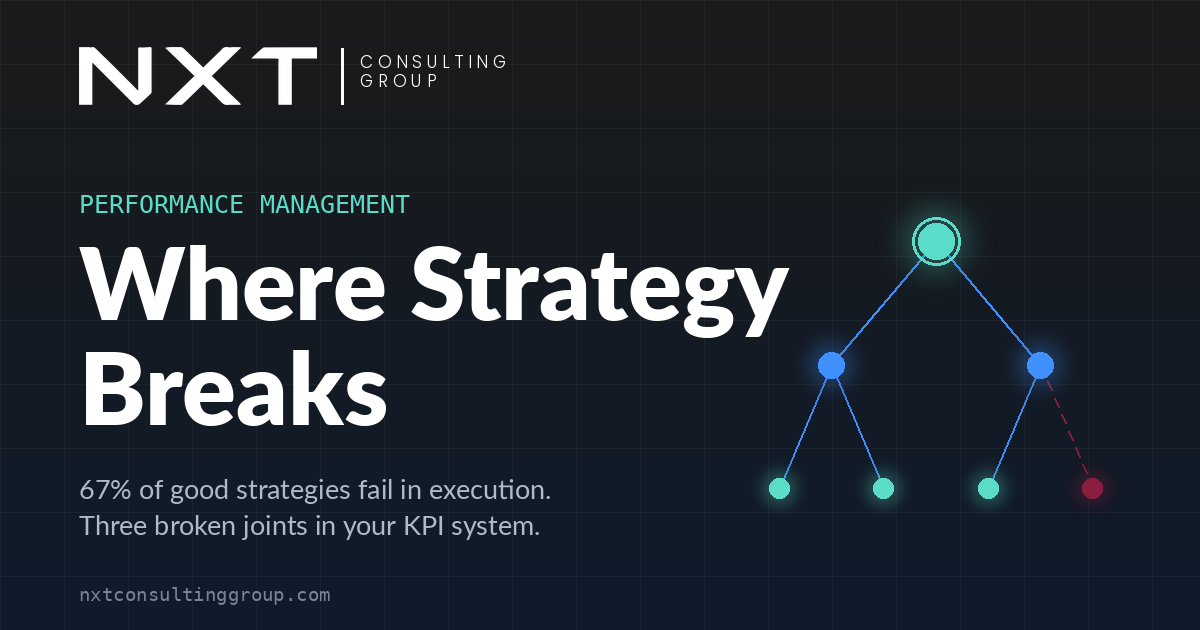
KPIs Everywhere, Strategy Going Nowhere: 3 Places Performance Measurement Systems Usually Break
Read
Hiring a Business Consultant: Key Reasons, Types of Consultants, and How to Choose One That Is Worth It
Read
Business Consulting Firms in Thailand 2026: Comparing McKinsey, BCG, Bain, the Big Four, Bluebik, LiB, Korn Ferry and Options for SMEs
ReadOur people in this area
 Piyamin TrithipcharoenchaiManaging Partner & Co-founderCo-founder of NXT, working across strategy, research and organization developmentView profile
 Garuna YooyartwongPrincipalStrategy, new-venture building and operations excellenceView profile
 Kanokphan SittiwanchaiEngagement ManagerMaster's in Economics, Manchester · B.Econ. with honours, Chulalongkorn · ISO/IEC 27001 Internal AuditorView profile
Book a 30-minute call
Tell us your organization's problem. We'll help you see where to start. No obligation.
Contact usStrategic planning consulting for government agenciesBusiness consulting for companies and family businesses