How to Prepare a Strategic Plan and a Government Action Plan in Thailand: Steps, Example and KPIs
Short answer: A strategic plan states what results an organization will achieve over three to five years and what it will choose to do to get there. A government action plan (phaen patibat ratchakan) is the plan Thai government agencies must prepare under the Royal Decree on Criteria and Procedures for Good Governance, as a 5-year plan and an annual plan aligned with the National Strategy, its master plans, the National Economic and Social Development Plan and Cabinet policy. In Thailand's three-level planning system, the government action plan is a Level 3 plan that turns national targets into an agency's projects, budget and indicators. Preparing one takes seven steps: analyse the situation, set the vision and strategic issues, define goals and KPIs, design strategies and projects, link them to the budget, plan monitoring and evaluation, and communicate and cascade the plan.
This guide is for planning divisions and executives of government agencies, public organizations and state enterprises. The 13th National Economic and Social Development Plan runs until 30 September 2027, and many agencies' 5-year action plans for 2023–2027 (B.E. 2566–2570) end with it. The next cycle covers 2028–2032 (B.E. 2571–2575). The facts here were checked against NESDC's latest documents, including the Cabinet resolution of 26 May 2026.
Strategic plan, government action plan and action plan: what is the difference
The three terms are often mixed up. The difference lies in what each plan does, not in the name on the cover.
- —Strategic plan: what results the organization will create, for whom, and what it will and will not do, usually over three to five years.
- —Government action plan (phaen patibat ratchakan): the formal name of the Level 3 plan that agencies at department level and above must prepare under the Royal Decree, as a 5-year plan and an annual plan with goals, results, indicators, projects and budget. In practice the 5-year action plan is also the agency's strategic plan.
- —Action plan: who does what, when and with what budget, in any sector. In Thai government usage, an "action plan on ..." (phaen patibat kan dan ...) is an issue-based plan shared by several department-level agencies, prepared only where necessary.
Names also differ by type of body. NESDC's manual says public organizations and independent bodies use "action plan of (agency name)", state enterprises use "enterprise plan" unless a law sets another name, and "National Strategy" is reserved for Level 1. Calling the document a strategic plan is fine if it contains everything a Level 3 plan requires.
Thailand's three plan levels
On 4 December 2017 the Cabinet resolved to classify the country's plans into three levels. On 26 May 2026 the Cabinet approved consolidating its resolutions on how plans are submitted for Cabinet consideration into a single resolution. It revoked four earlier resolutions, including the one of 4 December 2017, but kept the three-level classification unchanged. Plans for the new cycle should therefore cite the resolution of 26 May 2026.
| Level | Plan | Status and period |
|---|---|---|
| Level 1 | National Strategy (2018–2037), six strategies | Published in the Royal Gazette on 13 October 2018 under the National Strategy Preparation Act B.E. 2560 (2017) |
| Level 2 | Master Plans under the National Strategy, 23 issues | Revised edition (2023–2037) approved by the Cabinet on 17 January 2023; targets set for four five-year periods |
| Level 2 | National Economic and Social Development Plan | 13th Plan (2023–2027) with 13 milestones, in force until 30 September 2027; the 14th Plan (2028–2032) is being drafted |
| Level 2 | National Reform Plan | Achieved its results on 31 December 2022; there is no new reform plan for 2023–2027, and the issues needing one are under study |
| Level 2 | National Security Policy and Plan | 2023–2027 edition, under the National Security Council Act B.E. 2559 (2016) |
| Level 3 | 5-year and annual government action plans, issue-based action plans, area-based plans | Prepared by state agencies to carry Level 1 and Level 2 targets into practice, or as required by law or international obligations |
Area-based Level 3 plans (regional, provincial cluster and provincial plans) fall under the Royal Decree on Integrated Area-Based Administration B.E. 2565 (2022). Local development plans of local administrative organizations follow a separate Ministry of Interior regulation; the principles on goals and indicators here apply, but their format and deadlines follow that regulation.
Level 3 also covers plans prepared under international obligations. Since the National Reform Plan ended, part of Thailand's regulatory reform work has come from the OECD accession process, where Thailand is a candidate in the technical reviews. Agencies whose mandates are under an OECD committee review should carry that work in their action plan as projects with owners and indicators. See NXT's OECD Accession Playbook, independent research by NXT Consulting Group, not affiliated with or endorsed by the OECD or the Royal Thai Government.
How targets cascade: the XYZ principle
NESDC uses a causal-relationship principle it calls XYZ, so that every agency's projects contribute to the same set of national targets.
- —Z: the targets of the National Strategy's six strategies
- —Y2: the 37 issue-level targets of the master plans
- —Y1: the 140 sub-plan targets of the master plans
- —X: the agency's projects and activities
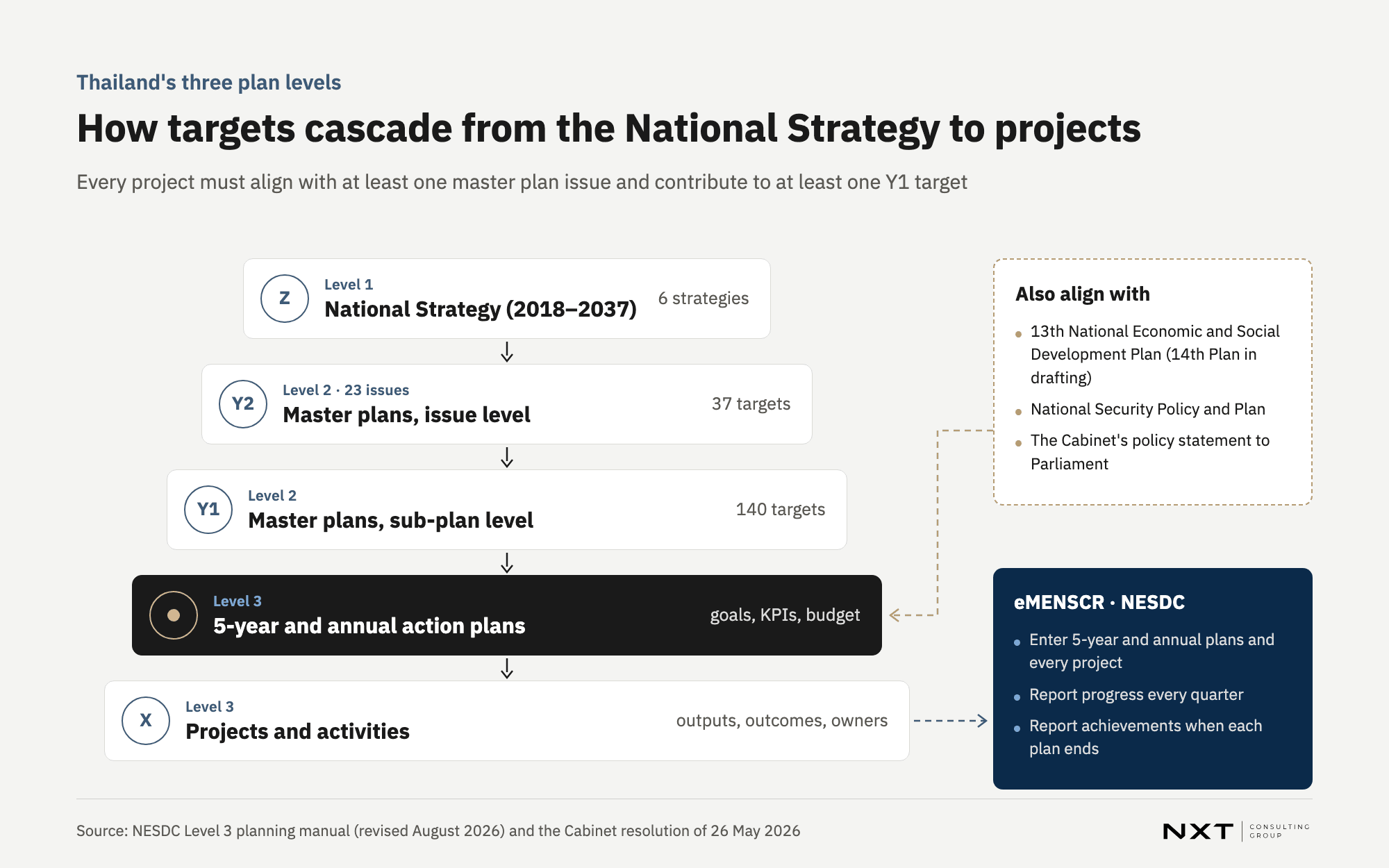
The rule to remember: every project must align with at least one master plan issue and contribute to at least one sub-plan target (Y1). NESDC's manual recommends using Final Value Chain Thailand (FVCT) data to see which factors are missing in the chosen Y1 target's value chain, then designing projects to close that gap. Choose the target first, then design projects, not the other way round.
Where eMENSCR fits
eMENSCR is NESDC's national monitoring and evaluation system for the National Strategy and the Level 2 plans. Agencies at department level and above must:
- —enter the 5-year action plan by 30 October of the plan's first fiscal year, and each annual plan within 30 days of its announcement;
- —enter every project for the fiscal year, funded or not, and report progress within 30 days of each quarter's end;
- —enter an achievement report within the first quarter of the fiscal year after each plan ends.
The 5-year and annual action plans need no Cabinet approval, so NESDC does not screen them; issue-based action plans are screened before they go to the Cabinet. Achievement reports score results on a base of 100 against the targets, so the targets written into the plan decide whether the end-of-plan report can be read at all.
The law behind government action plans
The Royal Decree on Criteria and Procedures for Good Governance B.E. 2546 (2003), amended in 2019, is the legal basis of the government action plan:
- —Section 9: agencies must plan before carrying out a mission, with steps, timing, budget, targets, results and indicators, and must monitor and evaluate against standards set by the Public Sector Development Commission (OPDC).
- —Section 16: the action plan is a five-year plan aligned with the National Strategy, the master plans, the National Reform Plan, the National Economic and Social Development Plan, the Cabinet's policy statement and other relevant plans. The first round covered fiscal years 2020–2022, so the current round is 2023–2027. Each year the minister approves an annual plan, the Bureau of the Budget allocates funds according to it, and a mission left out of the plan receives no allocation.
- —Section 18: moving budget away from a mission in the plan so that it misses its target requires Cabinet approval to amend the plan first.
Corporate strategic plans and government action plans: similarities and differences
The thinking tools are almost the same: situation analysis, indicators and regular review. The decision context is very different.
| Aspect | Corporate strategic plan | Government action plan |
|---|---|---|
| Who requires it | The board and shareholders; listed companies in SET's JUMP+ programme must publish a three-year value creation plan | Section 16 of the Royal Decree requires every government agency to prepare one |
| Ultimate goal | Enterprise value, profit and competitiveness | Results for citizens under the agency's mandate, and the targets of Level 1 and Level 2 plans |
| Freedom to choose | Can enter or leave markets and close businesses | The mandate is set by law; choices lie in methods, priorities and target groups |
| Budget | Allocated internally by expected return | Goes through the annual budget process and is tied to the annual plan |
| Monitoring | Monthly and quarterly reviews by management and the board | Quarterly reports in eMENSCR, achievement reports, and evaluation against OPDC standards |
| Changing course mid-plan | Management and the board decide | Budget transfers that change a mission in the plan need Cabinet approval |
Government can learn the discipline of choice from business: a good plan says what the organization will not do, and is reviewed often enough to correct course. Business can learn from government to write the logic from project to outcome so others can check it. For the corporate side, read our guide to strategic management, the strategy execution guide, from priorities to the monthly business review, and what JUMP+ is and how to build a plan investors believe. Companies looking for a team to help with corporate planning can see our strategy consulting and strategic planning page.
Seven steps to prepare a strategic plan and government action plan
NESDC's manual uses a five-stage policy cycle: agenda setting, policy formulation, policy decision, implementation, and review and evaluation. The steps below sit within the same cycle, split into seven so that a team can divide the work.
Step 1: Analyse the situation
Always start by reviewing the previous plan. Which indicators were met, which were missed, and why? Achievement reports in eMENSCR and any existing evaluations are the first data set. Then analyse three layers:
- —External (PESTEL): political, economic, social, technological, environmental and legal factors that will affect the mandate over the next five years, including the direction of the draft 14th National Economic and Social Development Plan.
- —Internal: resources, people, data systems, legal powers and budget constraints.
- —Stakeholders: interview executives, run workshops with divisions, and listen to service users, partner agencies and the private sector concerned.
Summarise the findings in a SWOT, then a TOWS matrix that pairs the factors into four types of option: strengths to seize opportunities (SO), fixing weaknesses to use opportunities (WO), strengths against threats (ST), and reducing weaknesses while avoiding threats (WT). A SWOT without the TOWS step usually stays a list of observations. NESDC's manual asks for empirical evidence, not assertion.
Step 2: Vision, mission and strategic issues
The vision should describe what service users will experience when the plan ends, not a slogan. The mission is the legal mandate the agency must fulfil. Strategic issues are the areas where the agency chooses to concentrate resources this cycle. Keep them to three to five. If every division needs its own issue, the plan becomes a table of contents of the organization instead of a set of choices.
Map each issue to the Y1 targets and National Economic and Social Development Plan milestones it supports. Build this alignment table now, not just before submission.
Step 3: Goals and KPIs
Each goal should have one or two outcome indicators and a leading indicator that shows early whether the agency is on track. Good indicators are SMART: specific, measurable, achievable, relevant and time-bound.
- —Lagging indicators: results that have already happened, such as target-group income or service times. Slow, but they show whether the plan succeeded.
- —Leading indicators: what happens before the result, such as the share of participants applying what they learned within 90 days. Fast, and they leave time to correct course.
Every indicator needs a baseline, a data source, a frequency and an owner. If there is no baseline yet, collecting it is a first-year task.
Step 4: Strategies, programmes and projects
A strategy is the chosen way to reach a goal; projects make it happen. Every project needs objectives, outputs, outcomes, a target group, activities, indicators, an owner and a timeframe. NESDC's basic quality check asks that a project fit the chosen Y1 target's value chain, rest on evidence, have feasible activities and measurable indicators. Projects that set up funds or committees, renovate buildings or buy equipment must show a clear contribution to Y1.
To show the plan on one page, use a strategy map from Kaplan and Norton's Balanced Scorecard: how investment in people and systems drives processes, results for service users and mission results. Public bodies usually put mission results at the top instead of the financial perspective.
Step 5: Link the plan to the budget
A plan not tied to the budget becomes a document separate from the real work. Section 16 ties budget allocation to the annual plan, and the revised master plan document states that annual budgets must be consistent with the master plans. In practice:
- —estimate each strategy's annual budget in the 5-year draft, without line-item detail but with clear priorities;
- —use the same project names and codes in the annual plan, the budget request and eMENSCR;
- —rank projects in advance, so the team knows what to cut if the allocation is smaller than requested;
- —settle the plan's direction before the budget request for its first year is prepared.
Step 6: Plan monitoring and evaluation
Write the monitoring and evaluation plan together with the plan, not near its end. At minimum, specify:
- —how each indicator is measured, who collects the data and how often it is reported;
- —the internal review rhythm, for example quarterly executive reviews aligned with eMENSCR reporting;
- —mid-term and end-of-plan evaluation points, the questions each evaluation must answer, and the budget for them;
- —the criteria for adjusting or stopping a project, and who approves the change.
Step 7: Communicate and cascade the plan
The 5-year plan has to be cascaded into annual plans and down to division and individual indicators, or staff will know the plan only by its cover. Communicate it as a short story: three to five things the agency will change for citizens, and which division contributes to each. How to cascade indicators without goals reaching teams weeks late is covered in our article on KPI cascading and OKRs.
Example: an action plan for a fictional agency
This table shows how the parts of a plan connect, using a fictional department-level agency whose mandate is helping community entrepreneurs sell online.
| Element | Example | Indicator and target |
|---|---|---|
| Link to Level 2 | Master plan issue (08), new-generation entrepreneurs and SMEs; choose the sub-plan target (Y1) that matches the mandate | Use the Y1 indicator from the master plan document; do not invent a new one |
| Strategic issue | Community entrepreneurs' income from online channels | No separate indicator; measured through the goal |
| Goal | Participating community entrepreneurs keep selling online and earn more | Average online income per participant up 20% by 2032 against a 2027 baseline (lagging) |
| Leading indicator | First sale after the incubation programme | 60% of participants make a sale within 90 days |
| Strategy | Mentored incubation over several months instead of one-off training | Lower share of participants who stop selling within six months |
| Project | Community online store mentoring project, owned by the market promotion division | Output: 1,000 entrepreneurs complete incubation each year |
| Budget | Tied to outputs and activities in each annual budget request | Cost per participant who actually makes sales |
| Monitoring and evaluation | Quarterly reports in eMENSCR, a mid-term evaluation in 2030, an outcome evaluation at the end | Achievement report within the first quarter of fiscal year 2033 |
The goal-level indicator measures entrepreneurs' income, not the number of trainees; trainee numbers remain a project output.
Writing good indicators: from measuring work to measuring results
A common problem in public-sector plans is indicators that measure whether work was done, not what changed as a result. The table compares common indicators with better ones.
| Common indicator | Problem | Better indicator |
|---|---|---|
| Percentage of plan activities completed | Measures completion, says nothing about service users | Share of permit applications decided within 15 working days, against a 2027 baseline |
| Number of training participants | An output; can be raised by running more sessions | Share of trainees who apply what they learned within six months, from individual follow-up |
| Five-level milestone score | Can be passed by completing paperwork | Average service time cut from 30 days to 10 days by 2030 |
| Service user satisfaction of at least 80% | No baseline, asked right after the service, same target every year | Share of users who must contact the agency again about the same matter, alongside satisfaction measured on a random sample |
| Database system completed | Yes or no; says nothing about use | Share of applications submitted online complete at the first attempt |
Milestone indicators suit the first year of a project that builds a system, not a goal's main indicator for five years. If you measure satisfaction, size the sample so year-on-year comparisons hold; see how many survey responses are enough.
Before finalising, write a KPI dictionary entry for each indicator: definition, formula, baseline, data source, frequency, owner and the reasoning behind the target. It keeps quarterly reports and the final achievement report on the same numbers. For cascading indicators to units and separating KPIs from OKRs, see our article on KPI cascading and OKRs.
Common mistakes
- —Copying national plan text as the agency's strategy: alignment is claimed but no logic shows how projects move a Y1 target. NESDC's revised manual itself notes that Level 3 plans have not always been cascaded from the National Strategy and Level 2 plans.
- —Too many strategic issues and indicators: when everything matters equally, nothing gets enough resources.
- —No review of the previous plan: new targets are set without knowing why the old ones were missed.
- —Indicators without a baseline or data source: the end-of-plan report cannot prove anything.
- —Finishing the plan after the budget request: the first year's budget does not reflect the plan.
- —Plan periods out of step with the master plans: NESDC's manual requires 5-year plans to end in line with the master plan periods, such as 2027, 2032 and 2037.
- —Writing to submit rather than to use: no quarterly reviews, and staff cannot see where their work sits in the plan.
Timeline for preparing the 2028–2032 action plan
Fiscal year 2028 (B.E. 2571) starts on 1 October 2027. The new 5-year plan should be approved before then and must be entered in eMENSCR by 30 October 2027 under NESDC's manual. For a department-level agency, a workable timeline looks like this:
| Period | Main work | Output |
|---|---|---|
| Nov 2026 to Jan 2027 | Set up the working group, review the 2023–2027 plan, gather data and existing achievement reports | Summary of the previous plan's results and gaps |
| Jan to Mar 2027 | PESTEL and SWOT/TOWS analysis, executive interviews, stakeholder consultation, mapping of Level 1 and Level 2 targets, tracking the draft 14th Plan | Situation analysis report |
| Mar to May 2027 | Executive workshops to set the vision, strategic issues, goals and indicators | Plan outline and KPI definition cards |
| May to Jul 2027 | Design strategies and projects, estimate budgets, rank projects, plan monitoring and evaluation | Full draft plan |
| Jul to Sep 2027 | Consult on the draft, revise, seek approval under the agency's procedures, prepare the FY2028 annual action plan | Approved 5-year plan and first annual plan |
| Oct 2027 | Enter the plan in eMENSCR and communicate it across the agency | Plan ready for monitoring |
One caution: the FY2028 budget request is prepared months before the fiscal year starts, on the budget calendar the Cabinet approves each year, so the plan's direction and key projects should be clear before it begins, even if the full document comes later. If the 14th Plan is published after your draft is done, review the alignment table again. Agencies with many sub-units or consultation rounds should start earlier.
Who should be involved
- —Head of agency and senior executives: choose the strategic issues and approve the plan.
- —Strategy and planning division: owns the process, writes the plan and manages eMENSCR entry.
- —Division directors: own strategies and projects and set reachable targets.
- —Finance and budget: estimate costs and link the plan to the budget request.
- —HR and IT: assess workforce, competencies and the data systems indicators need.
- —Service users and partner agencies: show where the real problems are and share cross-agency targets.
- —External advisers, if any: design the process, analyse data and facilitate neutrally; the planning division keeps ownership.
How monitoring and evaluation connect to the plan
Monitoring asks whether the plan is being carried out and on time. Evaluation asks whether the plan and its projects produced the intended results, whether they were worth the money, and whether to continue, adjust or stop them. The Thai system has both.
- —Monitoring: quarterly reporting in eMENSCR and achievement reports for annual and 5-year plans, which NESDC compiles for the Cabinet.
- —Evaluation: Section 9 of the Royal Decree requires agencies to monitor and evaluate performance against OPDC standards, and Section 45 provides for independent evaluators to assess results, service quality, citizen satisfaction and value for money.
A well-designed plan makes evaluation much easier, because the logic from activities to outputs, outcomes and impact is already written in steps 3 and 4. Evaluators can build a logic model from it, or use the CIPP framework (context, input, process, product); see our article on project evaluation with the CIPP model and logic models. To value social outcomes against the budget spent, see social return on investment (SROI). Agencies looking for an external evaluation team can see our project, plan and performance evaluation work.
In practice: budget for evaluation from the start, collect baselines in year one, and schedule a mid-term evaluation around year three, while there is still time to adjust.
How NXT can help
NXT Consulting Group works with government planning divisions through the whole process: reviewing the previous plan, situation analysis, executive workshops, indicator design, and cascading into annual plans and monitoring tools. Engagements under the NXT name include a 5-year strategic plan with performance and economic impact evaluation for the Electronic Transactions Development Agency (ETDA), and a 5-year strategic plan with a ministry-level action plan setting out projects, owners and timelines for a government ministry. NXT is registered as a juristic-person consultant with the Ministry of Finance Consultant Database Center in the Research and Evaluation (RE) field.
The scope of our work with government agencies and how we run it is on our strategic planning consulting for Thai government agencies page, and each engagement is described on our work page.
Talk to us about your 2028–2032 plan
Official sources
- —National Strategy and Level 2 plans (NESDC portal, Thai)
- —Preparing Level 3 plans: manual, templates and related Cabinet resolutions (NESDC, Thai)
- —Level 3 planning manual, revised August 2026 (PDF, Thai)
- —Cabinet resolution of 26 May 2026 on submitting plans to the Cabinet (PDF, Thai)
- —Cabinet resolution of 4 December 2017 on the same subject (PDF, Thai)
- —eMENSCR FAQ (PDF, Thai)
- —National Strategy 2018–2037, Thai and English editions
- —Master Plans under the National Strategy (2023–2037), revised edition
- —13th National Economic and Social Development Plan (2023–2027)
Frequently asked questions
- What is a government action plan in Thailand?
- It is the plan Thai government agencies must prepare under Section 16 of the Royal Decree on Criteria and Procedures for Good Governance: a 5-year plan aligned with the National Strategy, the master plans, the National Economic and Social Development Plan and Cabinet policy, plus an annual plan approved by the minister each fiscal year. It is a Level 3 plan.
- What are Thailand's three plan levels?
- The Cabinet's classification of the country's plans, first set on 4 December 2017 and now in the resolution of 26 May 2026. Level 1 is the National Strategy. Level 2 is the master plans, the National Reform Plan, the National Economic and Social Development Plan and the National Security Policy and Plan. Level 3 is the plans state agencies prepare to put Level 1 and 2 targets into practice.
- What counts as a Level 3 plan?
- The 5-year and annual government action plans of agencies at department level and above, issue-based action plans shared by several agencies, and area-based plans such as provincial development plans, as well as plans required by law or international obligations.
- What is eMENSCR and who has to use it?
- NESDC's national monitoring and evaluation system. Agencies at department level and above enter their Level 3 plans, projects, quarterly progress and achievement reports in it. The public can follow some of the data and submit comments.
- Does a 5-year action plan need NESDC approval before it takes effect?
- No. Under NESDC's manual and the Cabinet resolution of 26 May 2026, 5-year and annual action plans do not go to the Cabinet, so NESDC does not screen them. They must still be entered in eMENSCR, with an achievement report when each plan ends. Issue-based action plans are screened by NESDC.
- What is the difference between a strategic plan and an action plan?
- A strategic plan says what results to create and what to choose over three to five years; an action plan says who does what, when and with what budget. A Thai agency's 5-year action plan contains both.
- Has the 14th National Economic and Social Development Plan been published?
- Not as of late October 2026. NESDC is drafting the 14th Plan (2028–2032) and presented its main ideas at its 2026 annual conference. The 13th Plan runs until 30 September 2027, so agencies should track the draft and recheck alignment once it is published.
- Can OKRs replace the indicators in a government action plan?
- No. Action plan indicators are reported in eMENSCR and achievement reports, so they must be clearly defined KPIs that stay stable for the whole plan. OKRs work well inside the agency to set quarterly team priorities that move those KPIs.
The planning-system facts are summarised from NESDC's Manual for Preparing Level 3 Plans and Submitting Issue-Based Action Plans to the Cabinet (revised August 2026), the Secretariat of the Cabinet letters notifying the Cabinet resolutions of 4 December 2017 and 26 May 2026, NESDC's eMENSCR FAQ, the National Strategy (2018–2037) announcement, the revised Master Plans under the National Strategy (2023–2037), the 13th National Economic and Social Development Plan, and the Royal Decree on Criteria and Procedures for Good Governance B.E. 2546 (2003) and its No. 2 amendment of 2019. Checked on 29 October 2026. Deadlines and templates can change with new government circulars, so check with NESDC and your parent ministry before relying on them. The agency and figures in the example are illustrative. The preparation timeline is guidance from practice, not an official requirement. Translated from the Thai original by NXT Consulting Group.
Share this article