What Is JUMP+? A Guide for Thai Listed Companies: Rules, Funding and How to Build a Plan Investors Believe
Short answer: JUMP+ is the Stock Exchange of Thailand's programme for raising the value of listed companies. Companies on SET and mai prepare a three-year value creation plan (2026–2028) with a business growth plan and a governance plan as the core and Climate Action as an option. They publish the plan on SETLink, brief investors within 15 days, and report progress within 15 days of filing half-year and year-end statements, at Opportunity Day. 143 companies take part (87 SET, 56 mai). Participants can receive up to THB 5 million from CMDF over the programme; for advisor fees, CMDF covers 50% up to THB 500,000, and the advisor must be in the programme's Advisory Pool. Companies need a CGR rating of at least 3 stars in the 2027 and 2028 assessments.
143 listed companies have joined JUMP+, the Stock Exchange of Thailand's programme for raising the value of listed companies: 87 on SET and 56 on mai. Applications and plan submissions closed on 31 March 2026. The harder part is still ahead: delivering the plan and reporting progress to investors every half year until 2028. This guide summarises the programme rules from SET's own documents, adds data on the 142 analyst reports already written about these plans, and sets out how to make a JUMP+ plan one that investors believe.
JUMP+ in one table
| Item | Summary |
|---|---|
| Run by | The Stock Exchange of Thailand (SET), funded by the Capital Market Development Fund (CMDF) |
| Who can join | Companies listed on SET or mai, on the same terms: no CB, CS, CC, CF, NP or SP flag, not in a delisting process, and no SEC accusation within the past five years |
| Participants | 143 companies (87 SET, 56 mai) |
| Plan period | Three years, 2026 to 2028 |
| Core plans | Business growth plan and governance plan |
| Optional plan | Greenhouse gas management (Climate Action) |
| Investor communication | An online investor briefing within 15 days of submitting the plan, then a progress report within 15 days of filing half-year and year-end financial statements, presented at Opportunity Day |
| Governance condition | CGR rating of at least 3 stars in the 2027 and 2028 assessments |
| Funding | Up to THB 5,000,000 per company over the whole programme |
| Application fee | None |
| Applications | Closed on 31 March 2026; a further intake is under consideration |
JUMP+ is separate from Corporate Value Up, the SEC's programme for companies with a CGR score of 90 or more, which places qualifying companies on the list of assets Thai ESG funds can invest in. A company can choose either programme.
Where the programme stands now
The programme has two phases. Phase 1, applying and writing the plan, is over: companies had to submit a board-approved plan by 31 March 2026 and brief investors online within 15 days. Phase 2, delivering and reporting, runs until 2028: a progress report is due within 15 days of filing the half-year and year-end financial statements, followed by a presentation at Opportunity Day.
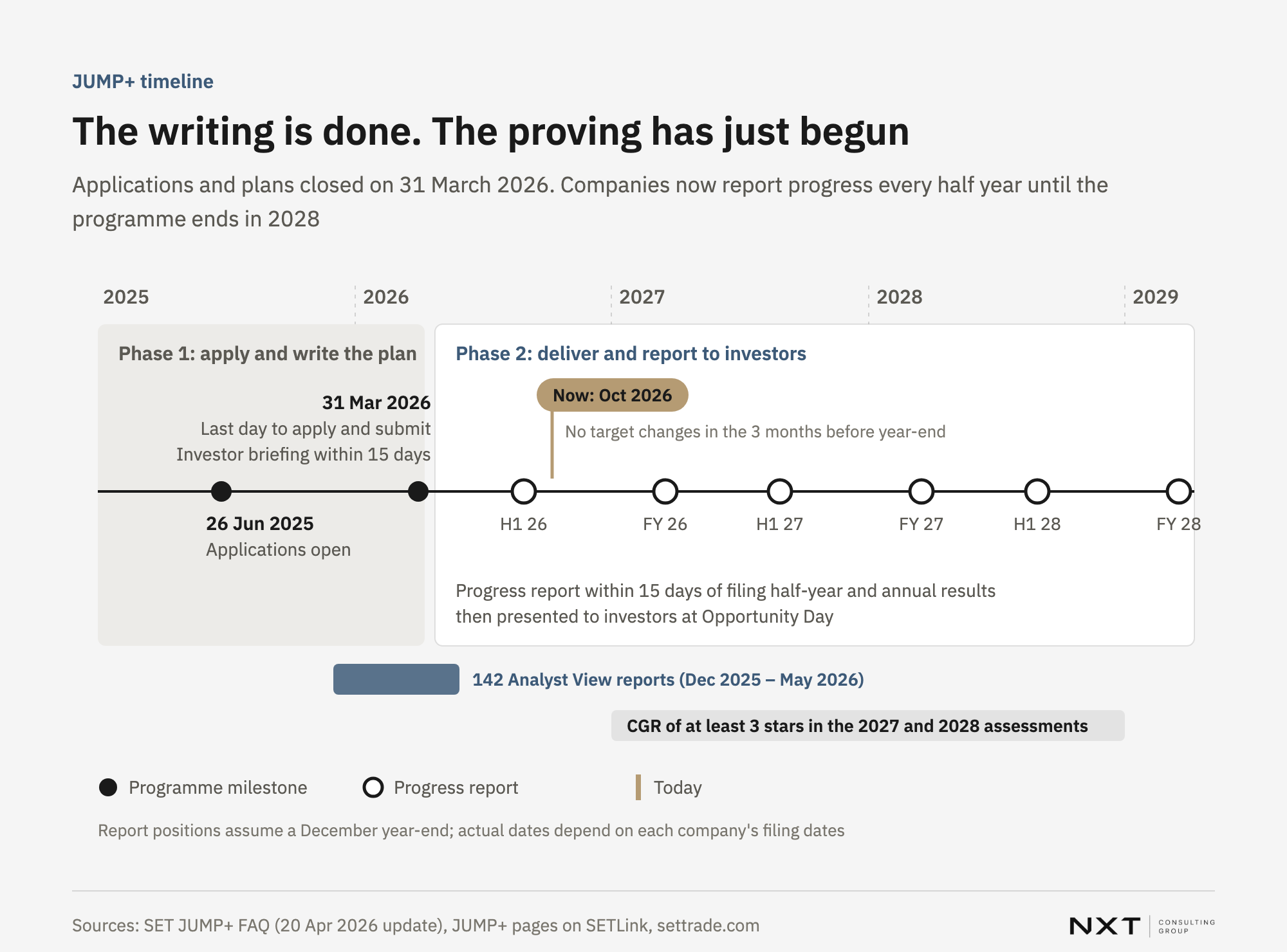
For companies with a December year-end, the next report follows the 2026 annual statements in early 2027. One rule matters right now. SET's FAQ says a year's target cannot be changed in the last three months before the fiscal year-end, so December year-end companies cannot revise their 2026 targets after 1 October. If a 2027 target needs to change, prepare the board paper in time for the next report. Another FAQ answer says profit targets can be revised immediately when assumptions change; the two answers are not reconciled, so confirm your case with SET.
Analysts have already read your plan
JUMP+ plans do not stay inside SETLink. SET arranges Analyst View reports on participants' plans, published on settrade.com for any investor to read. As of 6 October 2026, 142 reports on initial plans had been published by 13 securities firms, in Thai and English, covering 86 SET and 56 mai companies.
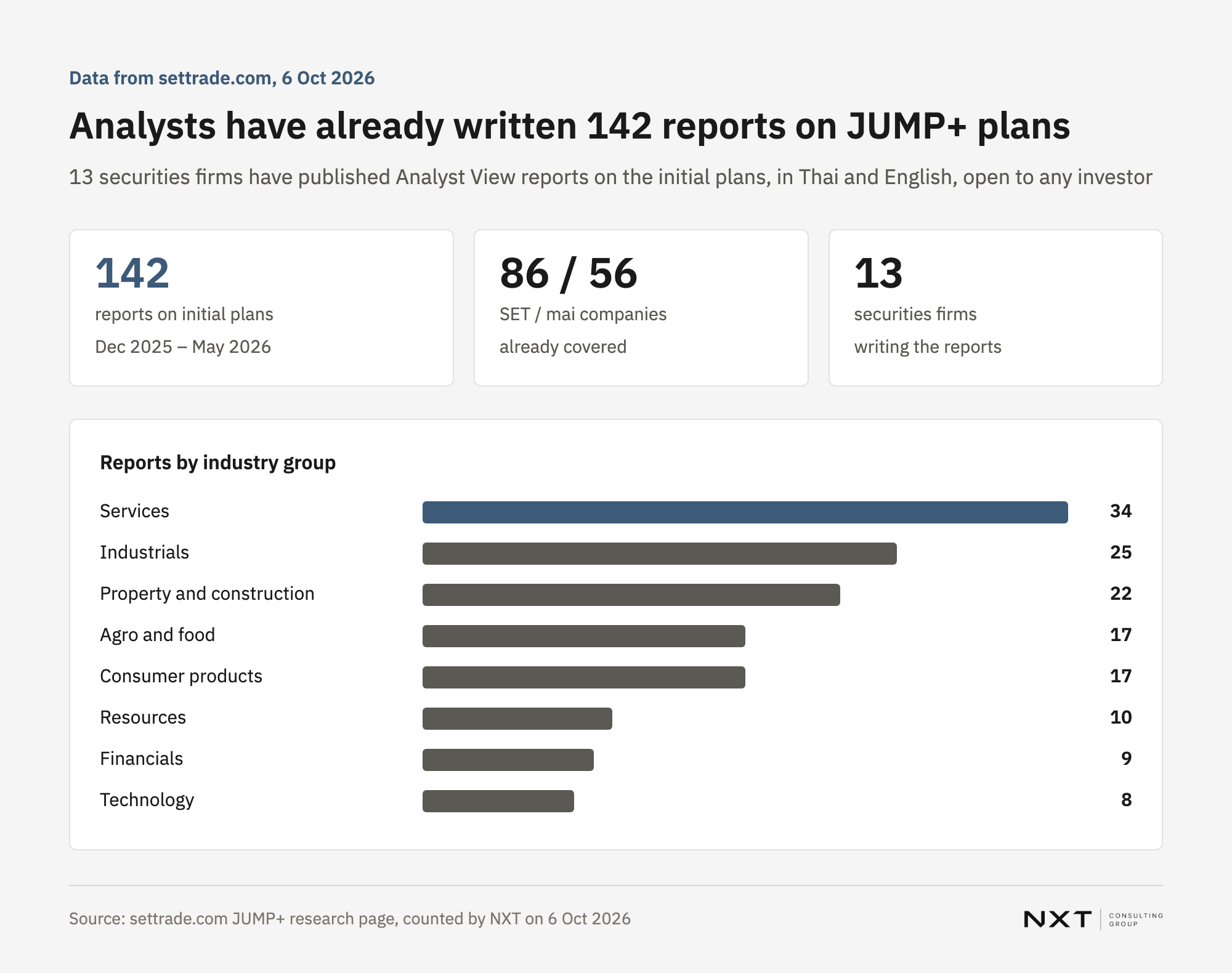
In practice, every progress report will be read against the original plan and the analyst's view of it. A plan with ambitious end targets but no interim numbers is easy to spot. SET's own summary shows most plans can be checked: 138 companies (96%) set revenue or profit targets, there are 278 business strategies across growth, efficiency and financial stability, and 272 governance initiatives, more than half on anti-corruption, whistleblowing and insider-trading prevention. 114 companies (80%) also chose to file the optional Climate Action plan.
Benefits and funding: the conditions a CFO should know
SET groups the benefits into three areas: support for preparing and delivering the plan, corporate visibility, and rewards and recognition. The funding from CMDF carries the most detailed conditions.
| Item | What you get | Key conditions |
|---|---|---|
| Total funding | Up to THB 5,000,000 per company for the whole programme (2025–2028), not per year | Rights are kept by reporting on schedule |
| Advisor fees | CMDF reimburses 50% of advisor fees, up to THB 500,000, shared across all three plans | The advisor must be in the programme's Advisory Pool; receipts must be dated after 26 June 2025 |
| Plan execution | Claimable within the total cap; unused advisor allowance can be moved here | Only after the plan is published, only for costs directly tied to it, only from registered companies; staff salaries and carbon credit purchases are not claimable |
| Investor visibility | Analyst View reports, OppDay, roadshows and media | As listed on the programme's benefits page on SETLink |
| Rewards and discounts | SET Group fee discounts and eligibility for SET Awards (JUMP+) | As announced by SET |
Two cautions. First, a company that receives a CB flag after drawing funds must repay CMDF under the terms of its application. Second, CMDF covers half of advisor fees and the company pays the rest, so choose an advisor for the result you need, not only because the fee is subsidised.
What makes a plan investors believe: plan, cascade, measure
SET states plainly that it does not certify plans: the board must approve its own plan, and a disclaimer is added automatically when the plan is published. A plan's credibility therefore comes from the plan itself and from results in every reporting round. From our team's work on strategic plans and performance systems, plans that hold up tend to pass three gates.
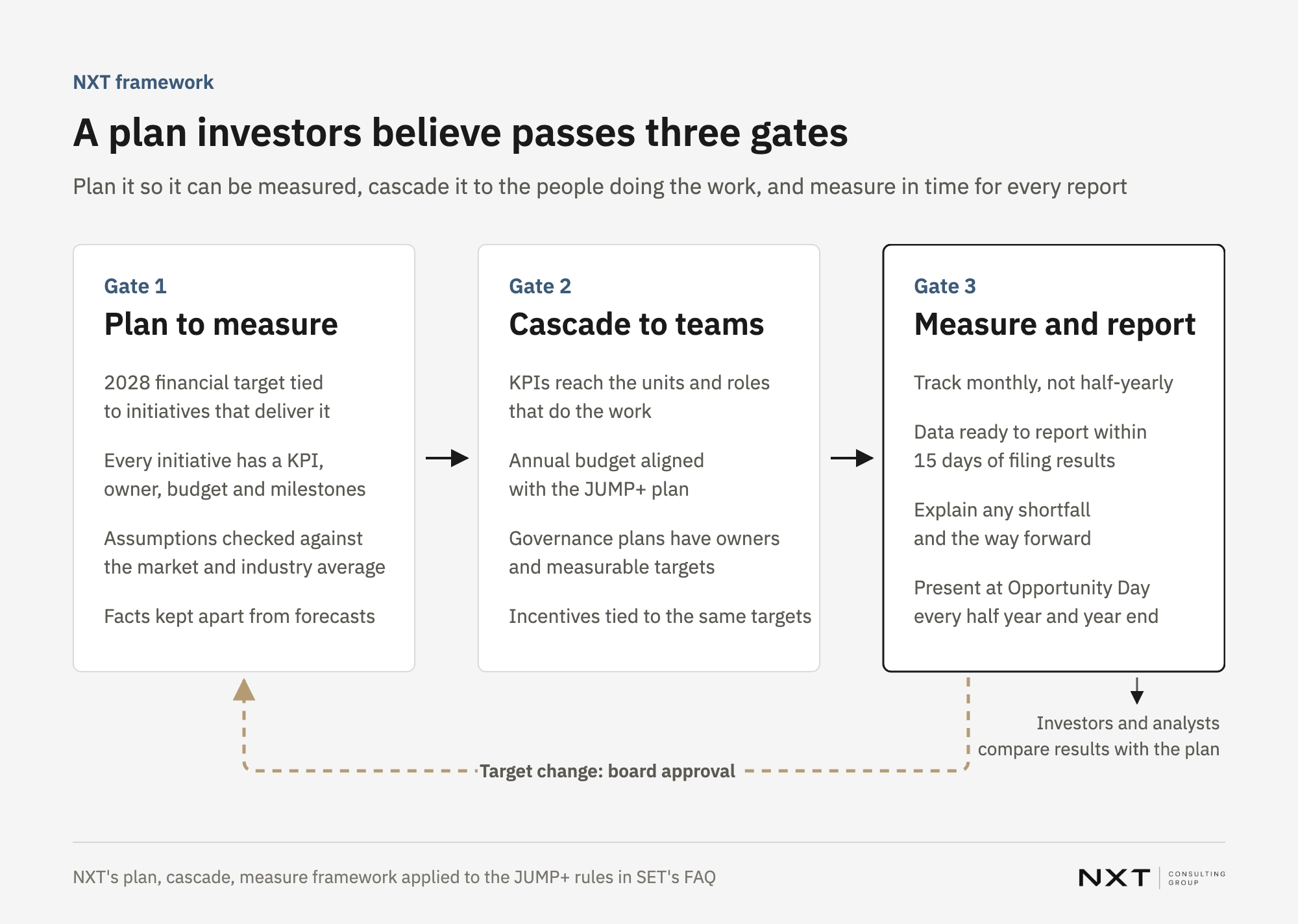
Gate 1: Plan it so it can be measured
The business plan needs at least one company-level financial target for 2028: net profit, EBIT, EBITDA or a measure the company defines, and a range is allowed. Investors' first question is where that number comes from. A good plan works back from the end target to each initiative, showing which revenue or profit each one produces, with a KPI, an owner, a budget and milestones, and it tests the key assumptions against the market or the industry average. That matches the scope SET sets for advisors in the programme. Any listed company can also use the JUMP+ Preliminary Analysis Tools in SETLink to see its score against the industry average.
Gate 2: Cascade it to the team
A plan that lives only in the document filed with SET will not deliver. Company targets have to become KPIs for the units and roles that do the work, the annual budget has to match the plan, and executive incentives should tie to the same targets. The governance plan is no different: the FAQ requires at least three governance strategies, an anti-corruption plan even for CAC-certified companies, and any certification the plan names must be obtained within three years. Each plan needs an owner and a measurable target, not just a policy review.
Gate 3: Measure and report
Progress reports are due within 15 days of filing the financial statements, which is too short if data collection only starts after the books close. Companies that track monthly see which targets are slipping early and have time to prepare an explanation. The FAQ says missing targets carries no penalty, but the company must still report and explain the way forward; failing to report or to present at Opportunity Day on schedule can lead to cancellation. Changing a target needs board approval, a report through SET's system, and disclosure at the next Opportunity Day.
For directors, the programme FAQ explains that directors' liability depends on fiduciary conduct, not on whether the plan succeeds. The recommended practice is to record the reasons for decisions in board minutes, label which figures are facts and which are forecasts, and state the risks.
10 questions a JUMP+ plan should answer
Use these to review the plan before the next report. Any question the team cannot answer straight away is one an investor or analyst may ask.
- —Source of the target: Which initiatives produce the 2028 financial target, and how much does each contribute?
- —Assumptions: Are market growth, pricing and cost assumptions reasonable against the industry average or peers?
- —Ownership: Does every initiative have an owner, a budget and milestones that can be checked during the year?
- —Cascade: Have KPIs reached the units that do the work, and do they match the annual budget?
- —Governance: Does each governance plan have a measurable target, and will it get the company to at least 3 CGR stars in 2027 and 2028?
- —Data readiness: Can the data for a progress report be pulled together within 15 days of filing the statements?
- —Shortfalls: If results fall short, is there an explanation and a way forward that investors can follow?
- —Risks: What are the main risks to the plan, and which early warning signs are being tracked?
- —Decision record: Are the reasons recorded in board minutes, with facts and forecasts clearly separated?
- —Revisions: If a target must change, does the team know the steps and the period when changes are not allowed?
How to choose a JUMP+ advisor
Hiring is between the company and the advisor; SET plays no part in sourcing or selection. SET sets three scopes for advisors in the programme: guidance on strategic direction, help preparing or improving the plan, and a view on the plan. Advisors differ in what they do best and in the fields they registered for. These questions help.
- —Which fields is the advisor registered for (Business, Governance or Climate Action), and do they match the plans you need help with?
- —Do they help only with writing the plan, or also with tracking and preparing progress reports?
- —Who on their team will do the work, and what strategy, KPI or governance work have they done?
- —How do they test the plan's assumptions, and where does their market and peer data come from?
- —Will the contract and receipts meet the programme's funding claim rules?
How NXT can help
NXT Consulting Group is a registered advisor in the JUMP+ Advisory Pool for Business (growth and business value) and Governance. We are not registered for Climate Action. Where we can help now:
- —Plan review: test the assumptions and the links from the 2028 financial target down to each initiative
- —Cascading targets: turn targets into OKRs and KPIs for units and roles, aligned with the annual budget
- —Tracking and reporting: set up monthly tracking and prepare progress reports for Opportunity Day
- —Governance: design governance plans with measurable targets and prepare for a CGR rating of at least 3 stars
Frequently asked questions
- What is JUMP+?
- JUMP+ is the Stock Exchange of Thailand's programme for raising the value of listed companies. Companies on SET and mai prepare a three-year value creation plan (2026–2028) made up of a business plan and a governance plan, with an optional Climate Action plan, publish it to investors and report progress every half year, with funding from CMDF.
- Can mai companies join JUMP+?
- Yes. SET and mai companies apply on the same terms. 56 of the 143 participants are mai companies.
- Can a company still apply to JUMP+?
- The current intake closed on 31 March 2026. SET says a further intake is under consideration. Companies outside the programme can still use the JUMP+ Preliminary Analysis Tools in SETLink to compare their score with the industry average.
- How much JUMP+ funding is available for advisor fees?
- CMDF reimburses 50% of advisor fees, up to THB 500,000, shared across the business, governance and Climate Action plans. The advisor must be in the programme's Advisory Pool, and the total funding cap is THB 5,000,000 per company over the whole programme.
- Is there a penalty if results miss the JUMP+ plan?
- The programme sets no penalty, but the company must still report progress and explain the way forward on schedule. If it does not report or present at Opportunity Day on time, SET may cancel its participation.
- Can a JUMP+ plan be revised?
- Yes, with board approval, a report through SET's system and disclosure at the next Opportunity Day. The FAQ says a year's target cannot be changed in the last three months before the fiscal year-end.
- What CGR rating does JUMP+ require?
- There is no minimum to apply, but participants need at least 3 CGR stars in the 2027 and 2028 assessments, or SET may cancel their participation.
- How is JUMP+ different from Corporate Value Up?
- Corporate Value Up is the SEC's programme for companies with a CGR score of 90 or more; it requires a growth plan and a carbon plan and places qualifying companies on the list of assets Thai ESG funds can invest in. JUMP+ is SET's programme and comes with CMDF funding. A company can choose either.
- Are directors liable if a JUMP+ plan fails?
- SET's FAQ explains that directors' liability depends on fiduciary conduct, not on the plan's outcome. Record the reasons for decisions in board minutes and separate facts from forecasts. For legal questions, consult the company's legal counsel.
Programme details are summarised from SET's JUMP+ FAQ (20 April 2026 update), the JUMP+ pages on SETLink and SET's advisor registration notice (updated 9 June 2026). Participant numbers and plan statistics come from figures SET released to the media in April 2026. The analyst report count was taken from settrade.com on 6 October 2026. Terms may change; check the latest documents with SET. This article is not legal or investment advice. NXT Consulting Group is a registered JUMP+ advisor for Business and Governance and wrote this article.
Share this article