Thailand's Draft Climate Change Act and EU CBAM: The Carbon Cost for Thai Business
Short answer: On December 2, 2025, Thailand's Cabinet approved in principle the draft Climate Change Act, the country's first law linking businesses directly to a carbon price; Kasikorn Research Center estimates it affects industries worth about THB 6.5 trillion, or 37% of GDP. Phase 1, from 2026, applies to large emitters and sectors directly tied to EU CBAM (transport, utilities, metals and non-metallic materials), which must measure, verify and report emissions annually, with fines from THB 10,000 to THB 5,000,000. Together with an interim carbon price of about THB 200 per ton CO2e on fuel excise, a planned ETS and EU CBAM's definitive period from January 1, 2026, carbon is becoming a direct cost that affects P&L, pricing and enterprise value.
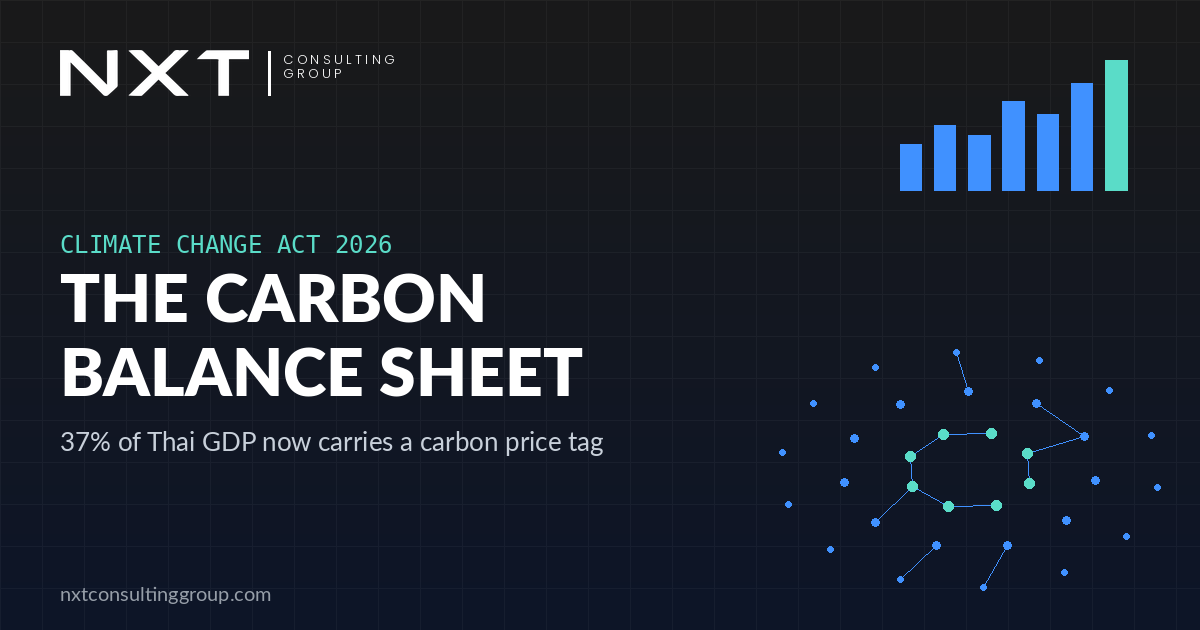
On December 2, 2025, the Cabinet approved in principle the draft Climate Change Act, Thailand's first law to tie businesses directly to a carbon price. Kasikorn Research Center estimates that the law affects industries worth a combined total of about THB 6.5 trillion, or 37% of the country's GDP.
Many executives still see this as an ESG agenda item for the sustainability team to handle. The fact is that from 2026 onward, carbon will become a cost that directly affects the P&L, pricing and enterprise value, not just the annual sustainability report.
A law five years in the making has finally arrived
The draft Act sets the goal of moving Thailand to a low-carbon economy and reaching net zero by 2050. Phase 1, starting in 2026, will apply to large greenhouse gas emitters and sectors directly linked to EU CBAM: transport, utilities, metals and non-metallic materials (Norton Rose Fulbright, Tilleke & Gibbins).
Organizations in this group must measure, verify and report their greenhouse gas emissions annually, and the data must be verified against prescribed standards. The criteria for which companies are covered are not yet settled, but the factors under consideration include energy consumption (KTOE), business size and number of employees.
The penalties are more than symbolic: fines range from THB 10,000 to THB 5,000,000 and may reach three times the benefit gained from the violation. Reporting false or incomplete data carries both administrative and criminal penalties.
The mechanisms that turn carbon into numbers in the financial statements
A carbon tax that is already being collected
Since March 2025, Thailand has begun restructuring its fuel excise tax to reflect carbon content, setting an interim price of about THB 200 per ton of CO2e as a bridge to a full carbon tax under this Act.
Emissions trading system (ETS)
The plan is to pilot an ETS in the late 2020s and expand it into a full system, alongside a Thai CBAM, in the early 2030s. This means organizations have less than five years to get their carbon measurement and management systems ready.
The Climate Change Fund
The law allows businesses that invest in reducing greenhouse gas emissions to access loans and financial assistance from this fund. It is an opportunity for organizations that prepare early, more than for those that wait for the law to force them to move.
Pressure from abroad: EU CBAM's definitive period began on January 1, 2026
While Thailand's law is still going through the process, the EU has already moved ahead. The Carbon Border Adjustment Mechanism (CBAM) officially entered its definitive period on January 1, 2026, after the end of the transitional period (October 2023 – December 2025). It covers six product groups: iron and steel, aluminum, cement, fertilizers, electricity and hydrogen.
Figures that export executives should know:
- —CBAM may affect about 3.8% of Thailand's total exports to Europe, equivalent to about THB 28 billion in 2026 (Nation Thailand).
- —Iron, steel and aluminum will be the first groups affected, because European importers have already started factoring CBAM costs into their purchasing decisions.
- —Production in Thailand that relies on coal-based processes can have carbon emissions per ton of output up to 17 times higher than in Europe, which means significantly higher CBAM certificate costs than European competitors.
- —There is an exemption threshold for small importers with volumes below 50 tons per year (for iron and steel, aluminum, fertilizers and cement), but electricity and hydrogen do not receive this exemption.
Why this is about enterprise value, not just ESG
This is the point most executives overlook: carbon costs do not sit only in the sustainability report. They are about to show up everywhere that affects business value.
Higher operating costs from the carbon tax and CBAM certificates directly squeeze EBITDA for businesses with high Scope 1-2-3 emissions in metals, cement or transport. Investors and buyers in M&A deals will increasingly raise questions about carbon liability during due diligence. Organizations that do not have verified GHG data ready to present risk being marked down on price or facing special conditions in negotiations.
Conversely, organizations that have put carbon measurement systems in place and have a credible emissions reduction plan can use this data as an advantage when negotiating fundraising or the sale of the business, because it shows that regulatory risk is already being managed, not a burden the buyer has to take on.
What executives must do before the law takes effect
- —Start a GHG inventory today. Don't wait for the coverage criteria to be settled, because building a Scope 1-2-3 measurement system takes years, not months.
- —Build carbon costs into business plans and pricing. Assess how much a carbon tax of THB 200 per ton and future ETS costs will affect the cost of your products and services.
- —Incorporate carbon liability into business valuation. Before entering an M&A deal, raising capital or selling the business, this figure must already be in your financial model.
- —Exporters to Europe must accelerate their MRV (Measurement, Reporting, Verification) systems so they are ready to supply verified emissions data to European importers, who must buy CBAM certificates from 2027 for goods imported in 2026.
- —Consider accessing the Climate Change Fund for investments in carbon reduction, rather than bearing the full cost yourself.
Conclusion
Once the draft Climate Change Act takes effect, it will permanently change how Thai businesses calculate cost and value. Organizations that wait for the law to force them to move will be at a disadvantage in both cost and bargaining power in future deals. Organizations that start measuring, planning and integrating carbon into business decisions today will turn regulatory risk into a competitive advantage.
If your organization wants to assess its carbon cost exposure or incorporate this risk into its business valuation, the NXT team is ready to talk with you.
Talk to NXT about carbon cost exposure
Sources:
- —Kasikorn Research Center — assessment of the impact on industries worth THB 6.5 trillion / 37% of GDP
- —Norton Rose Fulbright — The Impact of Thailand's Climate Change Bill
- —Tilleke & Gibbins — Thailand's Draft Climate Change Act: Key Business Considerations
- —Nation Thailand — EU CBAM to shake Thai exports as definitive phase starts on Jan 1; EU CBAM carbon levy may hit Thai steel exports by 28bn baht in 2026
- —European Commission, Taxation and Customs Union — Carbon Border Adjustment Mechanism
Translated from the Thai original by NXT Consulting Group.
Share this article