ISSB Is Here: SET50 Enters Its First Climate Disclosure Year, but More Than 88% of Thai Listed Companies Still Disclose at a Low Level
Short answer: Under the Thai SEC's phased timeline, SET50 companies must disclose climate information under the ISSB standards (IFRS S1 and S2) starting with fiscal year 2026, with reports published in 2027; SET100 follows in 2027, all SET-listed companies in 2029, and mai, REITs and infrastructure and property funds in 2030. Krungthai COMPASS (2025) found that more than 88% of Thai listed companies on SET and mai still have a low level of ISSB-aligned disclosure. The real gap is a lack of data, systems and people rather than report-writing skill, so companies should start with data inventory, measurement methodology, data governance and linking climate risk to financial figures.
The first half of 2026 is over. For most companies, that means a mid-year financial checkpoint. For SET50 companies, this year means more: it is the first fiscal year in which they must disclose climate-related information under the ISSB (International Sustainability Standards Board) standards, following the timeline set by the Securities and Exchange Commission (SEC). The data to be reported is this year's data. That means that if the data collection system is not yet working, the first six months that have already passed can never be collected retroactively.
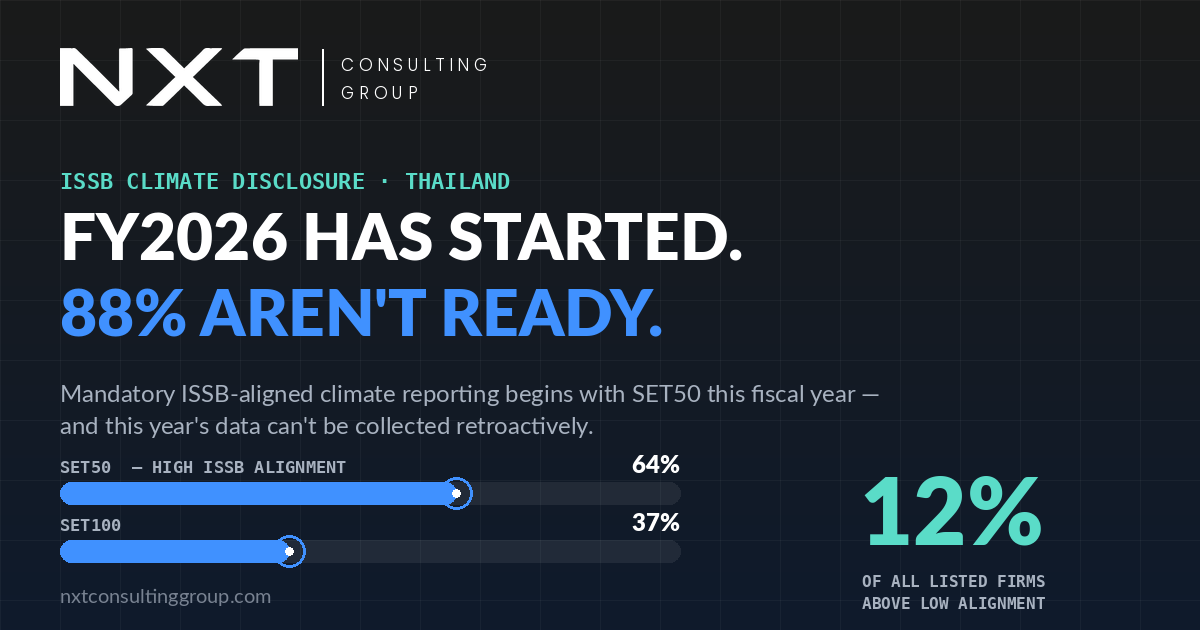
And the readiness figures are not pretty: an analysis by Krungthai COMPASS (2025) found that more than 88% of Thai listed companies on both SET and mai still have a low level of disclosure aligned with the ISSB Standards.
ISSB is not a "new report" but a move of sustainability work onto the CFO's desk
The ISSB standards consist of two main standards:
- —IFRS S1 — general requirements for disclosure of sustainability-related financial information (all three ESG dimensions)
- —IFRS S2 — climate-related disclosures specifically
What sets ISSB significantly apart from traditional sustainability reporting is that the standard requires sustainability issues to be linked to financial figures. Investors must be able to assess how climate-related risks and opportunities will affect cash flows, financial position and financial performance, and companies must disclose forward-looking information, such as scenario analysis of their strategy under a changing climate.
To put it plainly: this is no longer the CSR department's job. It is the job of the CFO, the strategy function and the board of directors, because what must be reported is the financial impact, not social activities.
Thailand's timeline: phased in step by step, but the first step has already begun
The SEC's approach uses phased adoption, as follows:
- —2026 — SET50 companies (fiscal year 2026, with reports published in 2027)
- —2027 — extended to SET100 companies
- —2029 — all companies listed on SET, including new IPO companies
- —2030 — extended to the mai market, REITs, infrastructure funds and property funds
There are also important transitional reliefs: no comparative prior-year information is required in the first year; the first five years focus on climate information only (IFRS S2 and parts of S1); and only GHG Scope 1–2 is reported at first. Greenhouse gas disclosures must receive limited assurance from a verifier registered with the Thailand Greenhouse Gas Management Organization (TGO) or a body under international standards.
The reliefs sound generous, but don't misread them. "Deferring Scope 3" does not mean Scope 3 has gone away. It means the clock has started ticking.
The real readiness figures for Thai companies
Data from several sources points in the same direction:
- —64% of SET50 companies have a high level of ISSB-aligned disclosure, but for SET100 companies the figure drops to 37%, and across the whole market only about 12% are above the low level (Krungthai COMPASS, 2025)
- —Almost all mai companies (99.5%) are still at a low level of alignment, while the group's three-year average net profit margin is only 0.4%. The cost of adapting is therefore a genuinely big issue, not an excuse
- —Only 41% of listed companies collect GHG Scope 1–2 data systematically, and only 18% track Scope 3 (SET, 2025)
- —Only 27% of Thai companies have in-house sustainability experts (Deloitte Thailand)
- —42% of Thai companies do not yet use technology and data for predictive analysis, and 47% do not yet use them in risk assessment, higher than the Asia-Pacific average (PwC Thailand, 2025)
So what? The real gap is not "not knowing how to write the report." It is no data, no systems and no people. None of these three can be bought off the shelf. They have to be built, and building them takes years.
Why companies outside the SET50 should not wait
If you are an executive at a company outside the SET50, or even one that is not listed at all, this news concerns you more than you might think, for three reasons:
1. Big companies' Scope 3 is your Scope 1–2
When SET50 companies have to report Scope 3 (emissions across the value chain) within the next few years, they will start requesting emissions data from every supplier. For those who cannot provide it, the risk is not just reputational damage but being dropped from the supplier list. The lesson from the EU (CSRD/ESRS) is clear: standards imposed on large companies spread to SMEs faster than anyone expects.
2. The cost of finance is becoming tied to sustainability data
Green loans and sustainability-linked loans adjust interest rates according to sustainability performance. Companies with ready data can access capital more cheaply. That is a competitive edge you can actually measure in basis points.
3. Climate risk is business risk, whether or not anyone mandates it
Climate risk affects revenue, costs and asset values, through both physical damage and the transition to a low-carbon economy, whether or not the law requires you to report it. Knowing where your own business is vulnerable is valuable in itself, not just for filling in forms.
This is a data readiness challenge, not a reporting challenge
We have written before, in the context of AI in the public sector, that "data not ready = AI can't be used." The same principle applies directly to ISSB: data not ready = no disclosure. The components you need before you can "write the report" are:
- —Data inventory — knowing where data on energy use, fuel, travel and raw materials is, who holds it and in what format (most of it is scattered across electricity bills, receipts and Excel files in several departments)
- —Measurement methodology — choosing emission factors and measurement boundaries that can be verified, not figures estimated differently from year to year
- —Data governance — assigning data owners, collection cycles and quality controls, just as with accounting data, because this data must go through assurance just like the financial statements
- —Linking to finance — translating climate risk into impacts on revenue, costs and asset values. This is the same skill used in valuation and in social return on investment (SROI) assessment: measuring things that are hard to grasp as figures that can be audited
Organizations that have already invested in building measurement discipline, whether through SROI work, impact assessment or data governance, will adapt to ISSB noticeably faster, because the underlying mindset is the same: clear definitions, measurable, verifiable.
What to do in the second half of 2026
- —SET50: If your data collection system is not yet stable, this is the last quarter in which you can fix it in time. Run a dry run of Scope 1–2 data collection with your verifier before the fiscal year closes.
- —SET100: You have about 18 months, exactly one cycle of building data infrastructure. Start today with a gap analysis against the IFRS S2 requirements.
- —Other companies and SMEs in the supply chain: Start collecting basic energy and emissions data now, because data requests from major customers will arrive before the law applies to you directly.
- —Every organization: Move ownership of this issue from the CSR department to the CFO and the board, with a clear budget and three-year roadmap.
Disclosure under international standards is not a paperwork burden. It builds the capability to see your own business risks. Companies that move first gain an advantage in cost of capital, investor confidence and their position in the supply chain.
NXT Consulting Group helps organizations build data readiness, assess disclosure readiness and translate sustainability impacts into auditable figures through SROI and valuation frameworks. If your organization needs a gap analysis before the clock runs any further, talk to us.
Talk to NXT about an ISSB gap analysis
Sources: Securities and Exchange Commission (SEC) Thailand, Krungthai COMPASS (2025), SD Thailand (2025), Deloitte Thailand, PwC Thailand (2025), SET / World Federation of Exchanges (2025)
Translated from the Thai original by NXT Consulting Group.
Share this article