Has Thailand Joined the OECD? Latest Progress on Membership (October 2026)
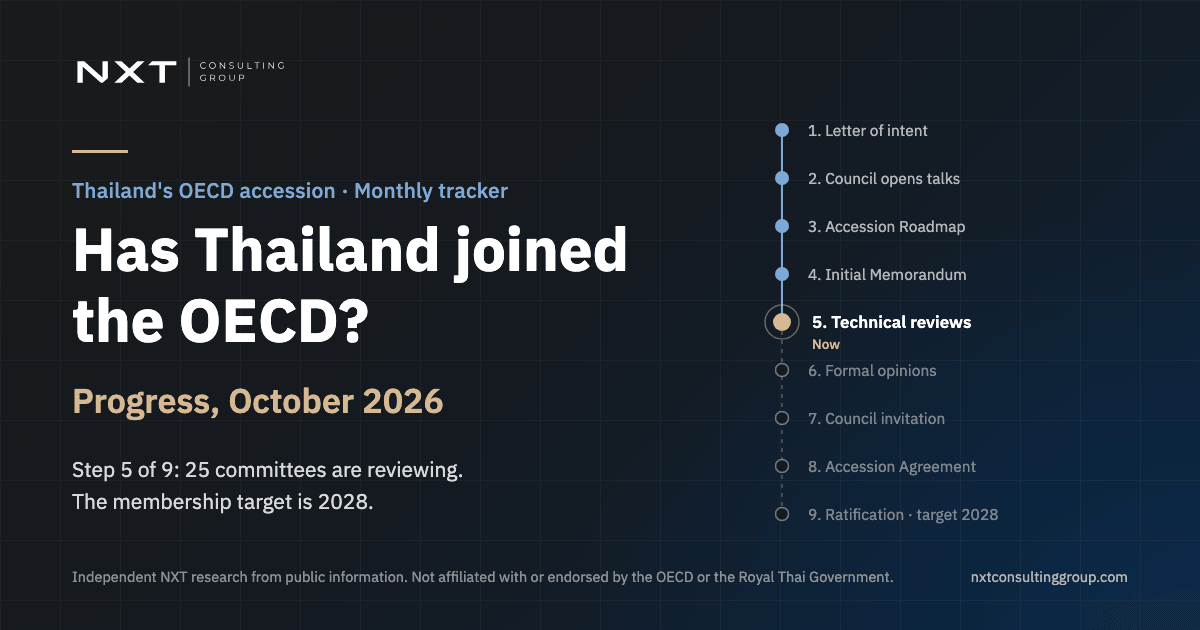
Short answer: Not yet. As of October 2026 Thailand is in the technical reviews, step 5 of the 9 steps to membership: 25 OECD committees are reviewing Thai law and practice, and the government's target is membership by 2028. Four steps are complete: the letter of intent (2024), the OECD Council's decision to open accession discussions (June 2024), the Accession Roadmap (July 2024) and Thailand's Initial Memorandum (December 2025).
This page answers whether Thailand has joined the OECD and is updated every month. This edition covers October 2026, with information to 26 October 2026. Every fact links to the original report or release; the full analysis is in NXT's OECD Accession Playbook.
Progress in October 2026
4 October 2026: a two-year aim. After talks with OECD officials in Paris, the government aims to complete accession in about two years as reviews by 25 committees continue (source: Krungthep Turakij, in Thai).
6 October 2026: Thailand joins the Global Trust Survey. The Cabinet approved Thailand joining the OECD Global Trust Survey, which measures public trust in government across six areas (source: Krungthep Turakij, in Thai).
14 October 2026: the Secretary-General on productivity. At a Bangkok forum, OECD Secretary-General Mathias Cormann said Thailand must revive productivity growth because its working-age population is projected to fall 29% by 2060, and that accession can serve as a framework for reform (source: The Nation).
16 October 2026: the Prime Minister confirms the 2028 goal. Prime Minister Anutin Charnvirakul met Mr Cormann at the Queen Sirikit National Convention Center during the IMF and World Bank Group annual meetings and confirmed the goal of membership by 2028. The Prime Minister said the Secretary-General saw Thailand as moving in the right direction (sources: Bangkok Post, The Nation; Thai PBS and Thairath, in Thai).
19 to 20 October 2026: an OECD mission on public integrity. The Office of the Public Sector Anti-Corruption Commission (PACC) hosted a fact-finding mission from the OECD Working Party on Public Integrity and Anti-Corruption, under the Public Governance Committee, to assess Thailand's readiness. Government agencies, business and civil society gave evidence (source: Krungthep Turakij, in Thai).
21 to 23 October 2026: the Deputy Prime Minister at the OECD justice roundtable. Deputy Prime Minister Pakorn Nilprapunt led Thailand's delegation to the OECD Global Roundtable on Equal Access to Justice in Istanbul and held bilateral talks with OECD leadership. He said every law must be reviewed at least every five years, and that new laws need a regulatory impact assessment (RIA) and public consultation before drafting (sources: Thairath and Nation TV, in Thai).
The nine steps, and where Thailand is now
The OECD, the Organisation for Economic Co-operation and Development, has 38 members. A candidate passes through nine steps. Thailand has completed four and is now in the fifth, the technical reviews.
- —1. Letter of intent · done (2024)
- —2. Council opens talks · done (June 2024)
- —3. Accession Roadmap · done (July 2024)
- —4. Initial Memorandum · done (December 2025)
- —5. Technical reviews · in progress now (2026 to 2027)
- —6. Formal opinions · not yet (one from each committee)
- —7. Council invitation · not yet (by unanimity)
- —8. Accession Agreement · not yet (signed)
- —9. Ratification · not yet (target 2028)
Sources for the completed steps. The letter of intent, dated 12 February 2024, was handed to the OECD Secretary-General in Paris on 16 April 2024 (MFA, Bangkok Post). The members decided unanimously to open accession discussions with Thailand on 17 June 2024 (OECD, MFA). The OECD Council adopted the Accession Roadmap on 10 July 2024, and the Secretary-General handed it over in Bangkok on 30 October 2024 (OECD). Thailand submitted its Initial Memorandum, its position on every OECD legal instrument, on 8 December 2025 (OECD).
What step 5 involves. Each committee sends a questionnaire and a fact-finding mission. On 19 August 2026 the government told the Senate Committee on Foreign Affairs that 10 of 25 questionnaires had been received, 8 Thai agencies had sent answers and 6 missions had been held (MFA, PRD, The Nation). As of August 2026 no committee had given its formal opinion. A committee issues its opinion only when it is satisfied, and the Council then decides, by unanimity, whether to invite Thailand.
Where the 2028 target comes from. On 19 May 2026 the Cabinet approved the goal of membership by 2028, brought forward from 2030, and appointed a steering committee chaired by the Prime Minister (NESDC, PRD).
What it means for government agencies and for business
For government agencies
For ministries and agencies, the work now is answering committee questionnaires and hosting fact-finding missions; every committee must give its formal opinion before the Council can invite Thailand. Volume 1 of the playbook (Public Sector) finds that five reforms set the timeline: anti-bribery, foreign investment, competition, environmental reporting and climate, and labour relations, which together need at least six bills. 2028 is possible if the gating bills reach Parliament in 2027; if they slip, 2029 to 2030 is the realistic path. Volume 1 also maps the readiness of all 25 committees and includes a self-assessment for agencies.
For business
OECD standards bind the state, but they reach companies through four channels: new laws, tougher regulators, buyers and investors, and banks. Listed groups, exporters and multinational subsidiaries feel it first; SMEs feel it mostly through customers, banks and public procurement. Companies do not have to comply overnight, because changes arrive through Thai laws that take time to draft and pass. Volume 2 (SMEs and Enterprise) suggests starting with no-regret moves: name an owner and map your exposure, install anti-bribery controls, build supply-chain and carbon data, and upgrade your board and disclosure.
The committee readiness ratings in Volume 1 and the exposure ratings by company type in Volume 2 are NXT's indicative assessment, not OECD findings.
What to watch
23 to 24 November 2026. The OECD Secretary-General is scheduled to return to Thailand, and the Prime Minister said the visit would include another meeting to take stock of progress (sources: Bangkok Post; Thai PBS, in Thai).
Beyond that visit, the markers to follow are how many of the 25 questionnaires Thailand has received, the first formal opinion from a committee, and progress on the gating bills, which the playbook expects need to reach Parliament during 2027 for a 2028 finish. We update this page every month.
Read the full playbook and check your readiness
NXT's OECD Accession Playbook comes in two volumes: Volume 1 for ministries, agencies and state enterprises (51 pages) and Volume 2 for Thai companies (47 pages). Read them online or download the PDFs free, in English and Thai. The same page has a five-minute self-check, with 12 questions for agencies and 16 for companies, scored in your browser only.
Frequently asked questions
- When will Thailand join the OECD?
- The government's target is 2028. The Cabinet approved it in May 2026 and the Prime Minister confirmed it again on 16 October 2026. NXT's playbook finds 2028 possible if the gating bills reach Parliament in 2027; if they slip, 2029 to 2030 is the realistic path. The process has no deadline of its own: each committee issues its opinion only when it is satisfied.
- What is the OECD, and how many members does it have?
- The OECD, the Organisation for Economic Co-operation and Development, is an international organisation with 38 member countries. To join, a candidate aligns its laws and practice with the organisation's legal instruments, about 260 in Thailand's case. Thailand is a candidate, not yet a member.
- How many steps does OECD accession take?
- Nine: the letter of intent, the Council opening talks, the Accession Roadmap, the Initial Memorandum, technical reviews by 25 committees, a formal opinion from each committee, the Council's unanimous invitation, signing the Accession Agreement, and ratification. Thailand has completed four and is in the fifth.
- What does Thailand gain from joining the OECD?
- The evidence is mixed. TDRI estimates the gain from accession-driven reform at about 1.6% of GDP (about THB 200 billion). An Ipea study links OECD entry to significantly higher FDI from OECD countries into Chile, Estonia, Slovenia and Israel. But the Bank of Israel found that countries joining in the decade before 2008 saw no significant change in capital inflows from membership alone. The playbook's conclusion is that the lasting value lies in the reforms the committees demand, not in membership itself.
- We are an SME and do not export. Should we care?
- Yes, but in proportion. SMEs will feel it through banks, large customers, procurement rules and PDPA enforcement. The five basics on page 29 of Volume 2 cost little.
- What if Thailand misses 2028?
- Most changes proceed anyway: the global minimum tax, EU supply-chain rules, PDPA enforcement and the planned climate law. Accession speeds up trends already under way.
Independent NXT research from public information. Not affiliated with or endorsed by the OECD or the Royal Thai Government. The facts on this page come from the reports and releases linked, with information to 26 October 2026; the analysis comes from the first edition of the OECD Accession Playbook, built from sources current to 12 October 2026. This page is general information, not legal, tax or investment advice. Accession status changes quickly, so check the latest official releases before acting.
Share this article