Designing a Loyalty Program Whose Points Actually Pay Off: What Point Economy Is and Why It Is Harder Than It Looks
Short answer: Point Economy is the economics behind a points program: how many points a purchase earns, what a point is worth, what it can be redeemed for, when it expires, and what each membership tier receives. A program breaks even only when the profit from sales that are "incremental because of the program" is large enough to pay for the points issued on "all" sales and still leave a profit. Setting up a points system does not take long, but designing it so this math holds requires product-level margin data, customer behavior data, research, and measured testing. Design takes from about 2 weeks, for a business with only a few product groups and ready data that uses existing customer data instead of new research, to about 3 months for a business with many product lines, channels, and customer segments, followed ideally by 3 to 6 months of testing against a control group before full rollout.
A Points System Can Be Set Up in a Day, but That Is Not the Hard Part
Today there are plenty of loyalty platforms to choose from, and some can set up a system within a single day. That is good news, because technology is no longer the obstacle.
But a platform only answers the question "how do we award points?" It does not answer the more important one: "how many points should we give, on which products, to get customers to do what, and how will we know it pays off?" These questions have no standard answer that works for every business, because the answer depends on each company's margin structure and customer behavior.
As a result, many loyalty programs launch with earn rates copied from competitors or set by a sense that they "seem about right," and then no one knows for sure whether the program is making or losing money.
Why Many Loyalty Programs Lose Money Without Realizing It
The biggest cost is rewarding what customers would have done anyway. When a program launches, the first to sign up are regular customers who already buy. They earn points on existing purchases that have not increased at all. That cost can only be paid for by sales that genuinely increase, and the increase required is usually much higher than executives expect.
The same earn rate on every product, even though margins differ. Product lines can differ in gross margin by several times. With the same earn rate, low-margin products must grow sales several times more than high-margin products to break even. By our calculations, in a business with multiple price tiers, the low-margin line may need to grow sales almost 4 times more than the premium line at the same earn rate, which in practice is nearly impossible.
Costing points on the wrong basis. The value customers perceive and the cost the company actually bears are not the same; the gap depends on what customers redeem, points that are never redeemed, and the mix of reward types. Companies that cost points at retail price often give rewards so small that nobody cares, while companies that overlook the outstanding points liability often run into trouble when many customers start redeeming at once.
Measuring the wrong thing. Member counts and member sales always look good, because the people who sign up are the ones who already buy a lot. Without a properly designed comparison group, you will never know whether the sales you see actually came from the program.
What Is Point Economy, and Why Must the Whole System Be Designed Together?
Point Economy consists of five main variables: earn rate, point value, reward catalog, point expiry, and membership tiers.
The difficulty does not lie in any single variable but in the fact that they all affect one another. Raising point value makes customers more interested but increases cost and the liability on the balance sheet. Changing the reward catalog changes the real cost of every point. Adjusting point expiry changes both cost and customer trust. And all of this has to be balanced against margins that differ by product line, channel, and customer segment.
That is why adjusting one variable at a time by feel usually moves the problem around instead of making it go away.
The Test Every Program Must Pass: Incremental Sales Must Pay Back the Cost of Points
The guiding principle of a good program is that it must pay for itself (self-funding). That is, the gross profit from the portion of sales that increases because of the program must exceed the true cost of points on all sales, plus the cost of running the program, including the system, marketing, reward fulfillment, and the team that manages it.
It sounds simple, but getting each of these numbers right is most of the design work. You need to know how to separate "sales that increase because of the program" from sales that would have happened anyway, what the "true cost of points" is after accounting for actual redemption behavior, and how much the break-even point differs across product lines and customer segments.
Once you have these figures, the actual target should be set comfortably above break-even, so the program makes a profit and leaves room for errors in the assumptions.
A Worked Example: How Complex Is a Program That Looks Simple?
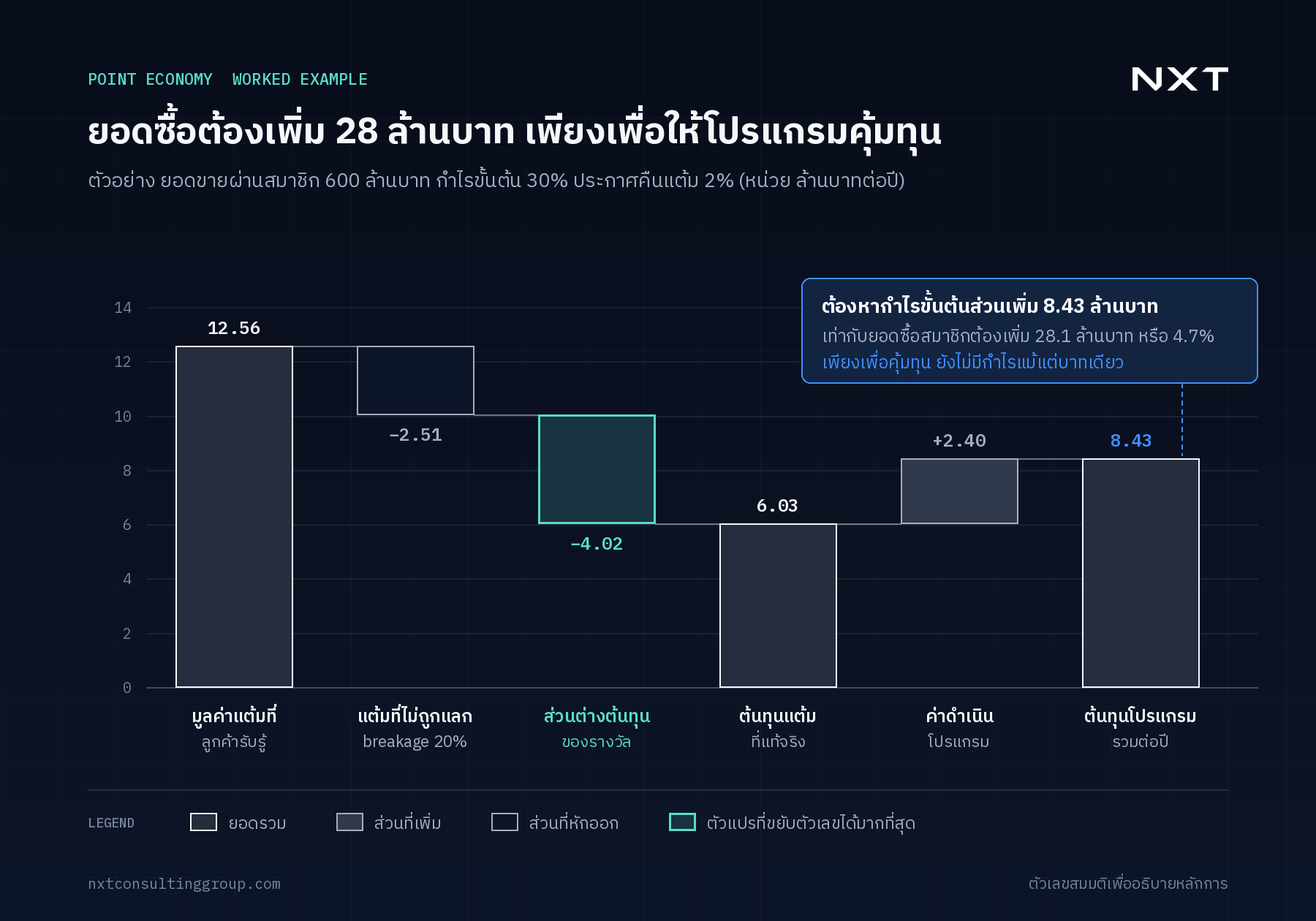
Suppose a business has annual sales of 1,000 million baht, of which 600 million baht comes through members, with an average gross margin of 30 percent. It sets up a program of the kind commonly seen in the market: 1 point for every 10 baht spent, with each point worth 0.20 baht.
Layer 1: What customers see. The advertised reward rate is 2 percent of spend.
Layer 2: What the company actually pays. If 80 percent of points are actually redeemed (20 percent breakage) and most rewards are the company's own products selected from high-margin lines, costing about 60 percent of their selling price (if ordinary products at a 30 percent gross margin were used instead, the cost would be 70 percent and the break-even point below would shift from 4.7 to about 5.3 percent), the true cost of points falls to 2% × 0.8 × 0.6 = 0.96 percent of spend, plus program operating costs of about 2.4 million baht a year, or 0.40 percent
Layer 3: Break-even. Member sales must increase by at least (0.96% + 0.40%) ÷ (30% − 0.96%) = 4.7 percent, or about 28 million baht a year, and that must be sales that increase genuinely because of the program, not sales that would have happened anyway. At this point, the additional gross profit of 8.4 million baht exactly equals the 6.0 million baht cost of points plus 2.4 million baht in operating costs. The program has not yet made a single baht of profit.
Layer 4: Broken down by product line. The average figures above hide the reality. With the same earn rate on every product:
- —Premium line, 45% gross margin: sales must increase by 3.1%
- —Core line, 30% gross margin: sales must increase by 4.7%
- —Value line, 12% gross margin: sales must increase by 12.3%
Layer 5: Sensitivity to assumptions. All of these figures can shift significantly from small changes.
- —If customers actually redeem 90 percent of points instead of 80, break-even moves from 4.7 to 5.1%
- —If customers choose to redeem for cash vouchers instead of the company's own products, break-even jumps from 4.7 to 7.0%, an increase of almost half, from changing the reward catalog alone
Layer 6: Financial statement impact. Under TFRS 15, the points issued to customers that year mean that about 10 million baht of revenue must be deferred and recognized later, when the points are redeemed. Reported profit in the first year may therefore fall, even if the business is genuinely improving.
All of this is for a program with just one rule. In reality, a typical program has bonus points, membership tiers, partner products, and seasonal campaigns, each of which multiplies the complexity of these numbers further.
The Numbers the Model Must Track
A workable Point Economy model must calculate and track at least the following figures, broken down by product line, channel, and customer segment:
- —Earn rate and advertised reward rate
- —Redemption rate and breakage, by point age
- —Cost-to-value ratio for each reward type
- —True cost of points as a percentage of spend
- —Program operating cost per member and per unit of spend
- —Incremental sales versus a control group (incremental lift)
- —Net incremental gross profit after the cost of points
- —Break-even by product line and customer segment
- —Profit from shifting spend across product lines (mix shift)
- —Outstanding points liability and deferred revenue under TFRS 15
- —Changes in customer lifetime value (CLV) and churn rate
No single figure is hard, but making them all consistent, drawn from the same data set, and updatable every month is work that has to be designed systematically.
The Point Economy Design Process We Use
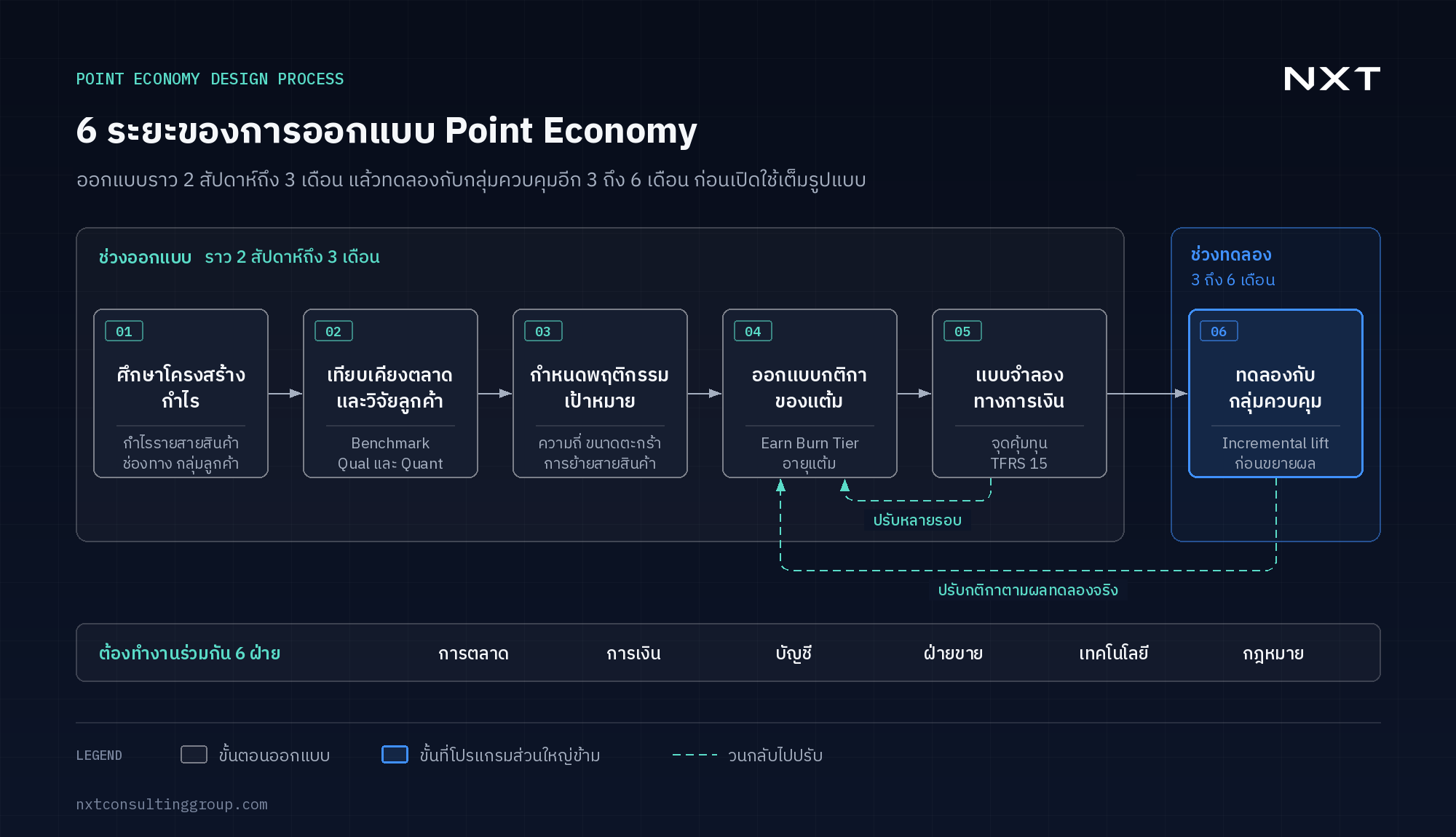
The process has two major stages. The first is design, covering Phases 1 to 5, which takes from about 2 weeks to 3 months depending on the complexity of the business, the number of product lines, data readiness, and whether new customer research is needed. A business with only a few product groups and sales data ready to use, and that can use existing customer data instead of new research, may finish the design in about 2 weeks, while a business with many product lines and channels that needs to prepare its data first usually takes about 3 months. The second stage is testing against a control group in Phase 6, which takes another 3 to 6 months before full rollout.
Phase 1: Study the Margin Structure
Analyze how much profit remains from every baht a customer spends, by product line, sales channel, and customer segment, including profit after promotional and channel costs, which sometimes turns a product that looks profitable into a thin-margin one.
The data required is transaction-level sales data going back at least 12 to 24 months, product-level costs, promotional expenses, and individual customer data if available. This phase requires close collaboration with finance and sales.
Phase 2: Benchmark the Market and Research Customers
Study competitors' programs and the programs the same customers already use, to learn what earn rates and rewards customers are used to.
The more important part is mixed-method customer research. Start with in-depth interviews to find out what really motivates each customer segment, then use a quantitative survey to test which reward bundles customers value most relative to what they cost the company. The greatest value in the whole project usually lies here: discovering rewards that customers want badly but that cost the company little.
Phase 3: Define Target Behaviors
Choose clearly what you want customers to do differently, such as buy more often, spend more per visit, try a new product category, shift to higher-margin products, or not defect to competitors. Each goal needs a different mechanism, and a program that tries to change every behavior at once usually changes nothing. This phase needs agreement from senior management, because it is a strategic decision, not a marketing one.
Phase 4: Design the Point Rules
Design all five variables to work together: earn rates by margin group; point value and a reward catalog that mixes low-cost rewards with rewards customers feel they can really use; membership tiers; point expiry; and rules to prevent misuse. This phase usually has to loop back several times, because every change affects the other variables.
Phase 5: Financial Model
Translate all the rules into numbers under three scenarios, conservative, base case, and upside, to find break-even by product line and customer segment, estimate the outstanding points liability on the balance sheet, and test whether the program survives if key assumptions turn out wrong.
This phase needs the accounting team involved, because under TFRS 15 the points given to customers are an obligation to be fulfilled in the future. The company must defer part of its revenue for later recognition, which affects the profit reported each quarter.
Phase 6: Test Against a Control Group Before Scaling (3 to 6 Months)
Pilot in selected areas, channels, or customer segments, with a comparison group designed to have the same characteristics, to measure how much of the increase in sales and profit actually comes from the program. Then adjust the rules based on real results before rolling out fully.
This is the phase most programs skip, and it is the main reason many companies have run loyalty programs for years yet cannot say whether they pay off.
Who Needs to Be Involved
Designing a Point Economy is not a job for the marketing department alone. A successful project needs people from at least six functions working together: marketing, finance, accounting, sales or channel management, IT, and legal to handle customer terms and the use of personal data under the PDPA.
Coordinating data and decisions across these functions often takes more real time than the analysis itself.
Signs Your Loyalty Program Needs a Redesign
- —The earn rate is the same on every product
- —No one in the organization can say what the true cost of points is as a percentage of sales
- —Success is measured by member count or member sales, with no comparison group
- —Most points are never redeemed, or the opposite: customers redeem so many points that costs overshoot the budget
- —The program has become a tool for price competition
- —The outstanding points liability on the balance sheet is growing faster than sales
If you see two or more of these, your program may be paying for customers' existing behavior without getting anything back.
Brands That Sell Through Retailers Without Their Own Points of Sale
Manufacturers that sell through department stores and retailers can run loyalty programs, but it is harder in three ways. First, the margin used in the calculation is the manufacturer's margin after channel costs, which is thinner than expected. Second, collecting points requires methods such as scanning codes on packaging or photographing receipts, which carry costs and fraud risks that must be designed for. Third, measuring genuinely incremental sales is harder because the manufacturer does not see all the sales data.
On the other hand, the end-consumer data the program generates may be highly valuable to a manufacturer that has never seen its own customers, so it should be included in the assessment of value from the start. Value it in baht based on the uses actually planned, such as advertising spend saved through better targeting, and obtain consent under the PDPA. The value of the data should not be used to justify a loss-making program.
How NXT Can Help
NXT designs Point Economy across all six phases: studying the margin structure from your real data, mixed-method customer research, designing the rules and the financial model, and designing a pilot that genuinely measures results. We tell you directly which rules pay off for your business, and if the data says a points program is not the right tool, we will tell you that too.
Frequently asked questions
- Is a points program worth it for our business?
- It is worth it if it is designed so that incremental sales pay back the cost of points, and it is not if most points reward purchases customers would have made anyway. The answer for each business depends on product-level gross margin, customers' repeat-purchase behavior, and which rewards customers value, which must be analyzed from real data, not benchmarked against a competitor's program.
- What percentage of spend should be returned as points?
- There is no standard figure. The right rate has to be worked backward from each product line's margin and the sales increase you can realistically expect, then compared with the rate customers in your market feel is worthwhile. In many businesses, the right answer is to use different rates for different product lines.
- Is an off-the-shelf loyalty platform enough on its own?
- A platform is necessary and helps you start quickly, but its job is to "award points according to the rules," while deciding what those rules should be is a separate task. The approach that works is to finish designing the Point Economy first, then choose a platform that can support those rules, not to choose a platform first and set rules based on what the system can do.
- How long does it take to design a loyalty program?
- Designing a Point Economy, from studying the margin structure to producing a financial model, takes from about 2 weeks, for a business with only a few product groups and ready data that uses existing customer data instead of new research, to about 3 months for a business with many product lines and channels, followed ideally by 3 to 6 months of testing against a control group before full rollout. The timeline depends mainly on data readiness, the number of product lines, and whether new customer research is needed.
- What data do we need to prepare before design starts?
- At a minimum, transaction-level sales data for the past 12 to 24 months, product-level costs and margins, promotional expenses, and individual customer data if available. If some of the data is not yet ready, the first phase of the project will include preparing it, which is normal for most businesses.
- How do loyalty points affect the financial statements?
- Under TFRS 15, points given to customers are an obligation the company must fulfill in the future, so part of the revenue must be recognized later, when the points are redeemed or expire. As a result, a fast-growing program may reduce reported profit in the short term even if the business is genuinely improving. Auditors should be involved from the design stage.
The timelines and examples in this article are estimates based on our experience, intended only to illustrate the concepts. Actual design depends on each business's data and context. For accounting treatment, consult your auditor. This article was prepared by NXT Consulting Group.
Share this article