TH-AI Passport Gives Pro-Tier AI to 5 Million People: Your Employees Will Have AI Before Your Company Has a Policy
Short answer: TH-AI Passport is a THB 1,621 million program from Thailand's Ministry of Digital Economy and Society (MDES) that gives 5 million Thais aged 15 and over free access to Pro-tier AI for one year, covering about 12 platforms including ChatGPT Plus, Gemini Advanced, Claude Pro and Typhoon. Registration opened on June 5, 2026. For employers, it means many employees will soon use Pro-tier AI the company did not provide or govern (BYOAI), creating PDPA, capability and measurement risks. The recommended response is an AI use policy within 30 days, a survey of actual usage, 2–3 measurable use cases with baselines, workflow-based upskilling and a single C-level owner.
On June 5, 2026, Thailand's Ministry of Digital Economy and Society (MDES) opened registration for TH-AI Passport, a THB 1,621 million program that gives 5 million Thais aged 15 and over free access to Pro-tier AI for one year. It covers roughly 12 platforms and 24–25 models, including ChatGPT Plus, Gemini Advanced, Claude Pro and Typhoon, a Thai-language model developed in Thailand (sources: Bangkok Post, Thairath).
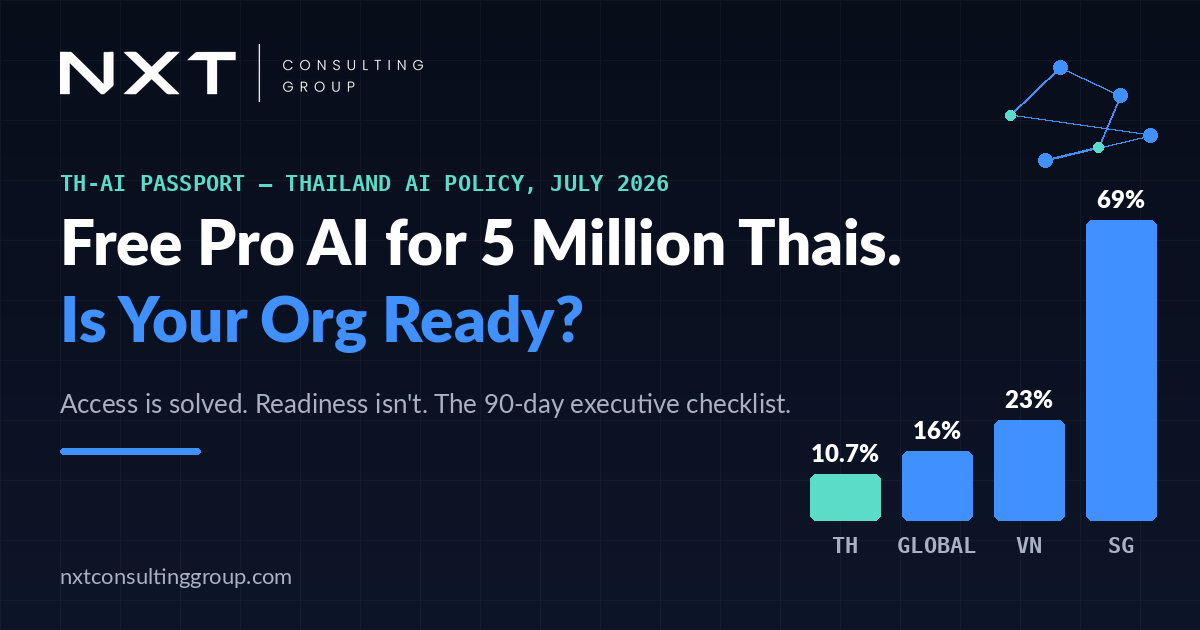
For the government, this is an attempt to close a worrying gap: the AI usage rate among Thai workers stands at 10.7%, ranked 89th in the world. That is below the global average of about 16%, below Vietnam at 23%, and far behind Singapore at 69% (source: Bangkok Post, citing Global AI Adoption data).
For corporate executives, though, the question is not whether the policy will succeed. The point is that within the next 6–12 months, many of your employees will have Pro-tier AI in hand, without the organization having provided it, chosen the tools, or set the rules. This is the phenomenon known as BYOAI (Bring Your Own AI).
Organizations that don't prepare won't simply get "nothing" out of this program. They will get Shadow AI instead.
TH-AI Passport: the numbers you need to know
Program facts, summarized from the ministry's announcements and news coverage:
- —Budget: THB 1,621 million, averaging about 27–28 baht per person per month, or roughly 330 baht per person per year.
- —Target group: 5 million Thais aged 15 and over, equivalent to about 12.5% of the national workforce (~40 million people).
- —What participants get: access to Pro-tier AI on about 12 platforms through a single entitlement, plus upskilling courses under a "Learn to Earn" framework.
- —Policy goal: raise national AI adoption from 10.7% to 23%, the level Vietnam is at today.
- —Timeline: procurement contract signed April 7, 2026; registration opened June 5, 2026.
The program has drawn real criticism, including over procurement transparency, which former Prime Minister Abhisit Vejjajiva has called to be investigated, and over the long-term risk of dependence on foreign AI, as analyzed by the Bangkok Post. But the ministry has confirmed it is going ahead, and as of early July 2026 the program was proceeding as planned.
So what: Whether or not you agree with how the budget is being spent, one fact has already changed: access to AI is no longer the bottleneck. The excuse that "our organization doesn't have the budget for licenses yet" expired the day this program opened for registration.
Why this is your problem, not just the government's
Consider this scenario: a salesperson at your company registers for TH-AI Passport and gets free access to ChatGPT Plus. They start feeding customer data, quoted prices and contract terms into the AI to help draft emails. No one in the organization knows. No policy says whether this is allowed, and no one knows which country's servers that data is flowing to.
This is not hypothetical. Research by Microsoft and LinkedIn (Work Trend Index 2024) found that 78% of employees who use AI at work bring their own tools rather than using ones provided by their organization. Microsoft's figures for Thailand show that AI use among Thai workers grew 36.2% between the first half of 2025 and Q1 2026: fast growth while most organizations still have no rules in place.
When the government adds another 5 million free licenses, this dynamic will accelerate immediately, and it brings three risks executives need to see clearly.
Risk 1: Shadow AI collides with the PDPA
Customers' personal data flowing through public AI without controls is a direct PDPA risk. The organization remains the data controller and is accountable, whether employees use tools the company provides or tools the government hands out. Administrative fines go up to 5 million baht per case, not counting the damage to customer trust.
Risk 2: Registering is not the same as knowing how to use it
The lesson from similar programs abroad is clear: registration numbers and actual usage differ many times over. Having Claude Pro in hand doesn't mean employees know which tasks to use it for, how to use it to get quality results, or which tasks it must never be used for. Organizations that leave employees to "figure it out themselves" will get random results: some people genuinely get better, while others produce wrong work faster.
Risk 3: Without a baseline, you can't know what you gained
If the organization has never measured how long each type of work takes, what it costs and what quality it reaches, then even if AI genuinely helps, you can't prove it, and you can't make the right decision about further investment. This is the same reason we see many Thai organizations stuck in pilot purgatory: pilots that never finish and can't be scaled, because there are no starting numbers.
A 90-day checklist for executives
What to do before TH-AI Passport is fully rolled out, in order of urgency:
- —Issue an AI use policy within 30 days. Be specific about which types of data must never be entered into public AI (customer personal data, internal financial data, trade secrets) and which types of work are allowed and how they must be reviewed. A one-page policy that is actually enforced beats a 50-page manual no one reads.
- —Survey actual usage before adding more rules. Ask directly who is using what, for which tasks, and with what results. Most organizations will find more usage than they expected, and the best use cases usually come from the front line, not from the executive meeting room.
- —Pick 2–3 measurable use cases, then actually measure them. Set a baseline before you start (time spent, cost, quality) and measure again after 60 days. These numbers become the evidence for deciding what to invest in next.
- —Tie upskilling to real workflows. Don't send employees to generic AI courses and hope productivity follows. Training that works teaches with the department's real work, real documents and real data (after screening).
- —Assign a C-level owner. BYOAI cuts across IT, HR, Legal and the business. Without a single owner who can make decisions, the policy will get stuck between departments until employees decide for themselves by using AI quietly.
Bottom line: the government has paid for the licenses; the rest is the organization's job
TH-AI Passport solves "access," which is only the first layer of AI readiness. The remaining layers (policy, ready data, skills tied to real work, and a measurement system) are not handed out for free, and they are what truly separates organizations that turn AI into productivity from those that end up with nothing but sign-up numbers.
If the national goal is to move from 10.7% to 23%, the organizational question is: what is your organization's number today, and who is responsible for moving it?
NXT helps Thai organizations assess AI readiness, design AI use policies that can actually be enforced, and set up measurement systems that let AI investments prove themselves with numbers.
Sources
- —Bangkok Post, "New plan to boost Thais' AI awareness" (AI adoption figures for Thailand and the region)
- —Bangkok Post, "Ministry pushes ahead with TH-AI Passport, despite criticism"
- —Bangkok Post, "AI Passport risks foreign reliance"
- —Nation Thailand, "Thailand's 1.6-Billion-Baht AI Gamble: Bold Vision or Costly Leap of Faith?"
- —Thairath, "รู้จัก TH-AI Passport โครงการอัปสกิลดิจิทัล" (Getting to know TH-AI Passport, the digital upskilling program)
- —Microsoft & LinkedIn, Work Trend Index 2024 (78% BYOAI figure)
Translated from the Thai original by NXT Consulting Group.
Share this article