How Much Does Market Research Cost in Thailand? (2026): Four Price Tiers, from Tens of Thousands to Millions of Baht
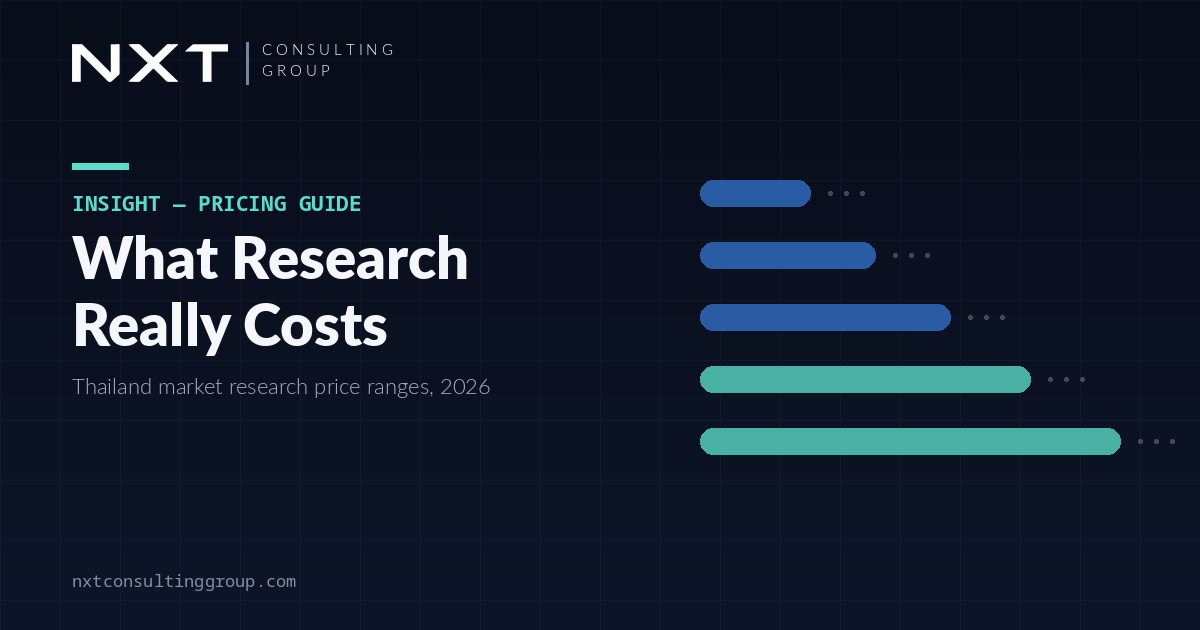
Short answer: Market research in Thailand in 2026 falls into four tiers: freelancers and off-the-shelf tools at about THB 5,000 to 80,000; small research shops at about THB 50,000 to 300,000; specialist market research agencies at about THB 300,000 to 1,000,000; and strategy consultants who conduct the research themselves, such as NXT, at about THB 250,000 to 900,000. The last two tiers overlap in price. The difference lies in who actually designs the study, conducts the interviews and interprets the results, and in whether the deliverable is a findings report or a recommendation for the decision. The right tier depends on what is at stake in the decision, not on the budget you have.
The price gap between providers is the widest in consulting. The same brief can draw quotes ranging from a few tens of thousands of baht to several million. The difference does not come from anyone's greed or generosity, but from the cost structure of each type of provider. This article breaks down what each price tier gets you, what it doesn't, and what size of decision it suits, so that by the end you can set a budget and choose a provider right away.
Four tiers of market research pricing, by provider type
Tier 1: DIY, freelancers and off-the-shelf tools — about THB 5,000 to 80,000
What you get: an online questionnaire distributed through social media or a low-cost panel, with results summarized in basic charts. Some freelancers also conduct a few interviews or run focus groups without an observation room.
What you don't get: rigorous respondent screening, question design that avoids leading respondents, and interpretation of what the results mean you should do next.
Best for: a preliminary check before a meeting, testing many ideas at an early stage, or decisions where getting it wrong costs only a few hundred thousand baht.
Main risk: respondents who are outside the target group or answer without reading, which makes the numbers look credible but unusable for decisions.
Tier 2: Small research shops and data collection firms — about THB 50,000 to 300,000
What you get: systematic data collection, several hundred questionnaires, basic screening, and a report of results tables with brief explanations.
What you don't get: these firms usually compete on price per response, so they focus on hitting the quota rather than asking the right questions from the start, and most deliver data, not recommendations.
Best for: briefs where you already know exactly what to measure and have an internal team that can turn data into decisions, such as a repeated annual satisfaction survey.
Tier 3: Specialist market research agencies — about THB 300,000 to 1,000,000
What you get: a dedicated research team, focus group facilities with one-way observation mirrors, a respondent recruitment network, standard methodology, and in-depth reports with analysis.
What you don't get: work is often handed off through several layers. The project manager you talk to is usually not the person who interviews or analyzes, and findings tend to stop at "what we found" rather than "what you should do."
Best for: large-scale research that needs a full fieldwork operation, tracking studies over multiple waves, or data collection across several regions at once.
Tier 4: Strategy consultants who design and conduct the research themselves (the NXT approach) — about THB 250,000 to 900,000
What you get: NXT's consulting team designs the study, runs the interviews and focus groups, and does the analysis itself, while survey fieldwork runs through a vetted external panel under NXT's quality control. Qualitative and quantitative research are used in sequence under the NXT Insight Loop framework, and the deliverable is a decision memo that sets out options, risks and recommendations.
What you don't get: no proprietary panel of tens of thousands of people, and not the right provider for nationwide quarterly tracking.
Best for: major decisions with millions to hundreds of millions of baht at stake, such as launching a new product, entering a new market, changing prices, or finding out why sales are missing the plan.
Quick comparison: one brief, four quotes
Take the brief: test a new product concept before deciding to invest in production. The scope is 4 focus groups, an online survey of 400 responses, and a summary for decision-making. The approximate prices you are likely to receive:
- —Freelancer: about THB 60,000 to 150,000. Usually covers only the survey; the focus groups are scaled down or run online, and the report is charts.
- —Small research shop: about THB 200,000 to 400,000. Covers both parts, but delivers analysis, not recommendations.
- —Specialist research agency: about THB 600,000 to 1,000,000. Full fieldwork operation and a detailed report.
- —NXT: about THB 350,000 to 600,000. NXT's consulting team designs the study, runs the focus groups and does the analysis itself, while the survey is collected through a vetted external panel. The deliverable includes a decision memo on whether to invest in production and where to adjust the concept.
For briefs like this, NXT's price falls between small research shops and specialist agencies. What to compare is who actually does the work and what is delivered, not price alone. The reasons are in the next section.
Where the price difference comes from
The lower price does not come from cutting quality, but from cutting three layers of cost that do not affect the quality of the answer.
- —No hand-off layers. In large research agencies, work passes through a project manager, a research team and a field team in several steps, and each step is time you pay for. A team that designs and interviews itself removes this cost, and findings don't get lost along the way.
- —No standing fieldwork infrastructure to carry. Focus group facilities, permanent interviewer teams and a proprietary panel are fixed costs spread across every quote, even if your brief doesn't need all of them.
- —No oversampling beyond what is needed. Starting with qualitative research to get the questions right makes the questionnaire shorter and limits collection to the groups that affect the decision, which often cuts the sample you pay for considerably.
Cases where NXT is not the best choice, and we will say so plainly: quarterly tracking studies with tens of thousands of respondents, studies that must collect data in several countries simultaneously, and work that needs field teams deployed across the whole country at once. For these, specialist research agencies offer better value.
Unit prices by research method
Use these ranges to check whether a quote you receive is reasonable. The first figure reflects entry-level providers; the second reflects specialist research agencies.
- —In-depth interviews: general consumers THB 5,000 to 25,000 per interview; hard-to-reach groups, such as executives or medical specialists, THB 20,000 to 60,000 per interview.
- —Focus groups: THB 25,000 to 60,000 per group for entry-level work, and THB 80,000 to 180,000 per group for work with an observation room, rigorous screening and a professional moderator.
- —Online surveys: THB 50 to 150 per response for low-cost panels, THB 150 to 600 per response for well-screened general consumers, and THB 800 to 3,000 per response for specialist groups.
- —Telephone interviews (CATI): THB 300 to 900 per response. Suited to groups that are rarely online, such as older people or those in provincial areas.
- —Ethnography (observing real behavior): THB 30,000 to 80,000 per participant. The most expensive per head, because researchers spend several hours to several days with each participant.
- —Mystery shopping: THB 3,000 to 12,000 per location, depending on how detailed the recording form is.
- —Full mixed-method project: 8 to 16 weeks. A single market costs THB 350,000 to 1,000,000; multiple target groups or multiple provinces cost THB 1,000,000 to 2,500,000.
The factors that make quotes differ the most
- —How hard the target group is to reach. The number one factor. Finding 400 general consumers costs several times less than finding 30 factory procurement managers. Always ask the provider what incidence rate they have assumed.
- —Length of the research instrument. A 10-minute questionnaire and a 25-minute one differ by almost double in respondent incentives and drop-off rates.
- —Number of subgroups to analyze separately. Every subgroup needs enough responses on its own, so splitting into 5 groups requires collecting 2 to 3 times more.
- —Level of the deliverable. Results tables, an analytical report and strategic recommendations are different levels of work at different price levels.
- —Who actually does the work. In qualitative research, the person asking the questions determines the quality of the findings.
The cost structure inside a quote
- —Respondent access and incentives: about 30 to 50 percent
- —Researcher time for design, collection, analysis and reporting: about 35 to 55 percent
- —Other operating costs, such as venues, travel and tools: about 10 to 20 percent
When a quote is much cheaper than the others, ask where the savings come from. If they come from respondent incentives, you usually get respondents outside the target group. If they come from researcher time, you usually get a report with no interpretation. When a price is very high, ask how much of it is project management and overhead rather than the actual work.
Which tier to choose: decide by what is at stake, not by the budget you have
A rule that works in practice is that the research budget should not exceed the expected loss you could avoid: the probability of making the wrong decision without the data, multiplied by the loss if the decision is wrong. For example, a THB 5 million stake with roughly a one-in-four chance of being wrong carries an expected loss of about THB 1.25 million, so a research budget in the hundreds of thousands of baht is worthwhile if the research genuinely reduces the chance of being wrong.
- —Less than THB 2 million at stake: for example, testing a campaign or an early-stage idea. Tier 1 or 2 is enough.
- —THB 2 million to 50 million at stake: for example, launching a new product, changing prices or opening a branch in a new area. You need an answer you can decide on, and Tier 4 offers the best value.
- —More than THB 50 million at stake, or broad nationwide data collection required: for example, investing in a factory or expanding nationwide. Use Tier 4 to frame the questions and interpret the results, together with a specialist research agency that has a wide fieldwork network.
- —Annual repeat measurement with the same instrument: Tier 2 or 3 offers better value, because the brief is already settled.
A 7-point checklist before you sign a quote
- —Sample size for each subgroup and the respondent screening criteria, stated as numbers
- —Who will actually conduct the interviews and analysis; ask for names and experience
- —The research instruments must be approved by you before data collection begins
- —Whether the deliverable is data, an analytical report or strategic recommendations
- —Respondent quality controls, such as attention-check questions and removing responses completed abnormally fast
- —Ownership of the raw data after the project ends
- —The number of report revision rounds included in the price
How to control your research budget without sacrificing quality
- —Reduce the size of each stage, don't cut stages. Interviewing 8 people instead of 15 is still better than skipping the qualitative stage and running only a survey.
- —Limit target groups to those that actually matter to the decision. Every group you add multiplies the cost.
- —Cut questions asked out of curiosity. If answer A and answer B would lead you to do the same thing, drop the question.
- —Use the data you already have first. Sales data, CRM and customer reviews can often answer part of the question at no cost.
- —Split the work into phases. Run a small first phase to frame the problem, then decide whether to invest in the next phase.
Frequently asked questions
- What is the minimum market research budget that is actually usable for decisions?
- For decisions with millions of baht or more at stake, a workable budget starts at about THB 250,000 to 350,000, which is enough for well-designed qualitative work or a small mixed-method study. A budget in the tens of thousands of baht suits a preliminary check, but figures from work at that level should not be used to decide on a large investment.
- Why do quotes from different firms differ several times over for the same brief?
- The main reason is the provider's cost structure, not the work itself. Large research agencies carry the cost of standing fieldwork infrastructure and several layers of project management, while small firms compete on price per response. The right way to compare is to ask every provider to state the sample size, the screening method, who will actually do the work, and examples of deliverables from past projects.
- Roughly how much does NXT charge for market research?
- Most NXT mixed-method research projects fall in the hundreds of thousands of baht, about THB 250,000 to 900,000, depending on the number of target groups and how hard they are to reach. We give a budget range from the first conversation, and if your brief doesn't yet need research, we will tell you plainly.
- If the price is lower than a specialist research agency's, how can the quality be comparable?
- The difference comes from costs that do not determine the quality of the answer: hand-off layers between teams, standing fieldwork infrastructure, and collecting more samples than necessary. What actually determines quality is who designs the questions, conducts the interviews and interprets the results; at NXT, the consulting team does this work itself throughout the project rather than passing it through layers. Survey fieldwork runs through a vetted external panel under NXT's quality control. That said, for large nationwide tracking studies, specialist research agencies still offer better value.
- Can a survey costing less than THB 100 per response be trusted?
- It is possible when the target group is broad, the questionnaire is short and a large panel is used. But you need to ask clearly about screening and quality controls, because a very low price per response often comes with respondents outside the target group or who answer without reading, which can make the entire dataset unusable.
- Should I hire a research agency and a strategy consultant separately, or use one team?
- If the brief ends at needing data, hiring a research agency alone is cheaper. But if the brief is to make a decision, hiring separately often creates a gap, because the consultant has to interpret data they did not design, and you often end up paying twice. A single team that both designs the research and makes the recommendations usually reaches conclusions that fit the decision better, on a lower budget.
All price ranges are overall estimates for the Thai market as of 2026, based on industry experience, quotes that clients have received and shared with us, and public information. They are intended only for initial budgeting and are not the reference prices of any particular company. The price-difference comparison is NXT's assessment for projects of similar scope. Actual prices vary with scope and how hard the target group is to reach. This article was prepared by NXT Consulting Group and translated from the Thai original.
More in this series
Share this article