Fewer Than Half of Thai Family Businesses Survive to the Third Generation: The Problem Isn't the Heirs, It's the 'Discount' You're Passing On
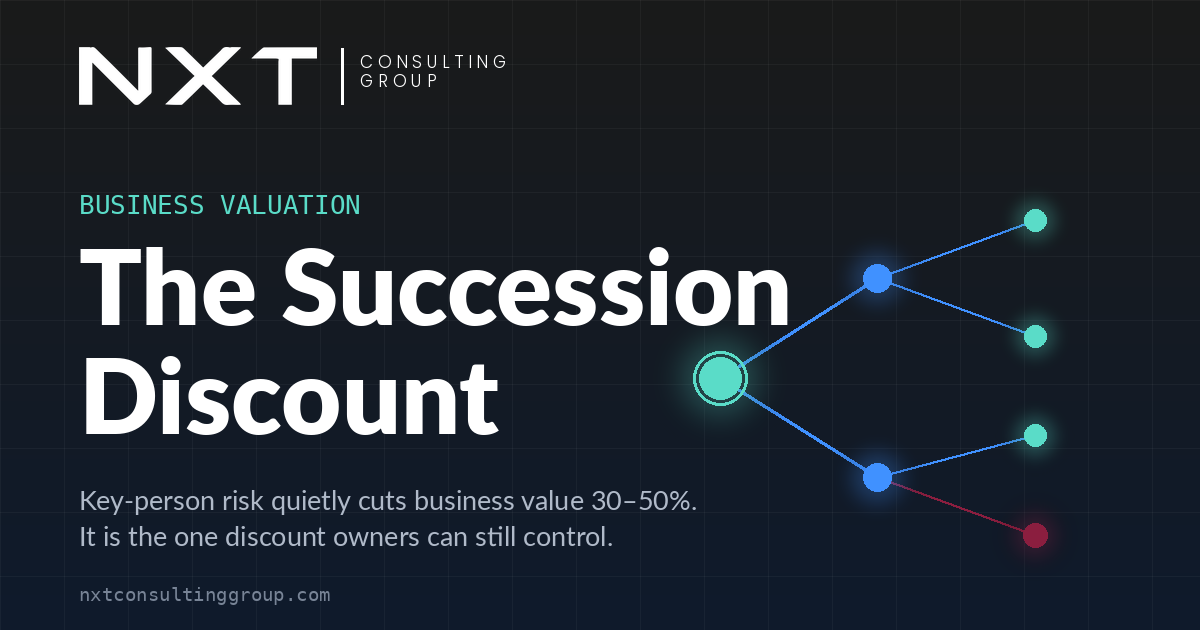
Short answer: Key-person risk is the discount buyers apply when a business depends on one person, usually the founder, for key customer relationships, supplier negotiations, approvals and critical knowledge. Because the buyer takes on that risk, a business tied to its founder is often valued significantly lower, and many owners have never assessed this in advance. Owners can reduce the discount by separating the business from the founder, systemizing processes, producing verifiable financial statements and data, and building a professional management team, work that should start 2–3 years before a sale or handover.
Data cited by the Bangkok Post suggests that around 99.7% of new businesses in Thailand may be family-founded, yet fewer than half survive to the third generation (Bangkok Post, 2026). The statistic has been repeated so often that it has become a sad story everyone nods at and then moves on from.
The problem is that most people misdiagnose the cause. We like to blame heirs who "don't want the business," even though the data says the opposite: around 85–90% of KBank's second-generation clients intend to take over the family business, clearly higher than Hong Kong and Singapore at around 50% (Bangkok Post, citing Kasikornbank, 2026). Thai heirs are more ready than people think.
So what: If the heirs are ready but businesses still fall apart at handover, the problem is not the "people" but the "value": the number that says whether the business can stand on its own. And a business tied to a single founder is often marked down significantly by buyers, because the buyer has to take on that risk, something many owners have never assessed in advance.
Market timing is good, but Thai SMEs still don't know how to value themselves
2026 is a period of high deal values worldwide. The median EV/EBITDA multiple for global M&A deals is around 10.7x, the highest since 2021, with private equity-led deals paying an average of 12.6x and corporate-led deals at 9.8x (M&A Community, 2026).
But those figures are averages for large companies with systems in place. For SMEs, the reality is different:
- —General retail and distribution businesses often trade at around 4–6x EBITDA, while fast-growing SaaS businesses may reach 12–15x (M&A Community, 2026).
- —The median for unlisted SMEs in European markets is around 8.3x EBITDA, but businesses with EBITDA below a certain threshold immediately have their value "cut" by 1–2x, because the pool of buyers narrows, the risk of closing the deal rises, and they are "too dependent on the founder" (QuantPillar / European SME data, Q4 2025).
So what: The gap between 4x and 8x is not luck; it is structure. And the factor that most often pushes a business to the bottom of that range has a clear name: key-person risk.
Key-person risk: the biggest discount no one talks about
In many Thai family businesses, one person, usually the founder, holds all the relationships with major customers, negotiates with suppliers personally, approves everything above a "limit in their head," and keeps critical information in their memory rather than in a system.
When it's time for a valuation, buyers or financial advisors ask the single most painful question: "If this person weren't here tomorrow, how much profit would be left?" If the answer is "I don't know" or "probably a lot less," the value is cut immediately, because what is being sold is not a business but a person, and a person can't be sold.
This is the real reason fewer than half survive to the third generation. Research and analysis of Thai family businesses suggest the obstacle is usually not capital but the blurred line between family and business: overlapping roles, power struggles and resistance to change (Bangkok Post, 2026). In financial terms, the business was never built to operate without its founder.
So what: Key-person risk is not a feeling. It is a discount that can be calculated, and it is the one discount the owner has the most control over before the handover date.
What actually moves the number (and what doesn't)
The good news is that most of the factors eroding the value of Thai family businesses are structural and can be fixed, if you start before the deadline. Four areas deliver the highest return on value:
1. Separate the business from the founder
Move customer relationships, approval authority and specialized knowledge out of one person's head and into teams and systems. Every relationship still tied to a single person is one more point a buyer will use to negotiate the price down.
2. Systemize processes
Standard operating procedures that are actually used, not just binders on a shelf, are the evidence that the business can repeat its results without relying on one person's judgment.
3. Verifiable financial statements and data
Buyers pay for profit that can be "proven," not profit that is "described." Clean financial statements, family accounts separated from company accounts, and data ready for due diligence are what lift a business from the bottom of the valuation range to the median.
4. A professional management team, not necessarily family
KBank notes that the first generation expects successors to drive digital transformation, while many families are starting to consider hiring professionals to run the business rather than relying solely on family members (Bangkok Post, 2026). This is where fractional executives, part-time CSOs, COOs or CFOs, can add professionalism to the management structure without the cost of full-time executives during the transition.
So what: All four take time, which is why good valuation work doesn't start on the day you decide to sell. It starts 2–3 years before that.
The window of time you have
Almost three-quarters of family business owners in Asia still have no clear succession plan; only about 27% have a fully developed plan (Hubbis, 2025). Since Thai heirs are ready to take over at a higher rate than the global average, the real gap is not the "successor" but the "condition of the business" being handed over.
Start with three questions:
- —If you disappeared for a month without telling anyone, by what percentage would that month's profit change?
- —Are your top three customers tied to the "company" or to "you"?
- —If you had to hand your financial statements and data to a professional buyer for review tomorrow, what percentage ready would you be?
Your answers to these three questions give you a rough estimate of your key-person risk discount before a buyer does it for you, and before that number becomes the price your heirs have to accept.
The bottom line
Thai family businesses don't fail because the heirs don't want them. They fail because the business was built to depend too heavily on one person, and no one turned that "people risk" into a number before the handover. The value lost to this discount is not fate; it is the result of starting too late.
At NXT, we help family business owners reduce key-person risk before a handover or sale. We put in place the organizational structure, roles, approval authority and KPIs that let the business run without depending on one person, and we provide fractional CSO/COO support during the transition, so the business is ready before it goes through a valuation with a financial adviser.
If you are planning a succession or want to know the true value of your business:
Sources
- —Bangkok Post, "Succession a top priority among Thai family businesses" (2026), citing Kasikornbank data
- —M&A Community, "M&A Multiples Explained: EV/EBITDA & 2026 Benchmarks" (2026)
- —QuantPillar, "2025–2026 Private Market Valuation Multiples" and European SME data, Q4 2025
- —Hubbis, "Fail-Session or Succession? Why Business Families Still Struggle to Plan for Continuity" (2025)
Translated from the Thai original by NXT Consulting Group.
Share this article